Table 2From “What is knowledge transfer? Absorptive capacity, operational replication, and stickiness”
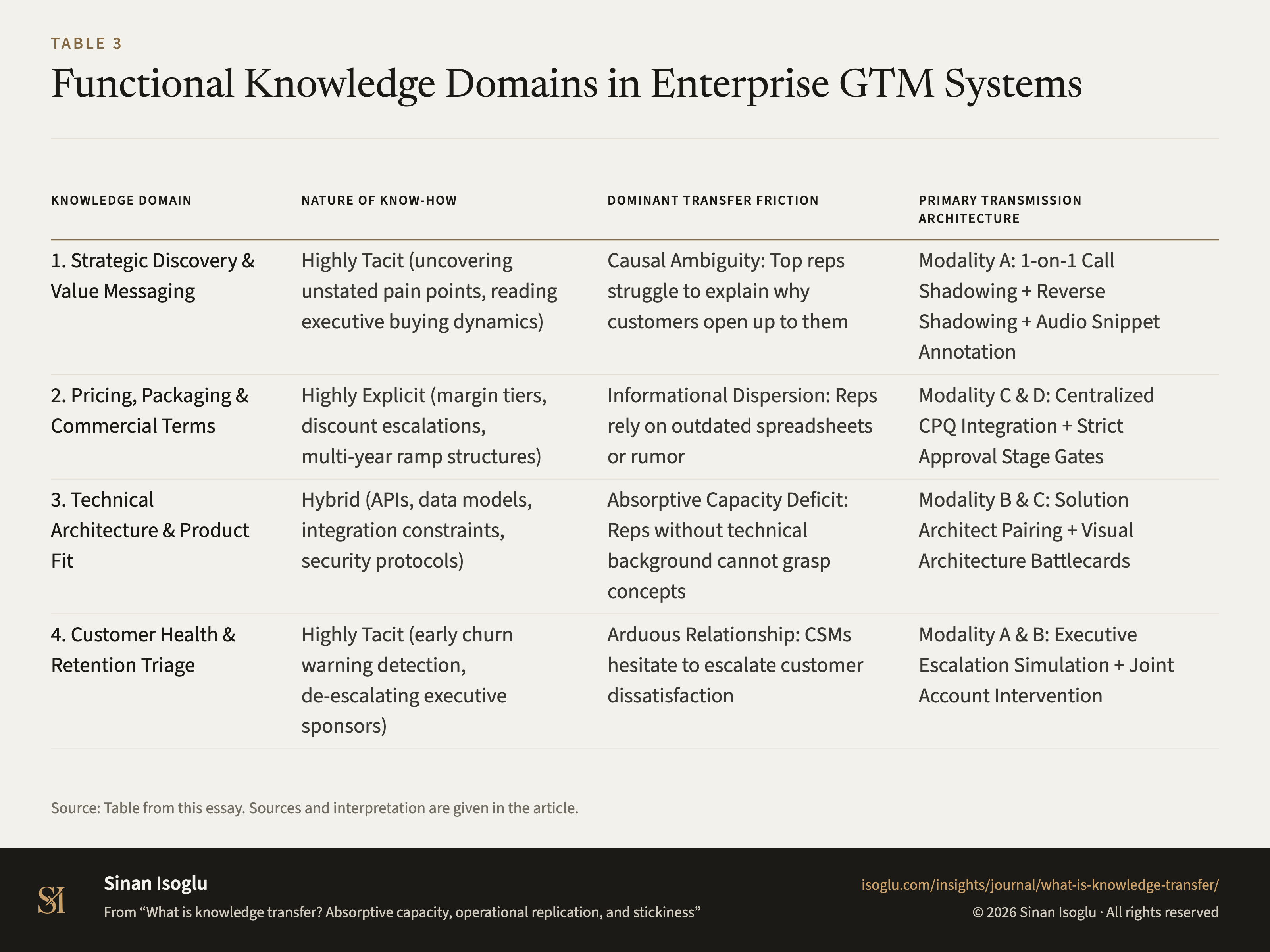
Functional Knowledge Domains in Enterprise GTM Systems
Table 2Functional Knowledge Domains in Enterprise GTM Systems
| Knowledge Domain | Nature of Know-How | Dominant Transfer Friction | Primary Transmission Architecture |
|---|---|---|---|
| 1. Strategic Discovery & Value Messaging | Highly Tacit (uncovering unstated pain points, reading executive buying dynamics) | Causal Ambiguity: Top reps struggle to explain why customers open up to them | Modality A: 1-on-1 Call Shadowing + Reverse Shadowing + Audio Snippet Annotation |
| 2. Pricing, Packaging & Commercial Terms | Highly Explicit (margin tiers, discount escalations, multi-year ramp structures) | Informational Dispersion: Reps rely on outdated spreadsheets or rumor | Modality C & D: Centralized CPQ Integration + Strict Approval Stage Gates |
| 3. Technical Architecture & Product Fit | Hybrid (APIs, data models, integration constraints, security protocols) | Absorptive Capacity Deficit: Reps without technical background cannot grasp concepts | Modality B & C: Solution Architect Pairing + Visual Architecture Battlecards |
| 4. Customer Health & Retention Triage | Highly Tacit (early churn warning detection, de-escalating executive sponsors) | Arduous Relationship: CSMs hesitate to escalate customer dissatisfaction | Modality A & B: Executive Escalation Simulation + Joint Account Intervention |
Swipe or scroll horizontally if the table is wider than your screen.
Source: Table from this essay. Sources and interpretation are given in the article.
From the essay
Revenue operations & AI
What is knowledge transfer? Absorptive capacity, operational replication, and stickiness
Knowledge transfer is the structured replication and embedding of tacit and codified commercial know-how across individuals and operational units.
Read the essayThis exhibit belongs to an essay: the numbers live here, the argument lives there.
Cite or embed
Related exhibits
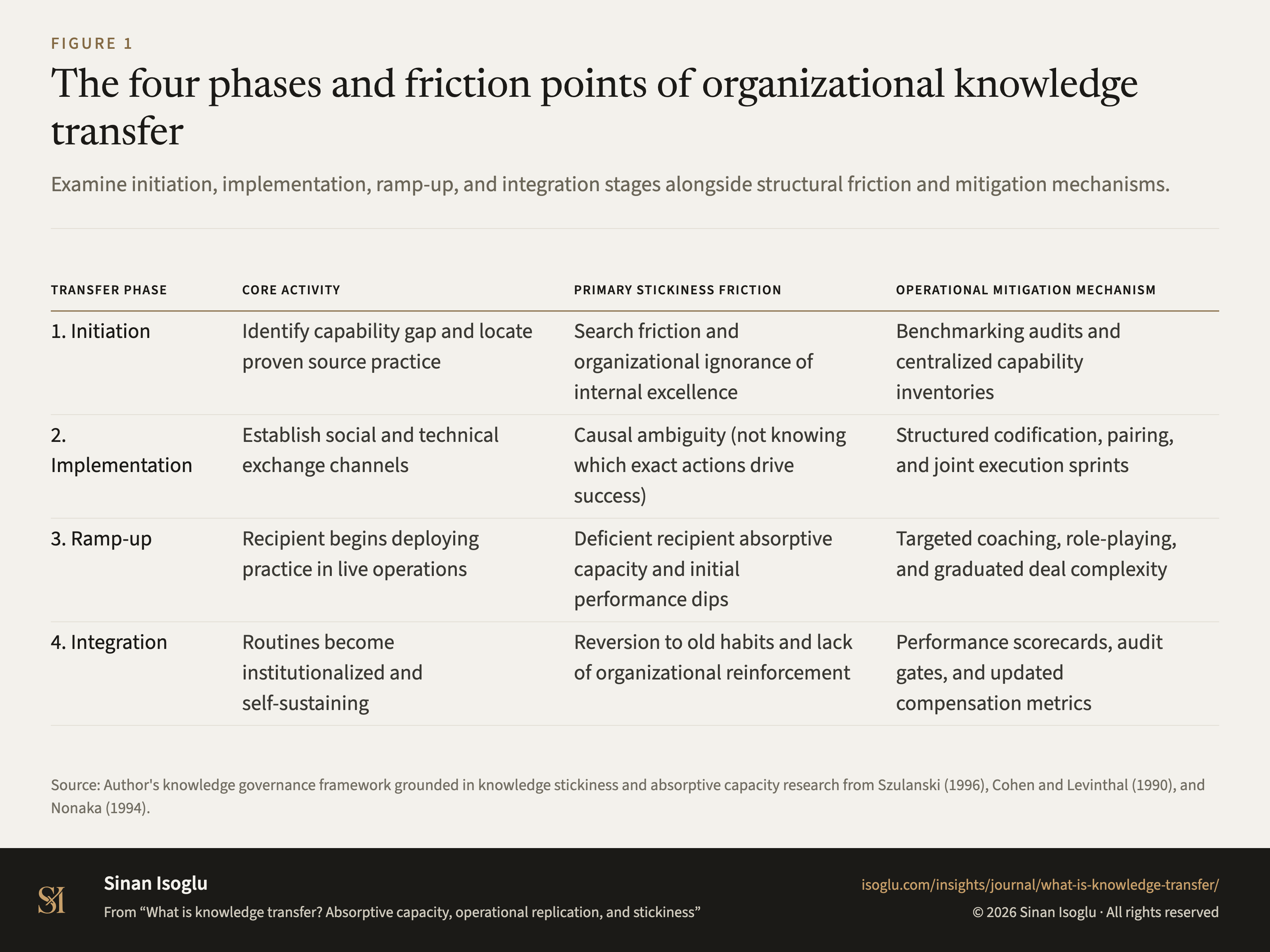
Figure 1Figure
The four phases and friction points of organizational knowledge transfer
What is knowledge transfer? Absorptive capacity, operational replication, and stickiness
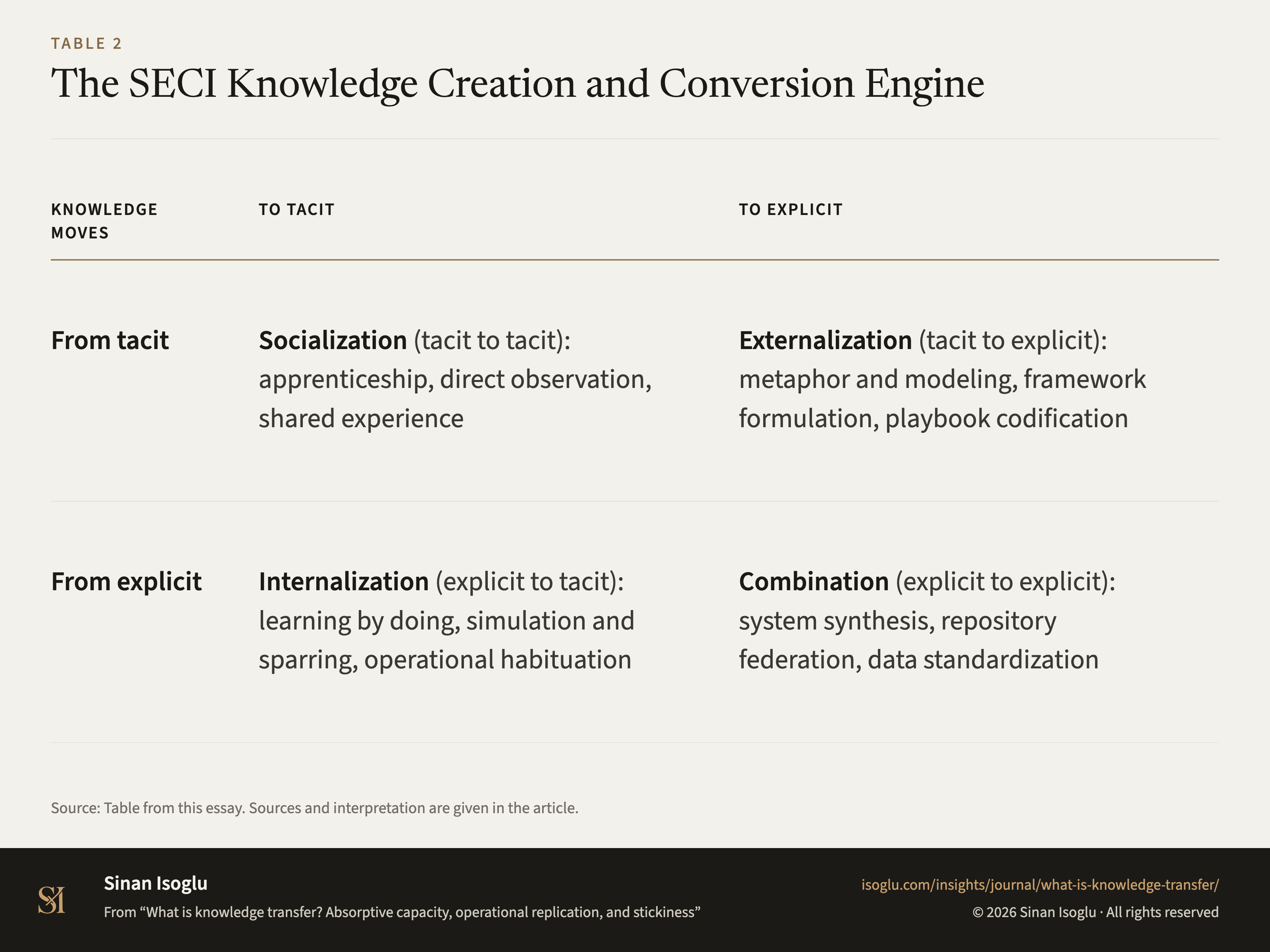
Table 1Table
The SECI Knowledge Creation and Conversion Engine
What is knowledge transfer? Absorptive capacity, operational replication, and stickiness
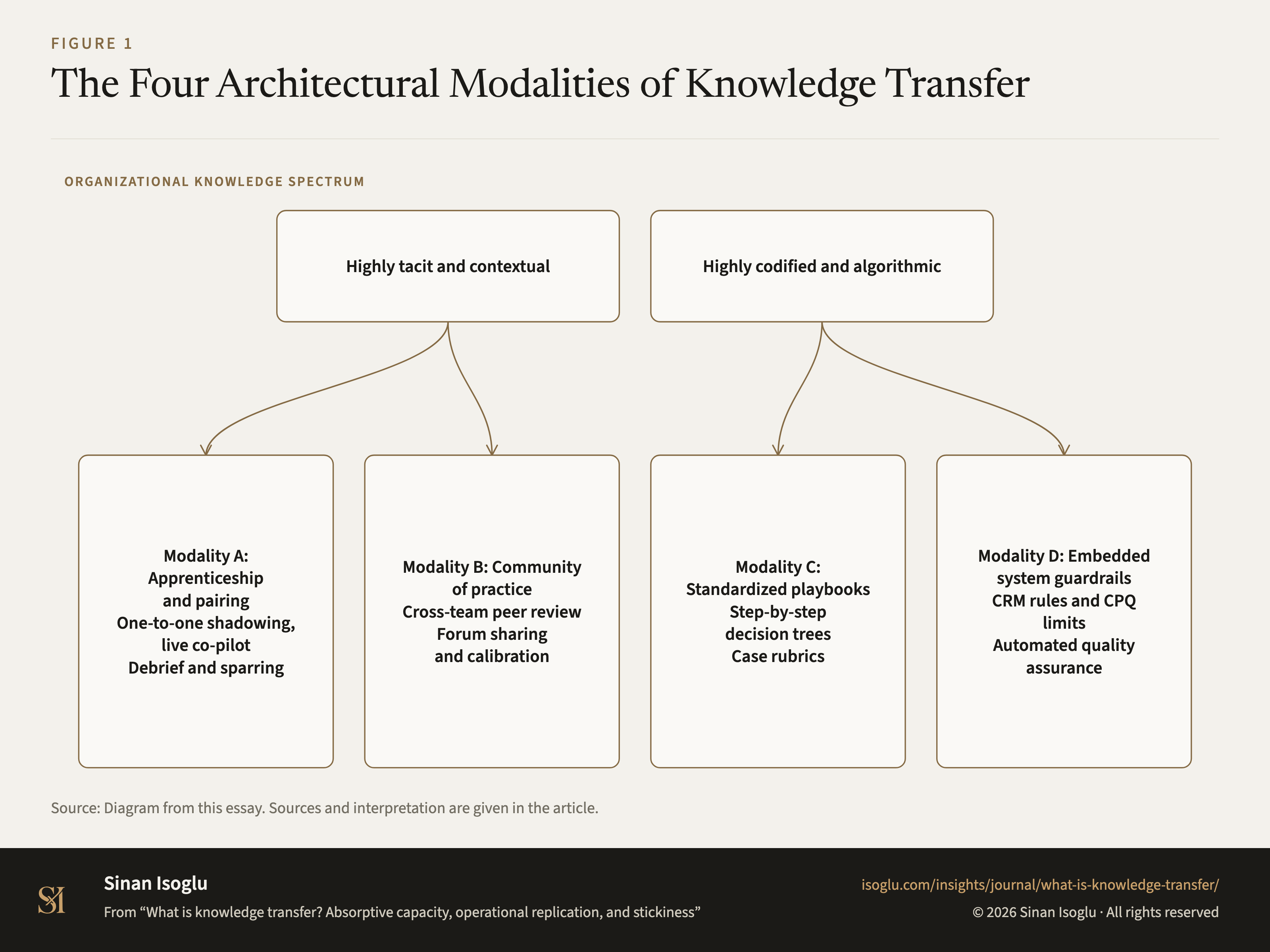
Figure 2Figure
The Four Architectural Modalities of Knowledge Transfer
What is knowledge transfer? Absorptive capacity, operational replication, and stickiness
Contact
Bring the question you're working on.
Research, a guest lecture, or a commercial question.