Table 3From “What is CRM data governance? Revenue control before reporting”
Which fields make a quality rule reproducible?
Table 3Which fields make a quality rule reproducible?
| Field in the quality register | Rule to declare | Evidence to preserve | Failure if hidden |
|---|---|---|---|
| Record grain | One contact, account, lead, opportunity, or another named unit | Object type and stable record ID | A count mixes units and double-counts entities |
| Field definition | What the field means and when it is populated | Data dictionary version and example states | Two teams use the same label for different facts |
| Data owner and steward | Who approves meaning and who handles daily quality | Named role, not only a team inbox | A defect has no accountable decision-maker |
| Requiredness | When the field is mandatory and when it is not applicable | Rule version and exclusion condition | A blank hides both omission and legitimate scope |
| Allowed values | Which values, formats, units, and currencies are valid | Validation rule and rejected-value log | A filled field is counted as valid without a test |
| Freshness | How recent the value must be for this decision | Last changed and last reviewed timestamps | A complete record survives after its evidence expires |
| Duplicate rule | Which identifier or combination makes records unique | Match key and merge decision | One customer appears as several pipeline entities |
| Data lineage | Where the value came from and what transformed it | Source, transformation, and destination | A number cannot be traced back to its input |
| Stage evidence | What observable event supports the current stage | Event ID, timestamp, or documented evidence | A label is treated as a commercial transition |
| Close-date rule | Which date boundary and movement rule apply | Current value, prior value, and change reason | A forecast movement is mistaken for new demand |
| Exception reason | Why a failed rule is temporarily treated differently | Reason, owner, expiry, and review date | The exception becomes a permanent hidden rule |
Swipe or scroll horizontally if the table is wider than your screen.
Source: Table from this essay. Sources and interpretation are given in the article.
From the essay
Revenue operations & AI
What is CRM data governance? Revenue control before reporting
CRM data governance decides who owns a CRM field, how its quality is tested, and when a record is fit for revenue reporting.
Read the essayThis exhibit belongs to an essay: the numbers live here, the argument lives there.
Cite or embed
Related exhibits
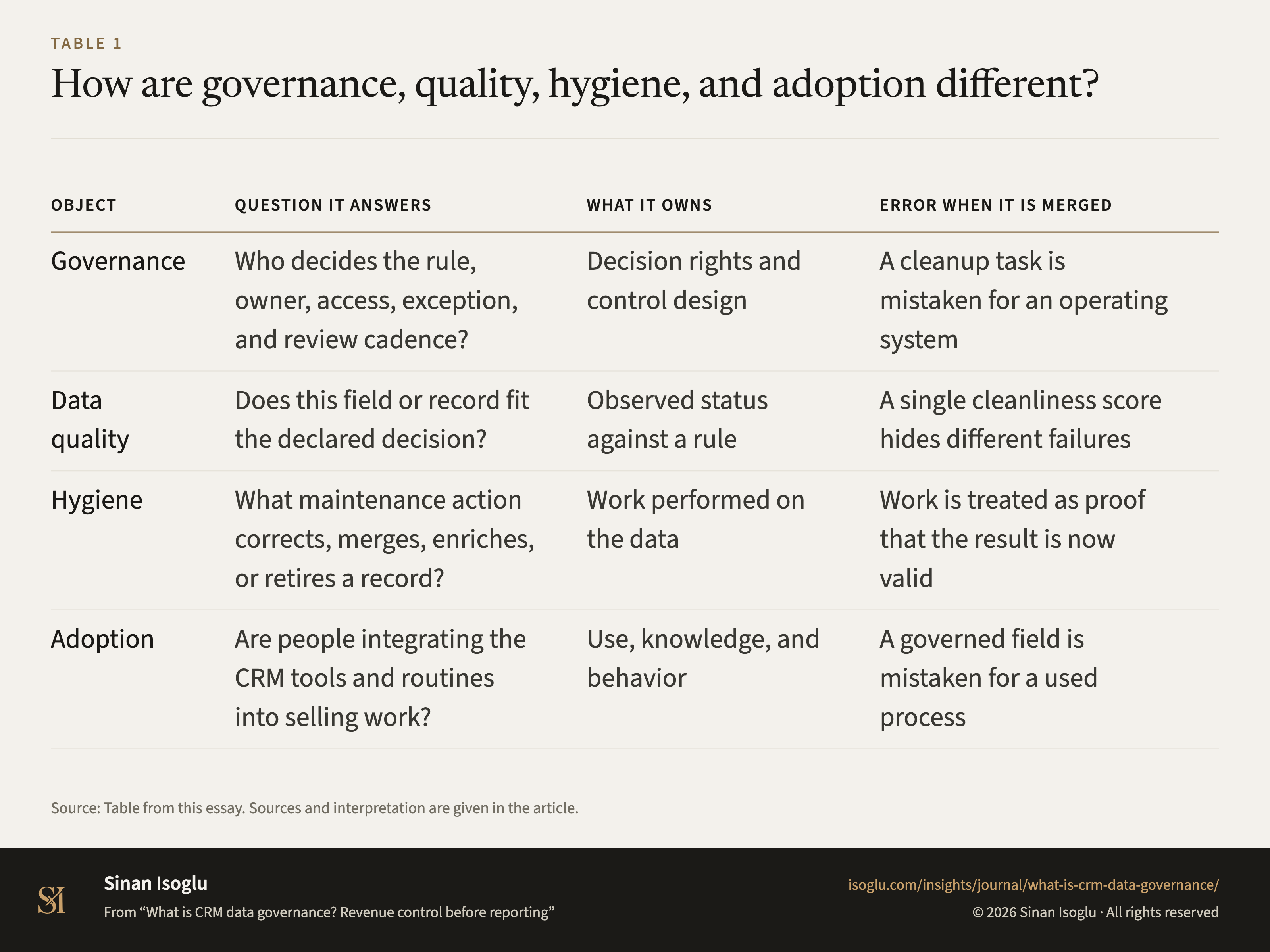
Table 1Table
How are governance, quality, hygiene, and adoption different?
What is CRM data governance? Revenue control before reporting
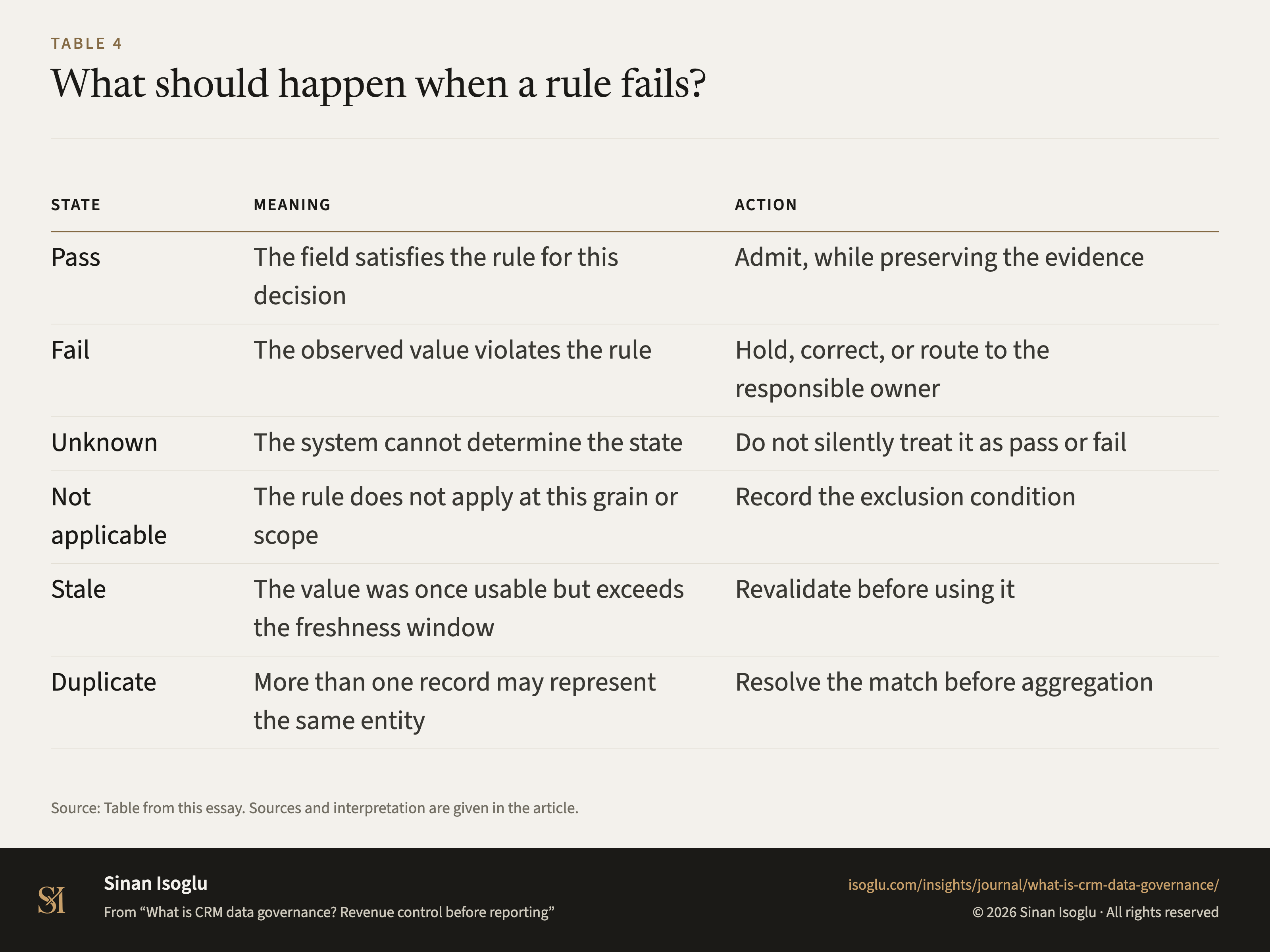
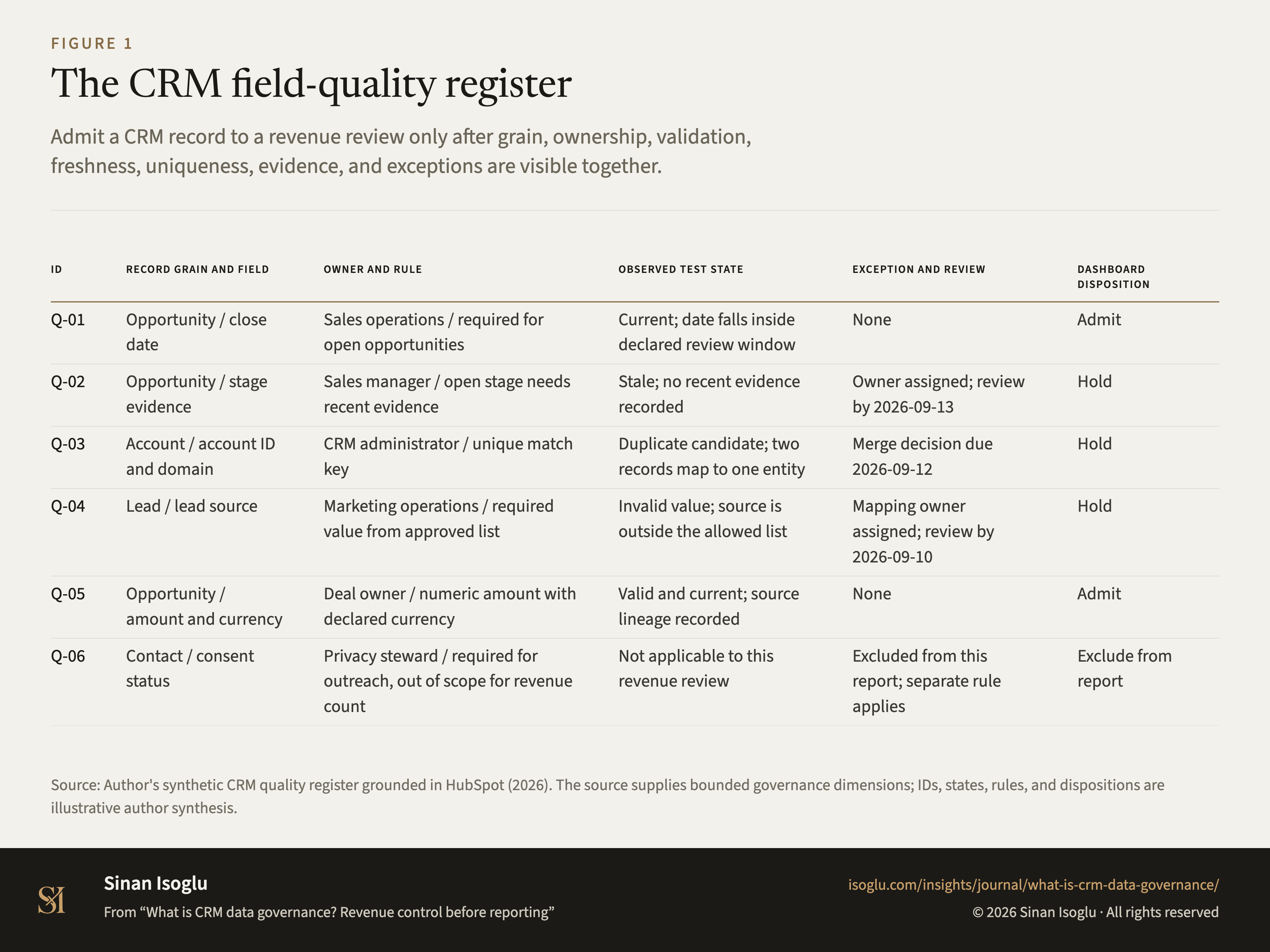
Figure 1Figure
The CRM field-quality register
What is CRM data governance? Revenue control before reporting
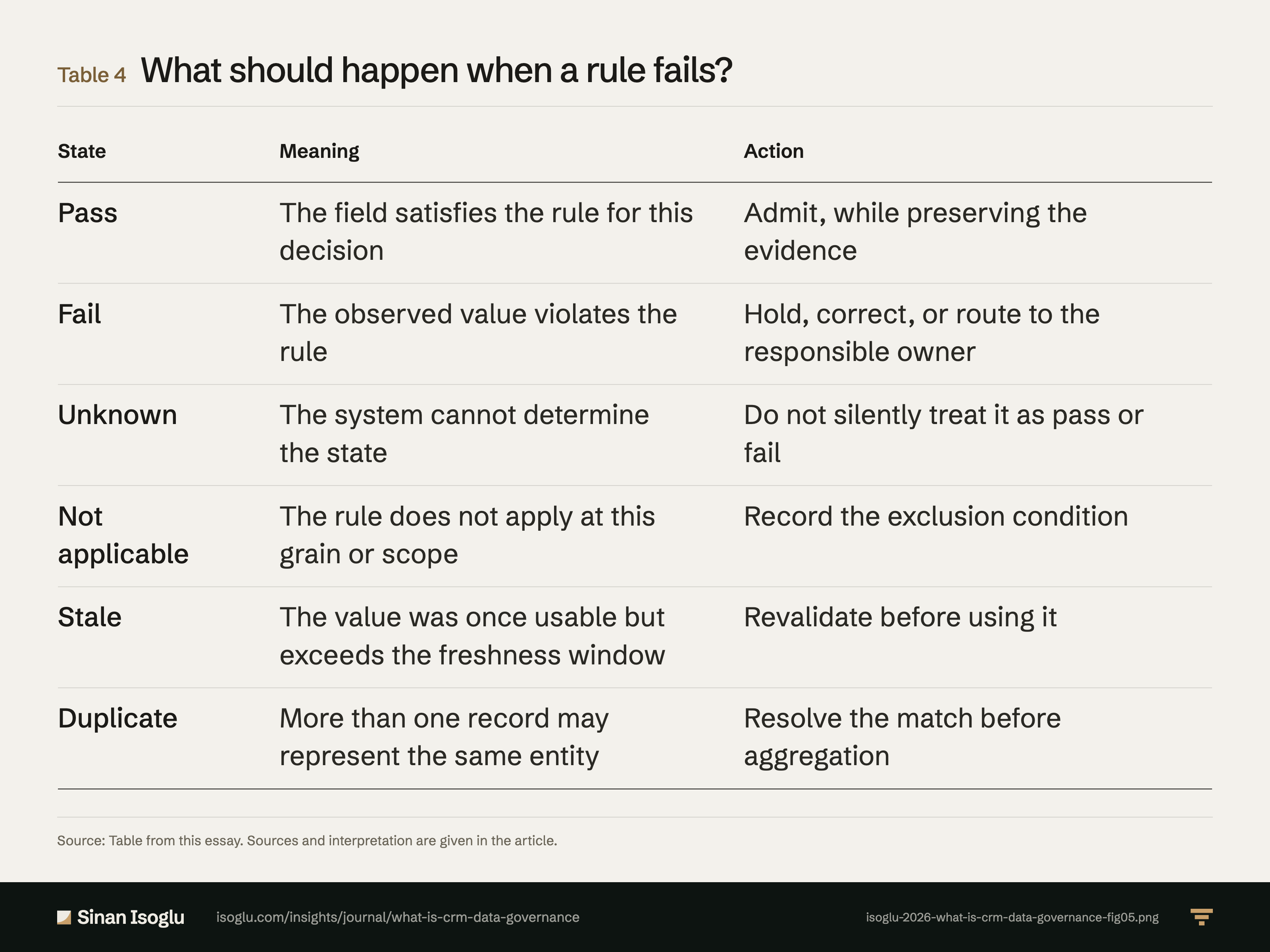
Table 4Table
What should happen when a rule fails?
What is CRM data governance? Revenue control before reporting
Contact
Bring the question you're working on.
Research, a guest lecture, or a commercial question.