Abbildung 1Aus „Was ist kausale Inferenz?“
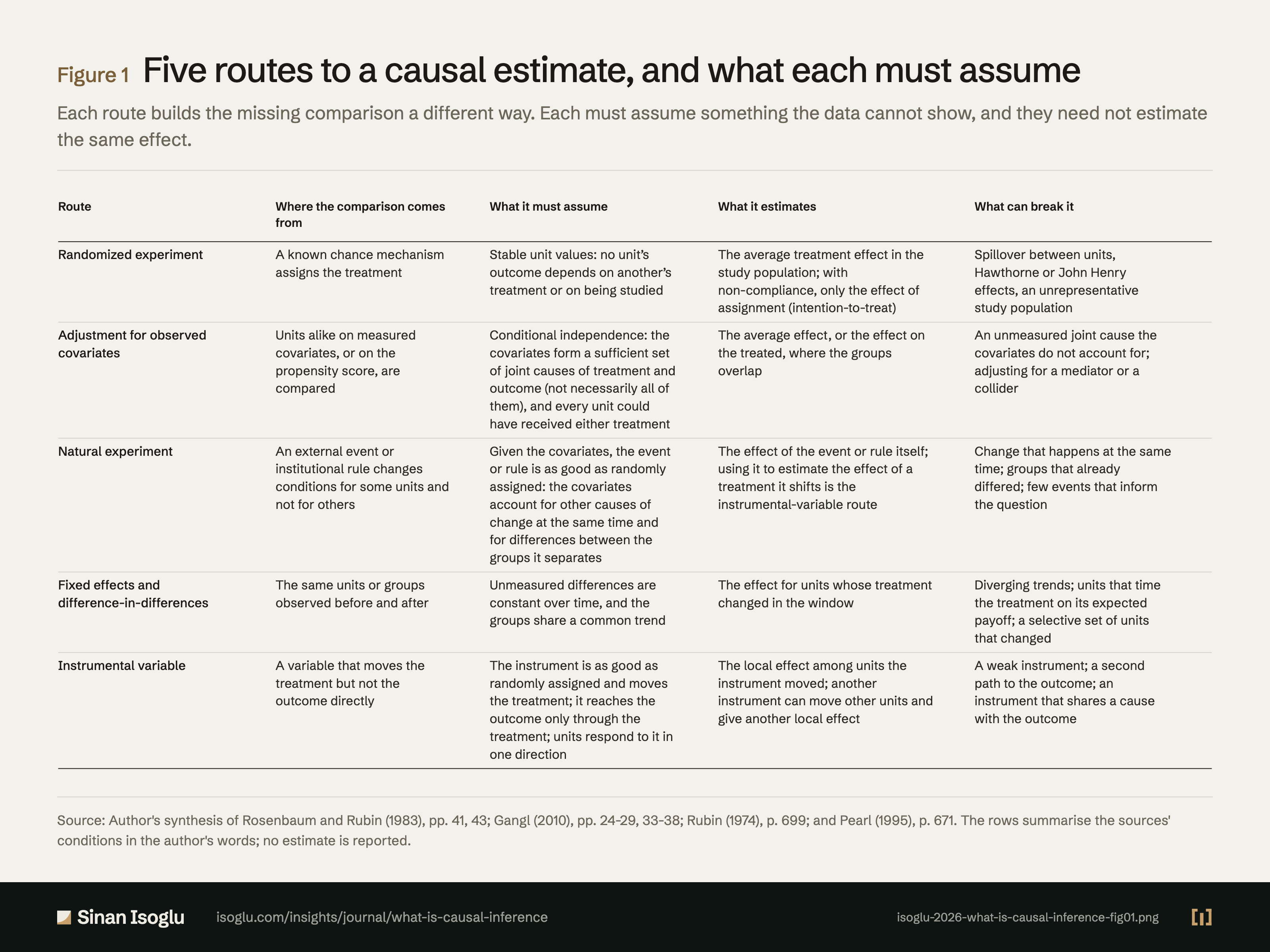
Fünf Wege zu einer kausalen Schätzung und was jeder annehmen muss
Jeder Weg baut den fehlenden Vergleich anders. Jeder muss etwas annehmen, was die Daten nicht zeigen, und sie schätzen nicht unbedingt denselben Effekt.
Abbildung 1Fünf Wege zu einer kausalen Schätzung und was jeder annehmen muss
| Weg | Woher der Vergleich kommt | Was er annehmen muss | Was er schätzt | Woran er scheitern kann |
|---|---|---|---|---|
| Randomisiertes Experiment | Ein bekannter Zufallsmechanismus teilt die Behandlung zu | Stabile Einheitswerte: Kein Ergebnis hängt von der Behandlung einer anderen Einheit oder vom Beobachtetwerden ab | Den durchschnittlichen Behandlungseffekt in der Studienpopulation; bei unvollständiger Compliance nur den Effekt der Zuteilung (Intention-to-Treat-Effekt) | Spillover zwischen Einheiten, Hawthorne- oder John-Henry-Effekte, eine nicht repräsentative Studienpopulation |
| Adjustierung für beobachtete Kovariaten | Einheiten mit gleichen gemessenen Kovariaten oder gleichem Propensity Score werden verglichen | Bedingte Unabhängigkeit: Die Kovariaten bilden eine ausreichende Menge gemeinsamer Ursachen von Behandlung und Ergebnis (nicht notwendig alle), und jede Einheit hätte jede Behandlung erhalten können | Den durchschnittlichen Effekt oder den Effekt bei den Behandelten, wo sich die Gruppen überlappen | Eine ungemessene gemeinsame Ursache, die die Kovariaten nicht abdecken; Adjustierung für einen Mediator oder Collider |
| Natürliches Experiment | Ein äußeres Ereignis oder eine institutionelle Regel ändert die Bedingungen für manche Einheiten und für andere nicht | Gegeben die Kovariaten ist Ereignis oder Regel so gut wie zufällig: Die Kovariaten decken andere gleichzeitige Ursachen von Veränderung und Unterschiede zwischen den getrennten Gruppen ab | Den Effekt des Ereignisses oder der Regel selbst; den Effekt einer Behandlung, auf die Ereignis oder Regel wirkt, liefert erst der Weg über die Instrumentvariable | Gleichzeitige andere Veränderungen; Gruppen, die sich schon vorher unterschieden; wenige Ereignisse, die die Frage klären |
| Fixed Effects und Difference-in-Differences | Dieselben Einheiten oder Gruppen vorher und nachher beobachtet | Ungemessene Unterschiede sind zeitlich konstant, und die Gruppen teilen einen gemeinsamen Trend | Den Effekt für Einheiten, deren Behandlung sich im Zeitfenster geändert hat | Auseinanderlaufende Trends; Einheiten, die den Zeitpunkt der Behandlung nach dem erwarteten Nutzen wählen; eine selektive Gruppe von Wechslern |
| Instrumentvariable | Eine Variable, die die Behandlung bewegt, das Ergebnis aber nicht direkt | Das Instrument ist so gut wie zufällig zugeteilt und bewegt die Behandlung; es wirkt nur über die Behandlung auf das Ergebnis; die Einheiten reagieren nur in eine Richtung | Den lokalen Effekt bei den Einheiten, die das Instrument bewegt hat; ein anderes Instrument kann andere Einheiten bewegen und einen anderen lokalen Effekt liefern | Ein schwaches Instrument; ein zweiter Weg zum Ergebnis; ein Instrument, das eine Ursache mit dem Ergebnis teilt |
Bei breiten Tabellen horizontal wischen oder scrollen.
Quelle: Synthese des Autors aus Rosenbaum und Rubin (1983), S. 41, 43; Gangl (2010), S. 24-29, 33-38; Rubin (1974), S. 699; und Pearl (1995), S. 671. Die Zeilen fassen die Bedingungen der Quellen in den Worten des Autors zusammen; es wird keine Schätzung berichtet.
Quelle und Evidenz
Jede Zeile nennt eine Aussage zu dieser Abbildung, ihre Quelle und die Art ihrer Prüfung.
- B CINF-OWN-C2 Five routes to a causal estimate (randomized experiment, adjustment for observed covariates, natural experiment, fixed effects and difference-in-differences, instrumental variable) differ in where the comparison comes from, what each must assume, what each estimates and what breaks it; adjustment needs a sufficient set of joint causes, not all of them; a natural experiment needs the event to be as good as random given covariates, and only its use as an instrument adds the exclusion restriction (revised at G5 2026-10-14).Author synthesis of RR83-C3, RR83-C4, GNG10-C5, GNG10-C6, GNG10-C7, GNG10-C8, GNG10-C9, GNG10-C12 and GNG10-C13
- A GNG10-C5 Randomized experiments eliminate bias, but still need the stable unit treatment value assumption, which rules out Hawthorne and John Henry effects and social interactions (p. 26): "Randomized experiments in particular eliminate bias"; "thus ruling out Hawthorne or John Henry effects"; "social interactions, information diffusion, norm formation"Gangl. (2010)
- A GNG10-C6 Experimental estimates may be hard to generalize when the study population or treatment is not representative (p. 26): "may be difficult to generalize if either the study population or the administered treatments cannot be considered representative of some larger context"Gangl. (2010)
- A GNG10-C7 The conditional independence assumption: given covariates, treatment is as good as random; it is a theoretical statement about joint causes, and a minimally sufficient set of covariates is enough (p. 27): "so that, conditional on covariates, variation in D is as good as randomly assigned"; "is not a primarily statistical, but rather a fundamentally theoretical statement about the joint causes X of D and Y"; "a minimally sufficient set of covariates"Gangl. (2010)
- A GNG10-C8 Conditioning on a mediator or a collider can damage the causal reading; only the total effect has straightforward causal content (p. 28): "put the causal interpretation in jeopardy"; "is an intervening mechanism that transmits the effect of D on Y"; "it is only the total effect of D on Y that has straightforward causal content"; "conditioning on collider variables"; "may inadvertently induce rather than alleviate dependency between treatment status and outcomes"; "that are typically intended to proxy some unobserved factor U"Gangl. (2010)
- A GNG10-C9 Natural experiments exploit an external event or institutional rule; regression discontinuity uses a known assignment rule; fixed-effects and difference-in-differences estimators condition on time-invariant unobservables (pp. 28, 29): "all share the idea of exploiting some external event or institutional condition that creates exogenous variation in the social process of interest"; "institutional rule to assign or withhold treatment that creates the relevant variation"; "difference-in-differences estimators may again be employed to condition on time-invariant unobservables"; "properly condition for both concomitant causes of change in Y and population heterogeneity"Gangl. (2010)
- A GNG10-C12 An instrument predicts treatment but not outcomes; IV does not reliably identify the average effect unless it is constant; under monotonicity it gives the local effect for compliers, which depends on the instrument; weak instruments undermine the estimator; in experiments the local effect is the complier average causal effect and the effect of the manipulation is the intention-to-treat effect (pp. 33, 36, 37): "that predicts treatment status D, but not outcomes"; "IV does not reliably identify the average treatment effect of D unless the"; "those units i that complied with treatment D because of the instrument Z"; "LATE is defined by the specific instrument Z available to the researcher"; "reliance on weak instruments undermines the statistical consistency and efficiency of the estimator"; "identifies the complier average causal effect (CACE), whereas the net effect of the manipulation Z corresponds to the intention-to-treat (ITT) effect"; "Z needs to be relevant for treatment assignment"; "potential outcomes need to be independent of Z given D"; "is untestable in principle and needs to be justified theoretically"; "the population of compliers cannot actually be identified in the sample data"; "variation in LATE estimates based on alternative instruments Z is indeed a desirable property of the analysis"Gangl. (2010)
- A GNG10-C13 The fixed-effects estimator assumes common (parallel) time trends, keeps a conditional independence assumption that is still a strong one, ruling out selection on predicted treatment impact, and with heterogeneous effects may have little external validity (p. 35): "rests on the assumption of common (parallel) time trends across groups"; "FE estimates may have little external validity"; "is still a strong one"; "ruling out endogenous selection into treatment based on agents’ reasonably accurate predictions about treatment impact"Gangl. (2010)
- A RR83-C3 The propensity score is the conditional probability of assignment given observed covariates, and adjusting for it removes bias from all observed covariates (p. 41): "The propensity score is the conditional probability of assignment to a particular treatment given a vector of observed covariates."; "adjustment for the scalar propensity score is sufficient to remove bias due to all observed covariates"Rosenbaum & Rubin. (1983)
- A RR83-C4 Strong ignorability: conditional independence of outcomes and assignment given covariates, known in a randomized trial and usually not in a nonrandomized one, plus a chance of each treatment for every unit (p. 43): "This condition is usually not known to hold in a nonrandomized experiment."; "every unit in the population has a chance of receiving each treatment"; "Generally, we shall say treatment assignment is strongly ignorable given a"; "with properly collected data in a randomized trial"Rosenbaum & Rubin. (1983)
Prüfgrade: A, gegen die gedruckte Seite der Primärquelle geprüft · B, Primärquelle, nur Textebene · C, belastbare Sekundärquelle · D, berichtet.
Aus dem Beitrag
Aus der Forschung
Was ist kausale Inferenz?
Kausale Inferenz schätzt, was eine Änderung bewirkt hat, aus Ergebnissen, die nie alle beobachtet werden. Die Antwort tragen Design und Annahmen.
Den Beitrag lesenDiese Abbildung gehört zu einem Essay: Die Zahlen stehen hier, das Argument dort.
Zitieren oder einbetten
Verwandte Abbildungen
Kontakt
Schicken Sie die Frage, an der Sie arbeiten.
Forschung, ein Gastvortrag oder eine Frage aus der Praxis.