← Every exhibit
Table 1From “What is CAC?”
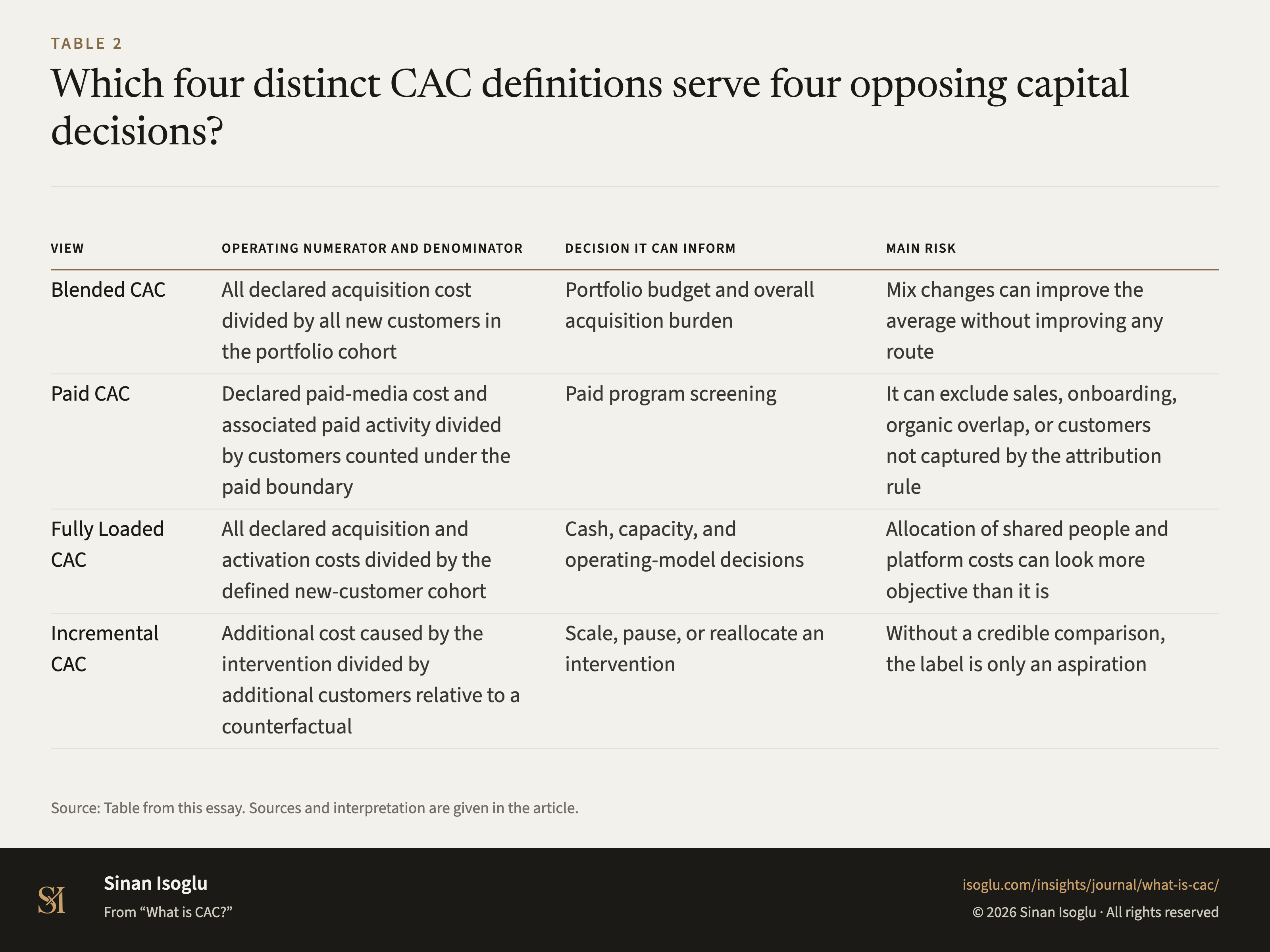
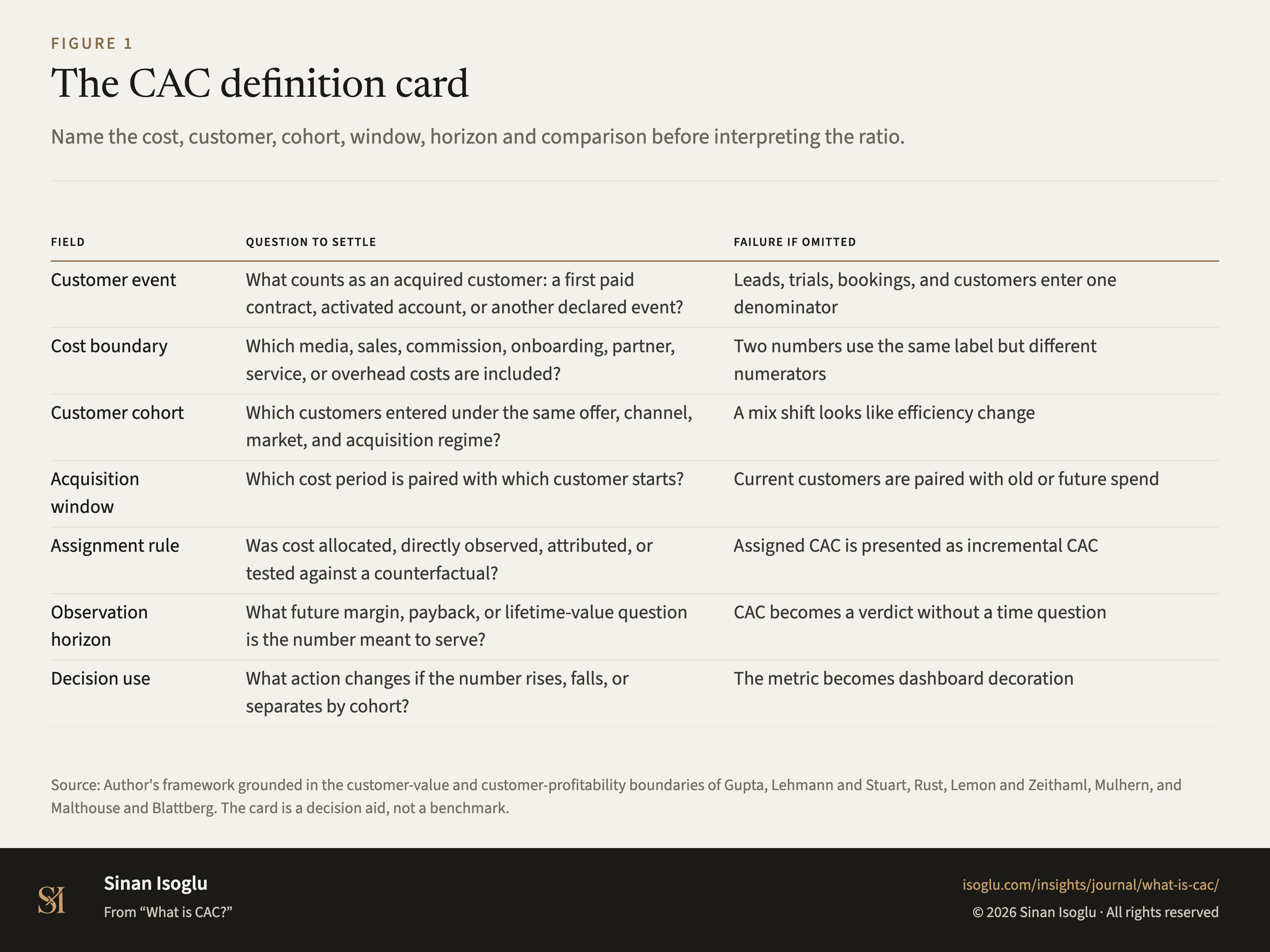
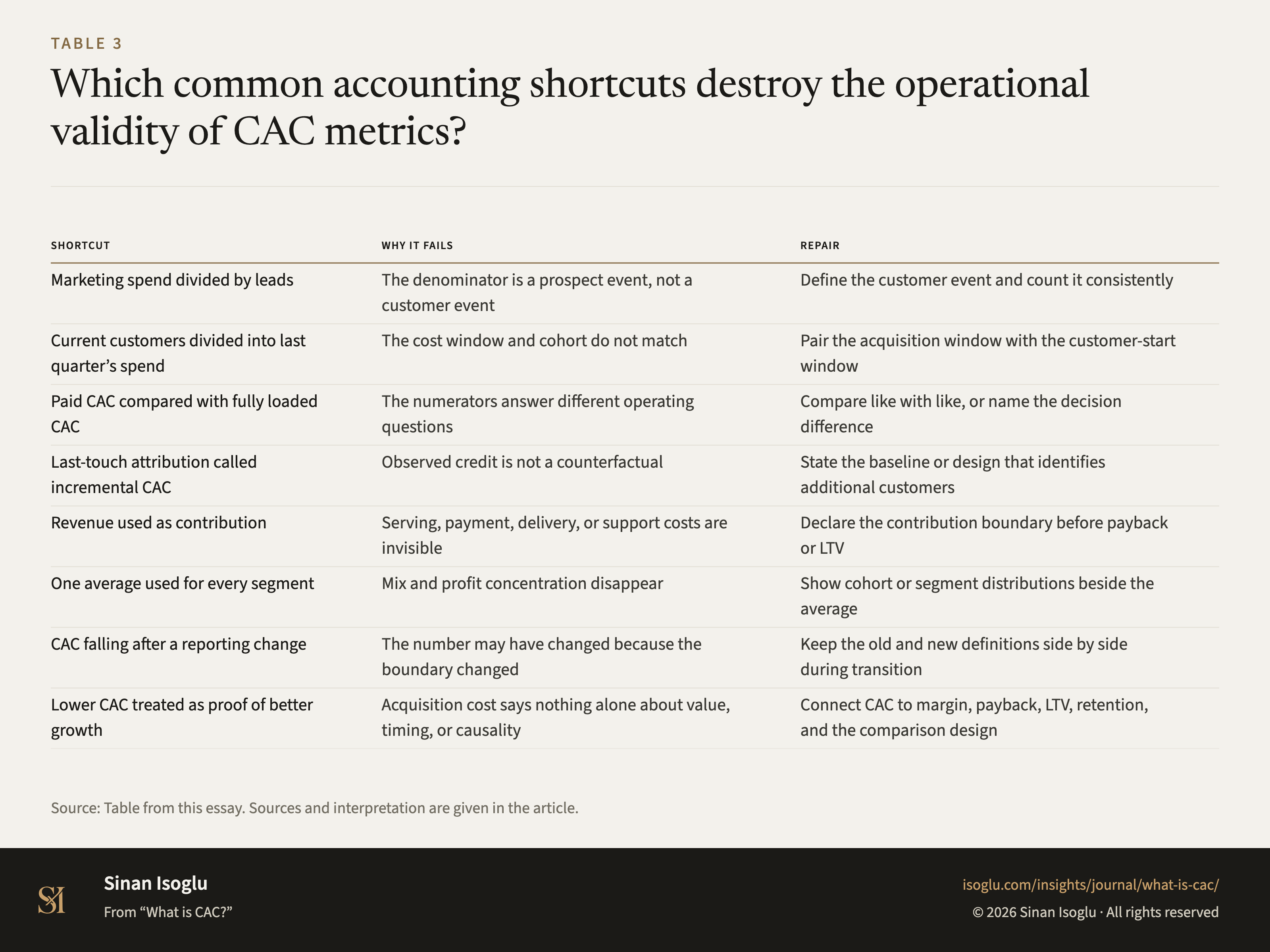
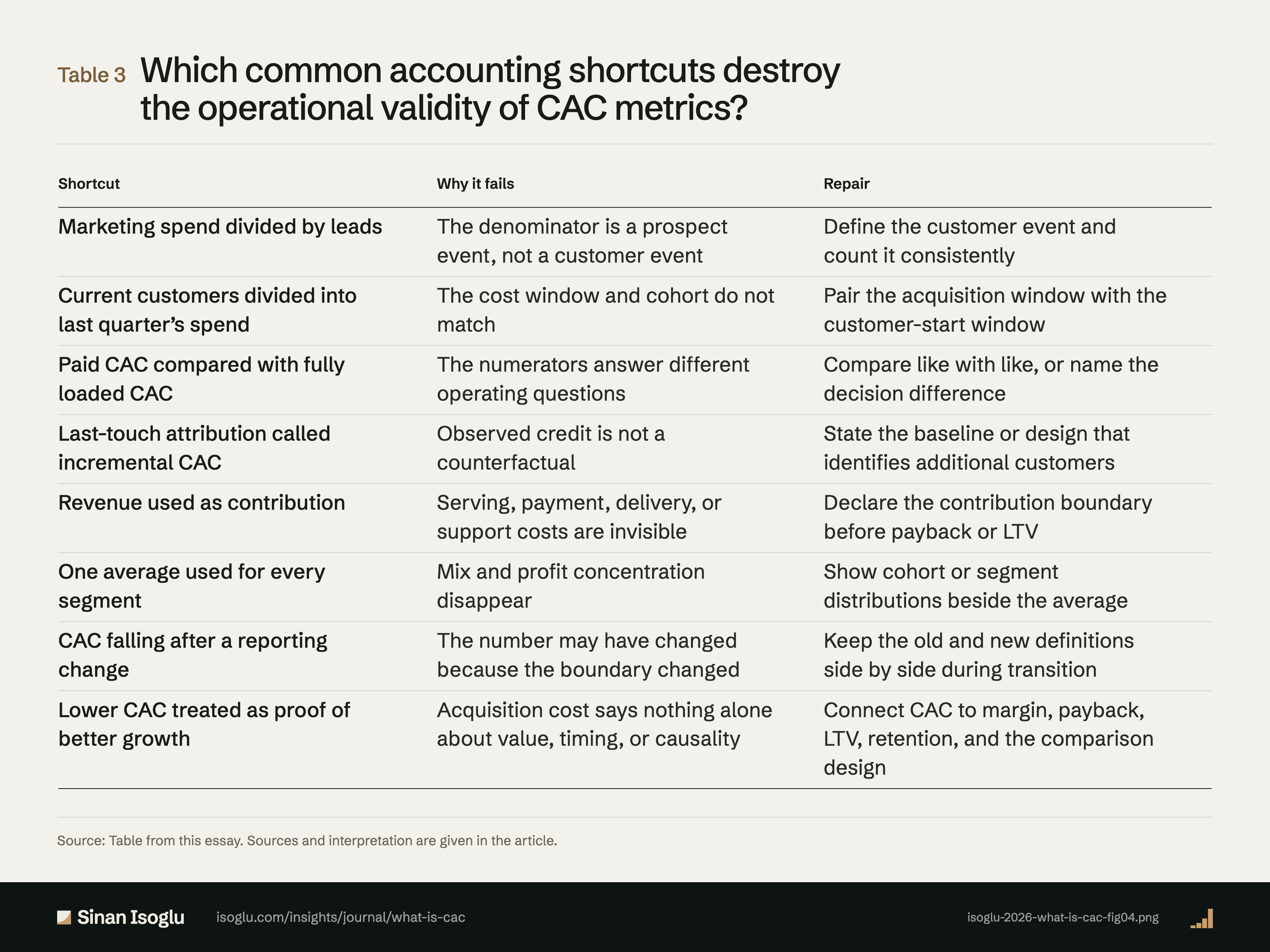
How should CAC be calculated and read across operating views?
Table 1How should CAC be calculated and read across operating views?
| Route | Declare | Do not infer |
|---|---|---|
| Formula and calculation | Included acquisition costs, customer event, cohort, window, assignment status, and denominator | One formula is the universal accounting or causal standard |
| Strategy and interpretation | Budget or capacity decision, comparison, contribution horizon, and the companion measure | A lower ratio is automatically better growth or better value |
| Dashboard and data requirements | Cost source, customer key, start event, channel, market, plan, allocation rule, version, and unresolved fields | A complete chart proves the customer count, cost attribution, or counterfactual |
| Cohort, segment, and B2B | Offer, channel, market, buying process, implementation event, customer grain, and maturity window | A blended average transfers unchanged across segments or buying motions |
| Checklist and review | Owner, included and excluded costs, exception state, sensitivity, source, decision, and next date | A checklist creates an incremental result without a comparison design |
Swipe or scroll horizontally if the table is wider than your screen.
Source: Table from this essay. Sources and interpretation are given in the article.
PNG4:3, 1600 × 1200, with the title, the source line and the attribution set in the image isoglu-2026-what-is-cac-fig02.png
From the essay
Growth that compounds
What is CAC?
CAC is a defined cost per acquired customer, not a universal ratio. State the cohort, boundary, horizon and counterfactual before comparing channels.
Read the essayThis exhibit belongs to an essay: the numbers live here, the argument lives there.
Cite or embed
Contact
Bring the question you're working on.
Research, a guest lecture, or a commercial question.