Table 3From “What is an acquisition thesis? Strategic underwriting, valuation, and M&A governance”
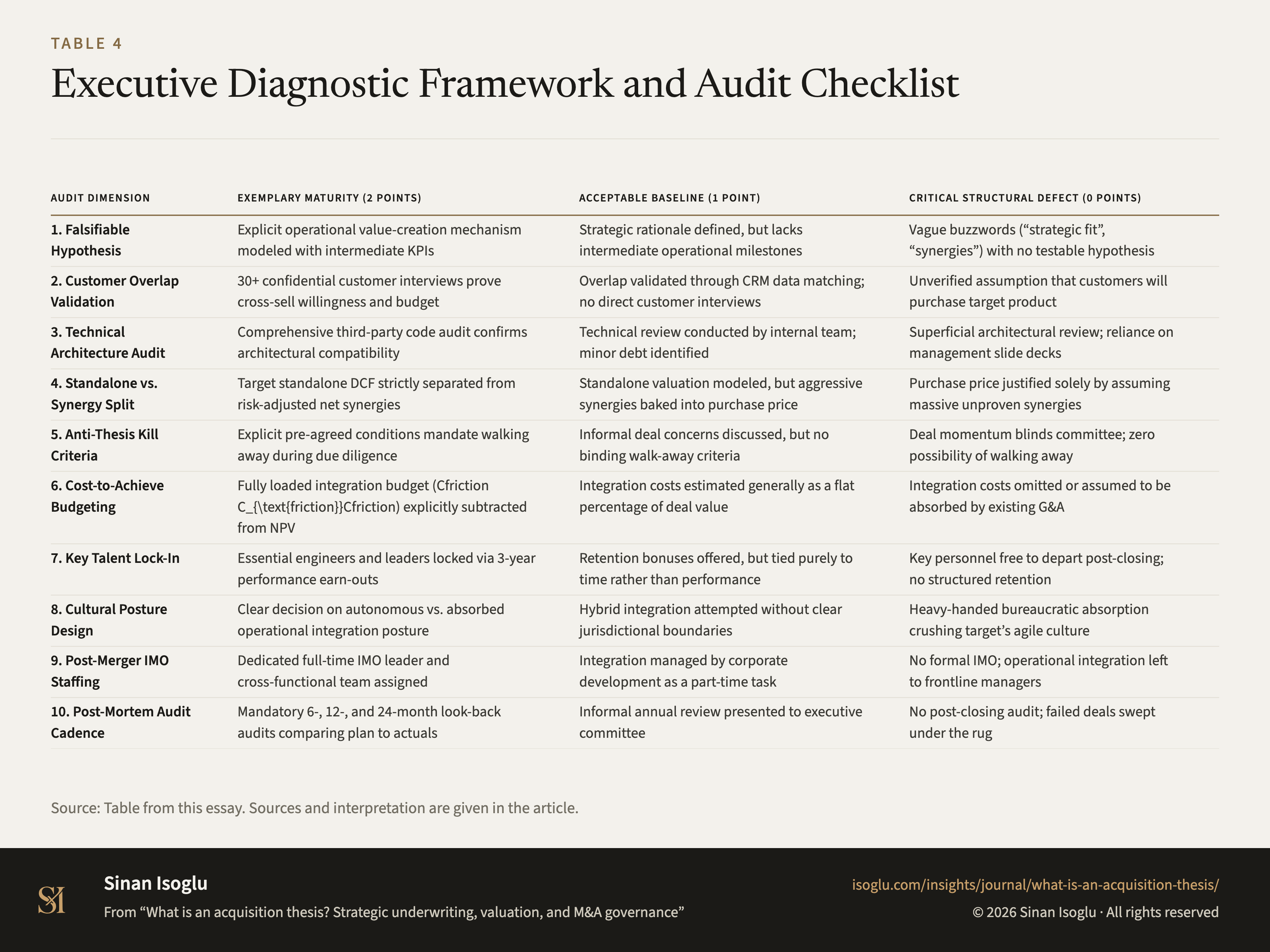
How do you score a transaction before the investment committee decides?
Table 3How do you score a transaction before the investment committee decides?
| Audit Dimension | Exemplary Maturity (2 Points) | Acceptable Baseline (1 Point) | Critical Structural Defect (0 Points) |
|---|---|---|---|
| 1. Falsifiable Hypothesis | Explicit operational value-creation mechanism modeled with intermediate KPIs | Strategic rationale defined, but lacks intermediate operational milestones | Vague buzzwords ("strategic fit", "synergies") with no testable hypothesis |
| 2. Customer Overlap Validation | 30+ confidential customer interviews prove cross-sell willingness and budget | Overlap validated through CRM data matching; no direct customer interviews | Unverified assumption that customers will purchase target product |
| 3. Technical Architecture Audit | Comprehensive third-party code audit confirms architectural compatibility | Technical review conducted by internal team; minor debt identified | Superficial architectural review; reliance on management slide decks |
| 4. Standalone vs. Synergy Split | Target standalone DCF strictly separated from risk-adjusted net synergies | Standalone valuation modeled, but aggressive synergies baked into purchase price | Purchase price justified solely by assuming massive unproven synergies |
| 5. Anti-Thesis Kill Criteria | Explicit pre-agreed conditions mandate walking away during due diligence | Informal deal concerns discussed, but no binding walk-away criteria | Deal momentum blinds committee; zero possibility of walking away |
| 6. Cost-to-Achieve Budgeting | Fully loaded integration budget ($C_{\text{friction}}$) explicitly subtracted from NPV | Integration costs estimated generally as a flat percentage of deal value | Integration costs omitted or assumed to be absorbed by existing G&A |
| 7. Key Talent Lock-In | Essential engineers and leaders locked via 3-year performance earn-outs | Retention bonuses offered, but tied purely to time rather than performance | Key personnel free to depart post-closing; no structured retention |
| 8. Cultural Posture Design | Clear decision on autonomous vs. absorbed operational integration posture | Hybrid integration attempted without clear jurisdictional boundaries | Heavy-handed bureaucratic absorption crushing target's agile culture |
| 9. Post-Merger IMO Staffing | Dedicated full-time IMO leader and cross-functional team assigned | Integration managed by corporate development as a part-time task | No formal IMO; operational integration left to frontline managers |
| 10. Post-Mortem Audit Cadence | Mandatory 6-, 12-, and 24-month look-back audits comparing plan to actuals | Informal annual review presented to executive committee | No post-closing audit; failed deals swept under the rug |
Swipe or scroll horizontally if the table is wider than your screen.
Source: Table from this essay. Sources and interpretation are given in the article.
From the essay
Go-to-market strategy
What is an acquisition thesis? Strategic underwriting, valuation, and M&A governance
An acquisition thesis is the formal strategic rationale specifying how combining two corporate assets generates quantifiable enterprise value beyond cost.
Read the essayThis exhibit belongs to an essay: the numbers live here, the argument lives there.
Cite or embed
Related exhibits
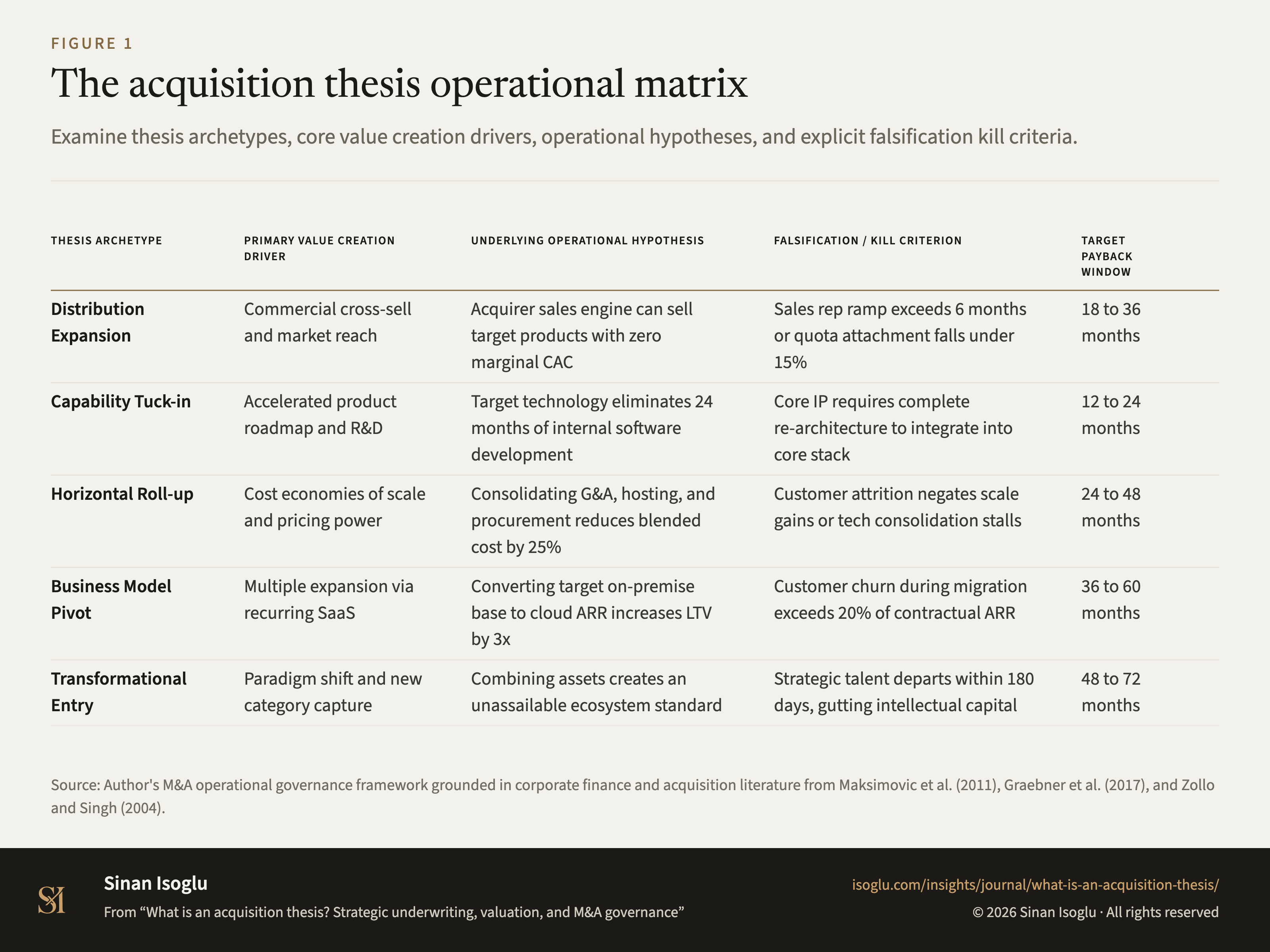
Figure 1Figure
The acquisition thesis operational matrix
What is an acquisition thesis? Strategic underwriting, valuation, and M&A governance
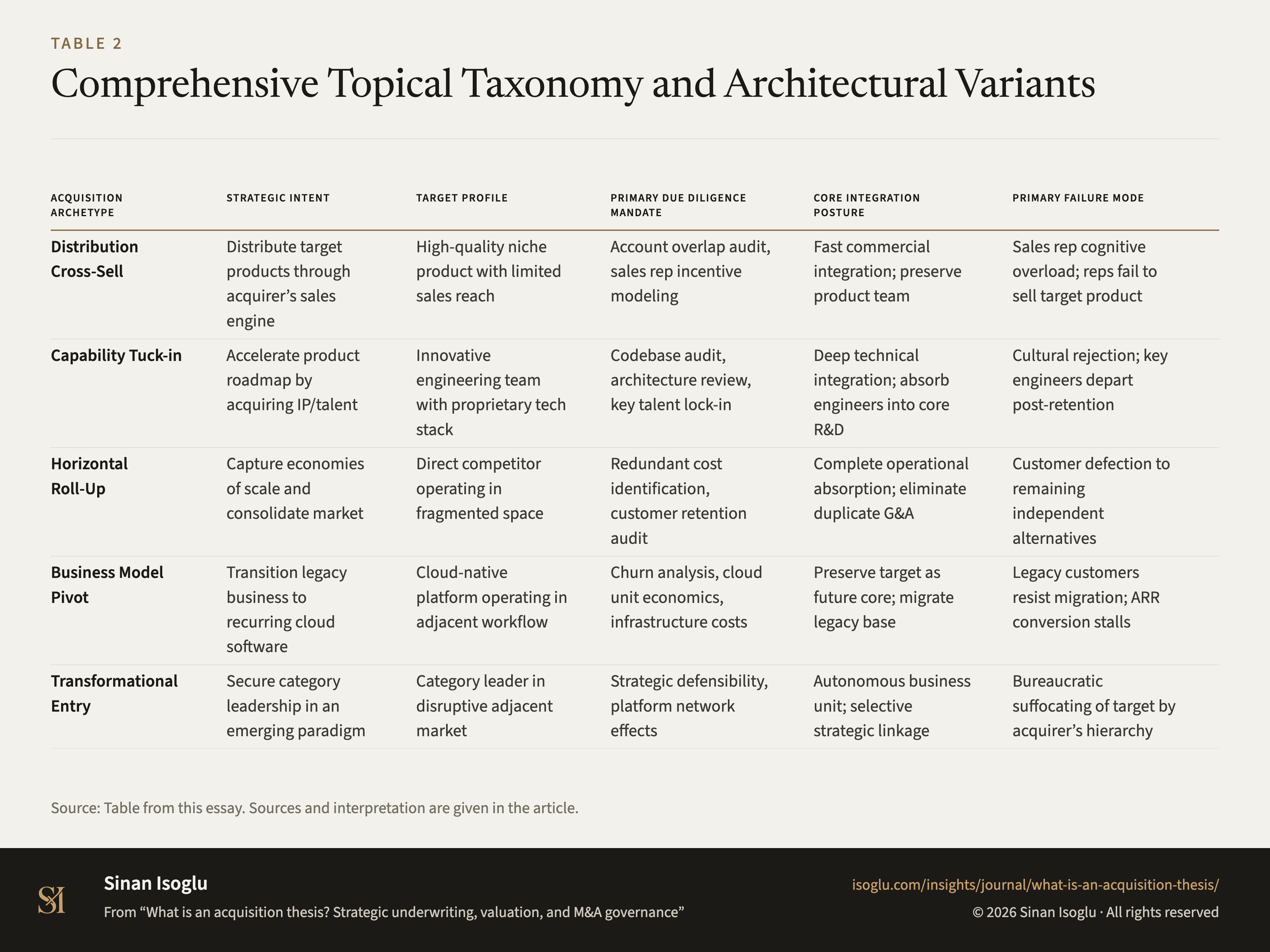
Table 1Table
What are the five archetypes of acquisition thesis?
What is an acquisition thesis? Strategic underwriting, valuation, and M&A governance
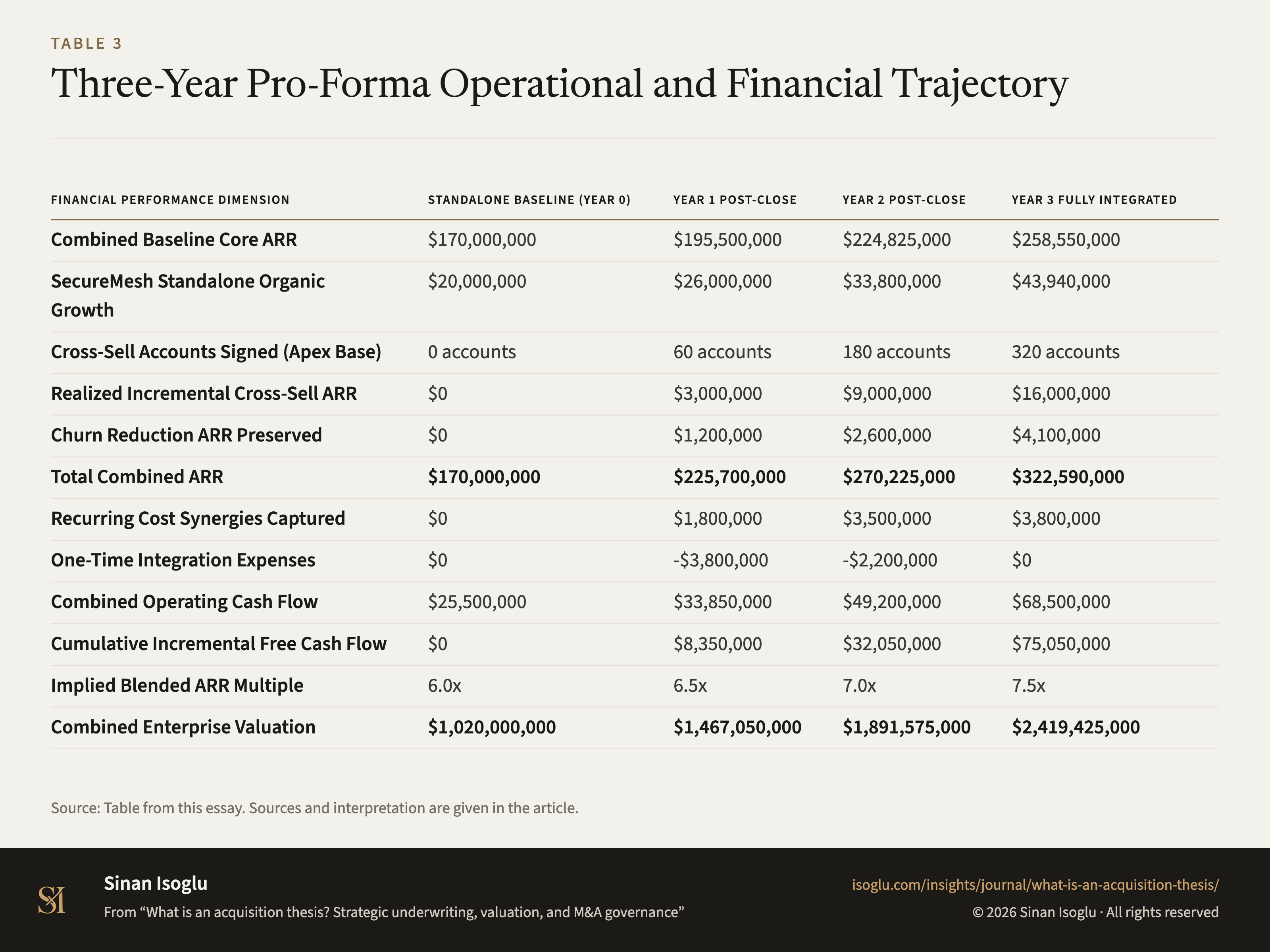
Table 2Table
Three-Year Pro-Forma Operational and Financial Trajectory
What is an acquisition thesis? Strategic underwriting, valuation, and M&A governance
Contact
Bring the question you're working on.
Research, a guest lecture, or a commercial question.