Figure 1From “What is activation rate? The first value event must be observable”
The activation-rate cohort worksheet
Keep the eligible cohort, first-value event, fixed window, activation count, and later outcome visible as separate objects.
Figure 1The activation-rate cohort worksheet
Source: Author's synthetic cohort worksheet grounded in Retana et al. (2016), Ascarza et al. (2016), and Steinhoff et al. (2025). The prompts and example values are illustrative, not benchmarks.
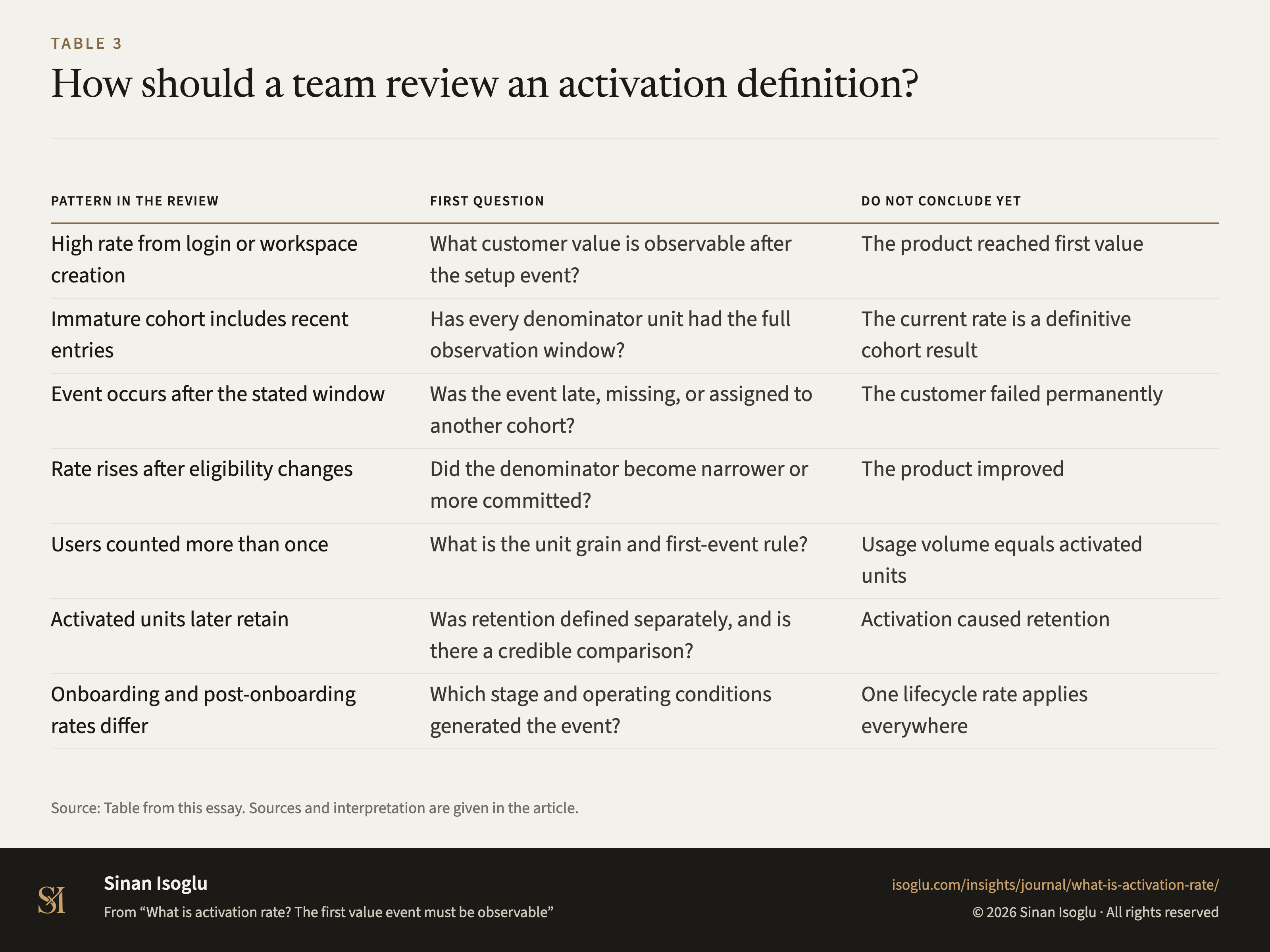
Source and evidence
Each line names a claim related to this exhibit, its source, and how it was checked.
- B G03-OWN-C1 Activation rate is the share of eligible units that reach a declared first-value event inside a fixed windowAuthor framework
- B G03-OWN-C3 A reproducible activation record names unit grain, entry event, eligibility, activation event, timing, window, and counting ruleAuthor framework
- B G03-OWN-C4 The synthetic worksheet has eight eligible units, four first-value events inside 14 days, and 4 / 8 = 50%Author synthetic arithmetic
- B G03-OWN-C5 Setup completion and descriptive retention among activated units are separate from activation rateAuthor framework
- B G03-OWN-C6 Changing event, cohort, unit grain, or window changes the comparison object before it proves product improvementAuthor boundary
Grades: A, verified against the printed page of the primary source · B, primary source, text layer only · C, authoritative secondary · D, reported.
From the essay
Growth that compounds
What is activation rate? The first value event must be observable
Activation rate is the share of an eligible cohort reaching a declared first-value event inside a fixed window. Define the event first.
Read the essayThis exhibit belongs to an essay: the numbers live here, the argument lives there.
Cite or embed
Related exhibits
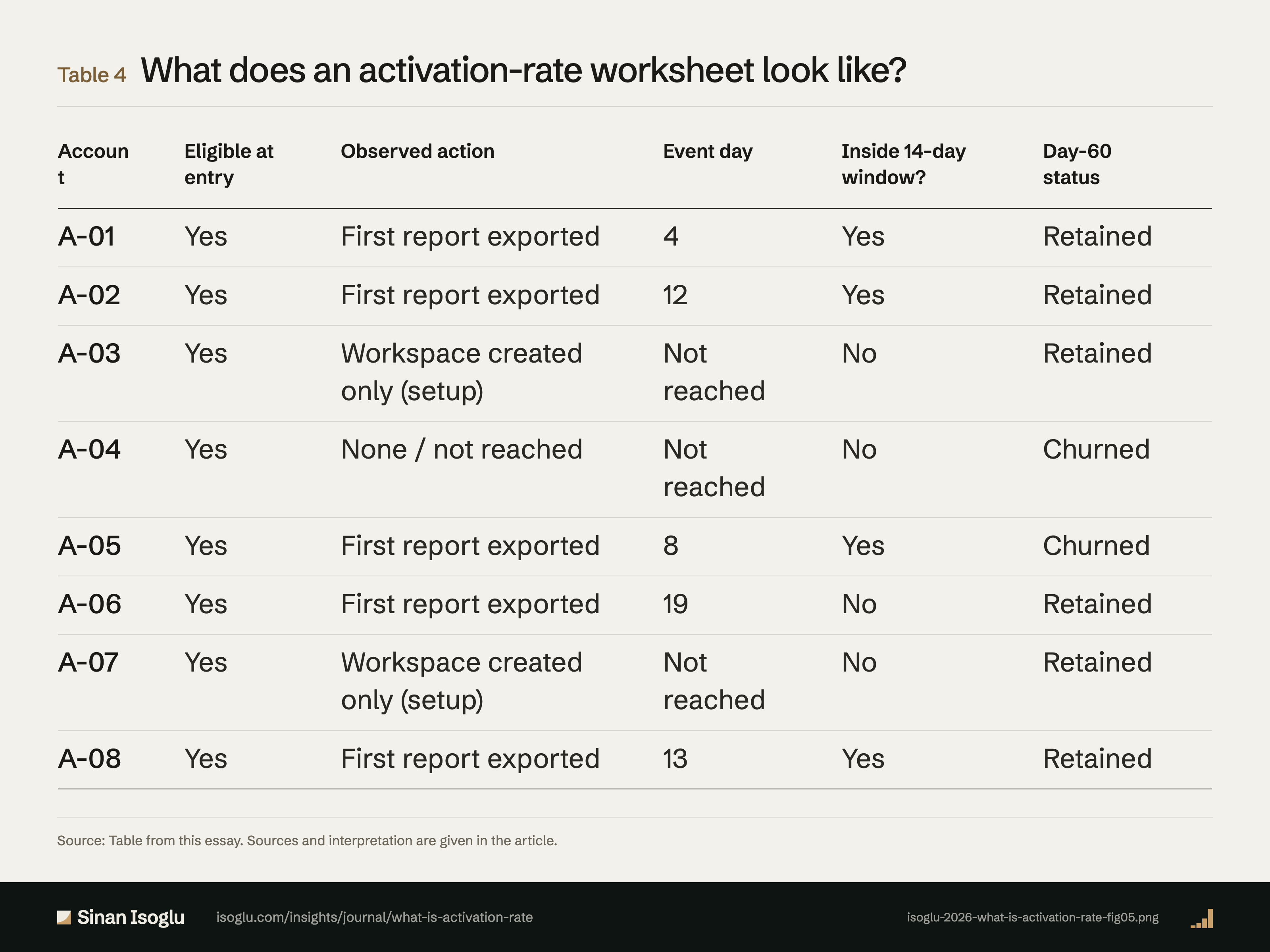
Table 4Table
What does an activation-rate worksheet look like?
What is activation rate? The first value event must be observable
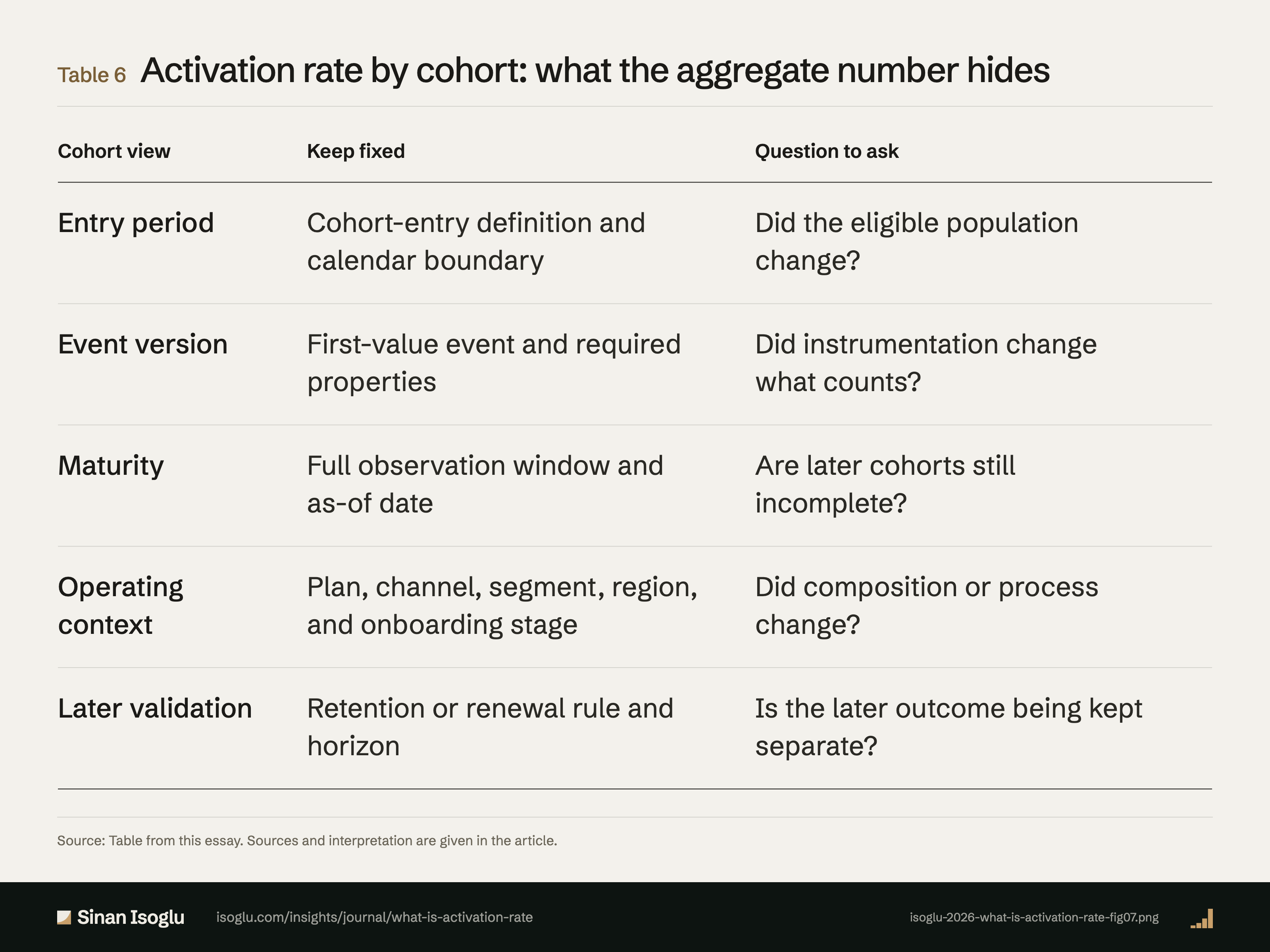
Table 6Table
Activation rate by cohort: what the aggregate number hides
What is activation rate? The first value event must be observable
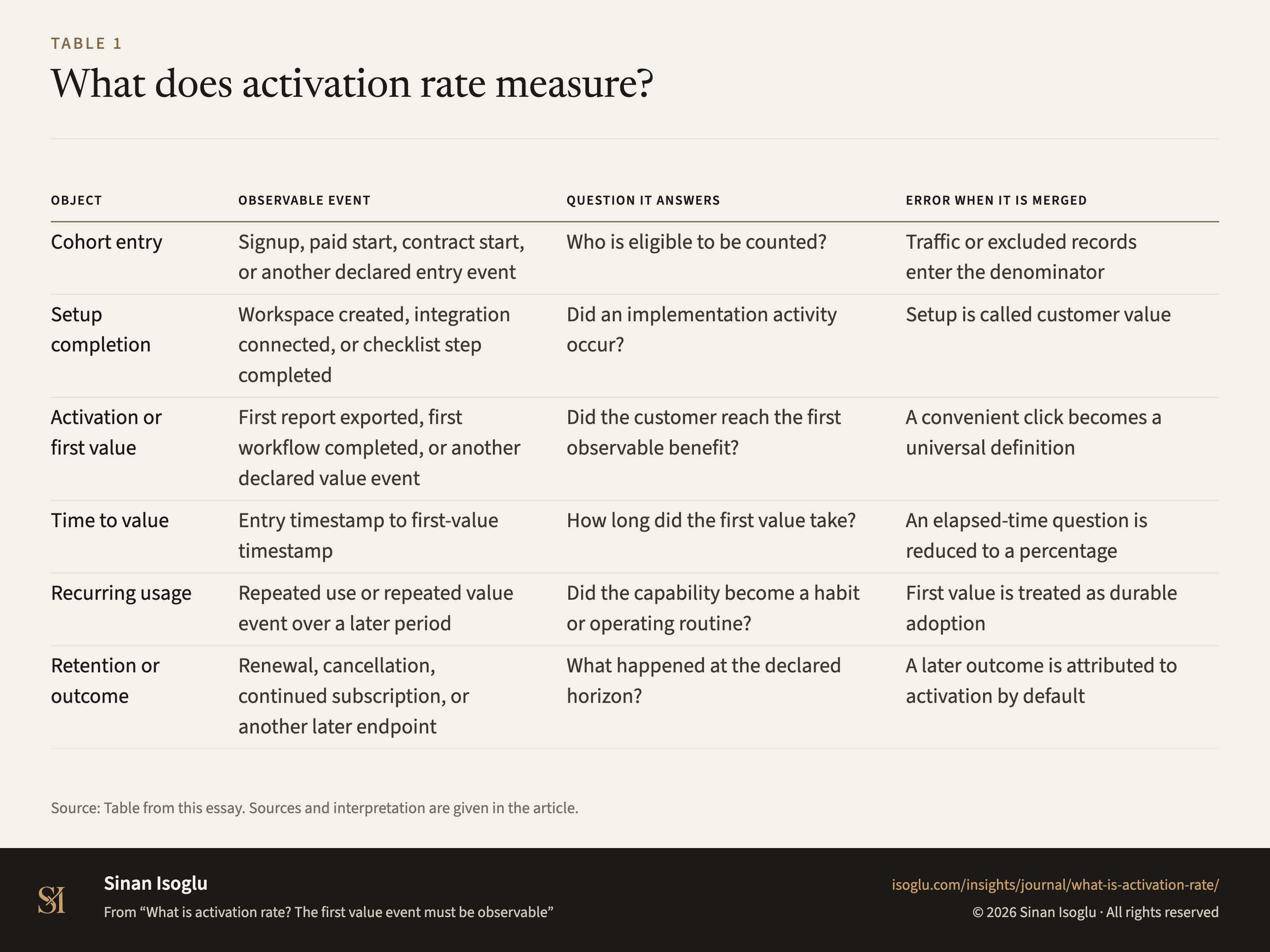
Table 1Table
What does activation rate measure?
What is activation rate? The first value event must be observable
Contact
Bring the question you're working on.
Research, a guest lecture, or a commercial question.