Figure 1From “What are forecast categories? Names need stable decision rules”
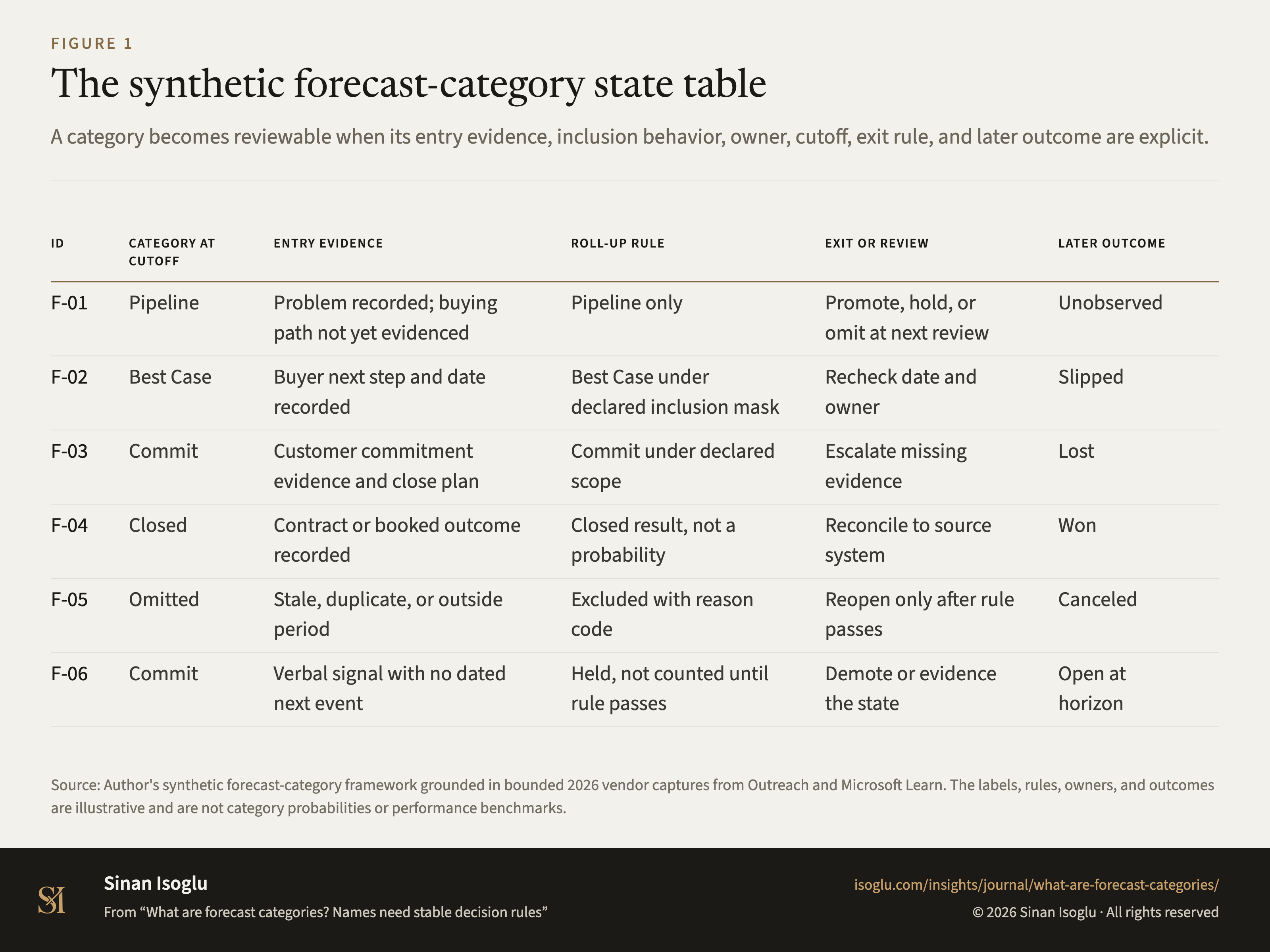
The synthetic forecast-category state table
A category becomes reviewable when its entry evidence, inclusion behavior, owner, cutoff, exit rule, and later outcome are explicit.
Figure 1The synthetic forecast-category state table
| ID | Category at cutoff | Entry evidence | Roll-up rule | Exit or review | Later outcome |
|---|---|---|---|---|---|
| F-01 | Pipeline | Problem recorded; buying path not yet evidenced | Pipeline only | Promote, hold, or omit at next review | Unobserved |
| F-02 | Best Case | Buyer next step and date recorded | Best Case under declared inclusion mask | Recheck date and owner | Slipped |
| F-03 | Commit | Customer commitment evidence and close plan | Commit under declared scope | Escalate missing evidence | Lost |
| F-04 | Closed | Contract or booked outcome recorded | Closed result, not a probability | Reconcile to source system | Won |
| F-05 | Omitted | Stale, duplicate, or outside period | Excluded with reason code | Reopen only after rule passes | Canceled |
| F-06 | Commit | Verbal signal with no dated next event | Held, not counted until rule passes | Demote or evidence the state | Open at horizon |
Swipe or scroll horizontally if the table is wider than your screen.
Source: Author's synthetic forecast-category framework grounded in bounded 2026 vendor captures from Outreach and Microsoft Learn. The labels, rules, owners, and outcomes are illustrative and are not category probabilities or performance benchmarks.
Source and evidence
Each line names a claim related to this exhibit, its source, and how it was checked.
- B FCAT26-C7 Outreach: "Commit is fundamentally an accountability signal rather than a probability estimate."Outreach. (2026)
- A FCAT26-C8 Outreach, general definition: categories are "structured labels that reps assign to individual deals to signal their confidence in closing them": the same article as C7, and it must always travel with itOutreach. (2026)
- A FCAT26-C9 Outreach, the accuracy method: "Accuracy is measured as the absolute percentage difference between the Day One commit forecast and cumulative Closed results at period end."Outreach. (2026)
- A FCAT26-C10 Outreach: "Closed is the only category with zero uncertainty, and it is the denominator in forecast accuracy measurement." The denominator is Closed, not CommitOutreach. (2026)
- B FCAT26-C13 Microsoft's category is Committed, defined by an evidence state: "Customer has made a verbal or contractual commitment": not by a probabilityMicrosoft Learn. (2026)
- B V04-OWN-C1 A forecast category is a named state assigned under a declared rule at a stated cutoff and forecast horizonAuthor framework grounded in FCAT26-C7 to FCAT26-C10
- B V04-OWN-C2 Forecast category, probability, forecast amount, stage, and actual outcome are separate objectsAuthor taxonomy
- B V04-OWN-C4 Labels such as commit, best case, and pipeline are not comparable unless their evidence and denominator rules are stableAuthor boundary grounded in FCAT26-C13 and FCAT26-C15
- B V04-OWN-C5 A category report can show coverage, movement, maturity, and outcome distributions without treating a category label as a probabilityAuthor metric framework
Grades: A, verified against the printed page of the primary source · B, primary source, text layer only · C, authoritative secondary · D, reported.
From the essay
Revenue operations & AI
What are forecast categories? Names need stable decision rules
Forecast categories are decision labels, not universal probabilities. Define the evidence, inclusion rule, denominator, and outcome behind each name.
Read the essayThis exhibit belongs to an essay: the numbers live here, the argument lives there.
Cite or embed
Related exhibits
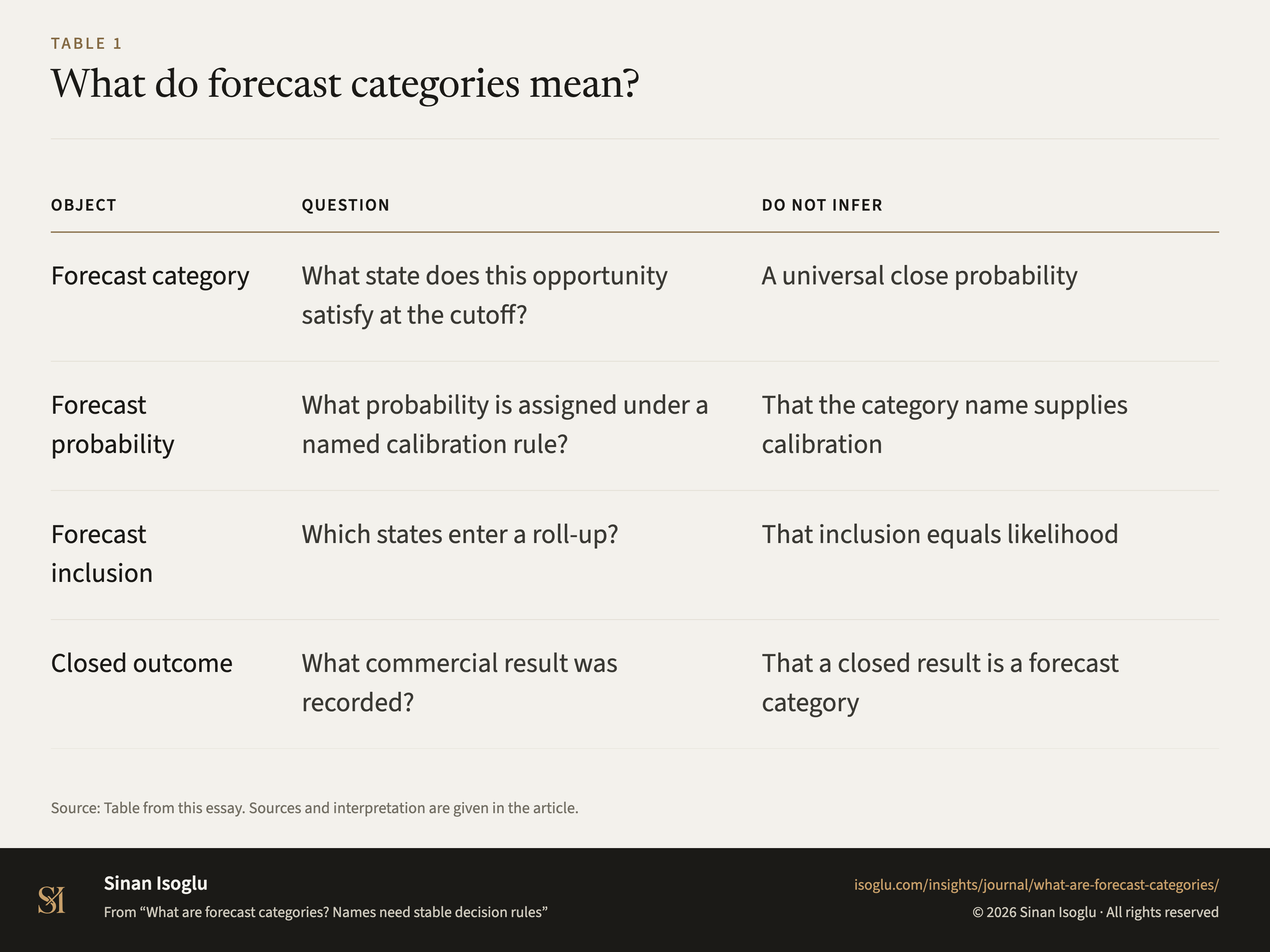
Table 1Table
What do forecast categories mean?
What are forecast categories? Names need stable decision rules
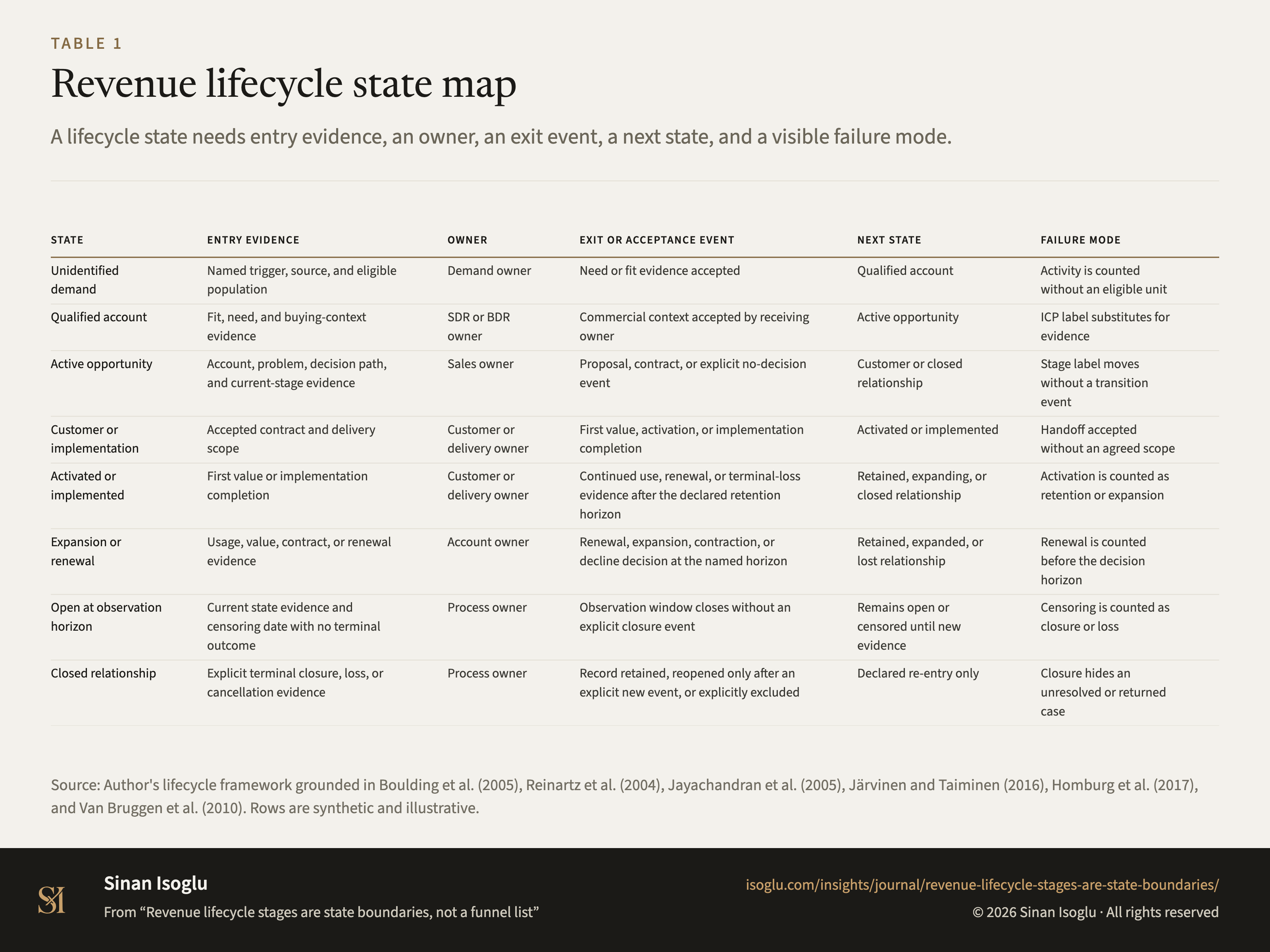
Table 1Table
Revenue lifecycle state map
Revenue lifecycle stages are state boundaries, not a funnel list
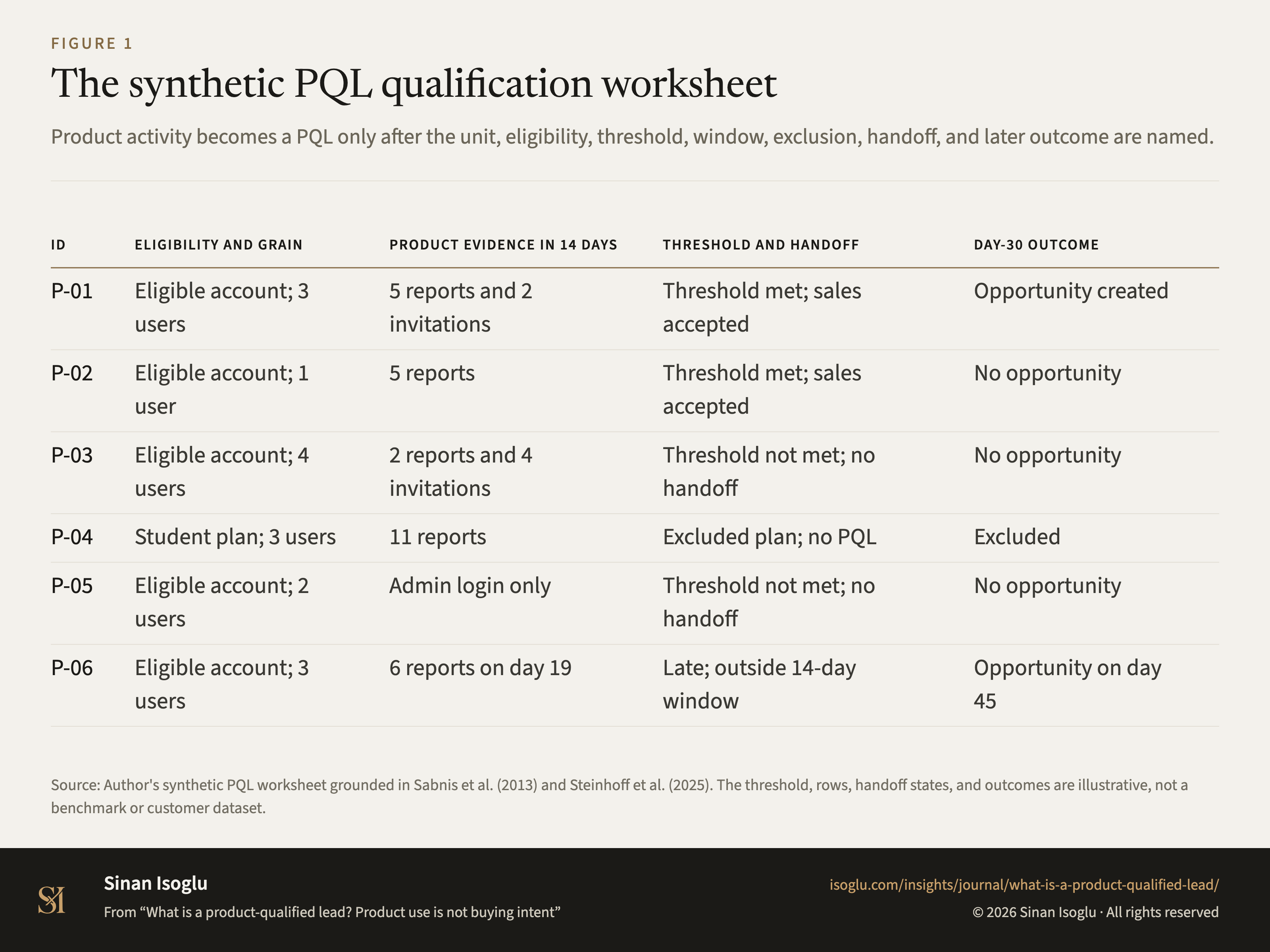
Figure 1Figure
The synthetic PQL qualification worksheet
What is a product-qualified lead? Product use is not buying intent
Contact
Bring the question you're working on.
Research, a guest lecture, or a commercial question.