Figure 1From “What a university ranking can tell you about a research partner”
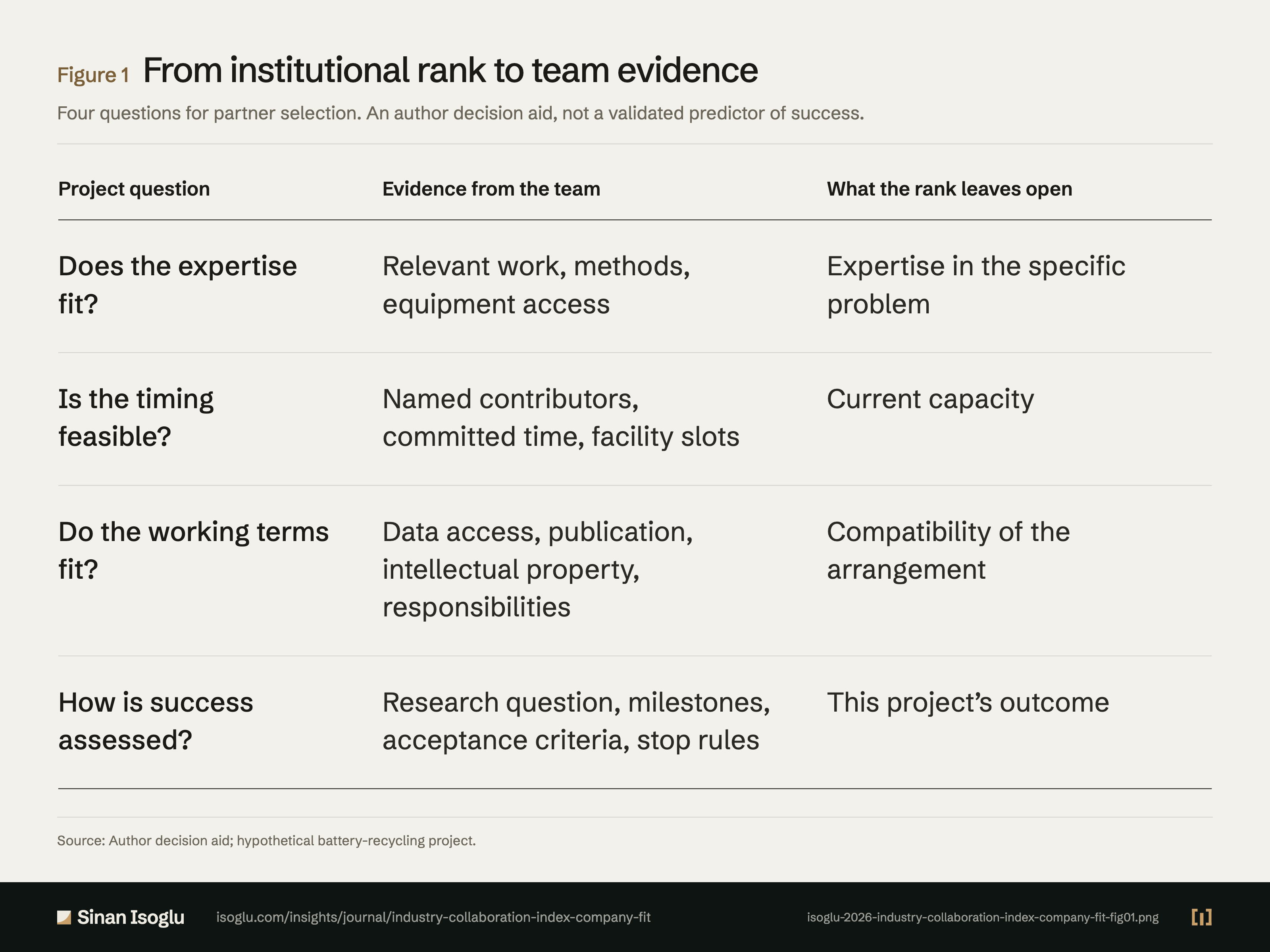
From institutional rank to team evidence
Four questions for partner selection. An author decision aid, not a validated predictor of success.
Figure 1From institutional rank to team evidence
| Project question | Evidence from the team | What the rank leaves open |
|---|---|---|
| Does the expertise fit? | Relevant work, methods, equipment access | Expertise in the specific problem |
| Is the timing feasible? | Named contributors, committed time, facility slots | Current capacity |
| Do the working terms fit? | Data access, publication, intellectual property, responsibilities | Compatibility of the arrangement |
| How is success assessed? | Research question, milestones, acceptance criteria, stop rules | This project’s outcome |
Swipe or scroll horizontally if the table is wider than your screen.
Source: Author decision aid; hypothetical battery-recycling project.
Source and evidence
Each line names a claim related to this exhibit, its source, and how it was checked.
- D UR26-OWN-C5 Author decision aid maps expertise, timing, terms and success criteria to evidence requested from the team; no validated outcome prediction.Author judgement, university-rankings research-partner note, 2026-10-11
Grades: A, verified against the printed page of the primary source · B, primary source, text layer only · C, authoritative secondary · D, reported.
From the essay
From the research bench
What a university ranking can tell you about a research partner
A university ranking can reveal research activity. Choosing a partner requires evidence about the team, the problem, and the proposed work.
Read the essayThis exhibit belongs to an essay: the numbers live here, the argument lives there.
Cite or embed
Related exhibits
Contact
Bring the question you're working on.
Research, a guest lecture, or a commercial question.