Figure 1From “The growth-share matrix is a capital-allocation device”
From quadrant to funding test
A quadrant is only a funding hypothesis until the market, cash mechanism, strategic unit, owner, and review trigger are visible.

Source and evidence
Each line names a claim related to this exhibit, its source, and how it was checked.
- B HEN70-C1 Henderson's own sentence: "The portfolio composition is a function of the balance between cash flows"henderson-1970-product-portfolio
- B HEN70-C2 "High growth products require cash inputs to grow. Low growth products should generate excess cash"henderson-1970-product-portfolio
- B HEN70-C3 The four positions are named by their coordinates: "Products with high market share and slow growth are" cash cows, "Products with low market share and slow growth are" pets, "Low market share, high growth products are the" question marks, and "The high share, high growth product is the" starhenderson-1970-product-portfolio
- B HEN70-C4 The balanced portfolio has "stars whose high share and high growth assure the future", "cash cows that supply funds for that future growth" and "question marks to be converted into stars with the added funds", while "Pets are not necessary. They are evidence of fail"ure to lead or to exithenderson-1970-product-portfolio
- A NPR11-C1 CPM comprises "entry into new businesses, allocation of scarce resources to different business units, and liquidation of value-destroying divisions"nippa-pidun-rubner-2011-corporate-portfolio-management
- A NPR11-C2 The coordinates are proxies, and the review says so: "market growth (as proxy for cash demand) and relative market share (as proxy for cash generation via an experience curve effect) constituted the basic dimensions" of the conceptnippa-pidun-rubner-2011-corporate-portfolio-management
- A NPR11-C3 Corporate portfolio management is the process and not the display: it is the thing "which should not be limited to simple matrices or other instruments for managing the corporate portfolio"nippa-pidun-rubner-2011-corporate-portfolio-management
- A NPR11-C4 The review separates the tool from the practice: "Criticizing strategic management tools such as CPM matrices because of oversimplification requires a clear distinction between instrumental simplification and misleading, logical, or methodological oversimplification"nippa-pidun-rubner-2011-corporate-portfolio-management
- A NPR11-C5 The trade-off is stated as a design constraint on any such instrument: methods "need to consider the inherent uncertainty, dynamism, and complexity of the strategic setting"nippa-pidun-rubner-2011-corporate-portfolio-management
- B ROB86-C1 The count IS in the paper, twice: "There are 13 mitigating factors that must be borne in mind before the cash flow characteristics of the strategic menagerie can be applied slavishly", and the abstract's "Thirteen caveats ranging from the breakdown of the implicit correlations between cash flows and market share and market growth rate through motivational and political problems must condition a competent analysis". Corrected 2026-09-07: this row said the paper enumerates no thirteen, which is contradicted by its own abstractrobinson-1986-growth-share-matrix-caveats
- B ROB86-C2 The share axis may not carry cash flow at all: "relative market share may not be correlated with cash flow", and "The relationship between market share and cash flow may" fail when other economics dominaterobinson-1986-growth-share-matrix-caveats
- B ROB86-C3 The growth axis carries the same warning: "market growth rate may not be strongly negatively correlat"ed with cash flow, because "High entry barriers may exist. Margins may be sustainable and large enough to produce" positive cash flow while growingrobinson-1986-growth-share-matrix-caveats
- B ROB86-C4 Market definition is a positioning error, not a rounding error: it can rest on "the incorrect assessment of market boundaries based on faulty geographic, demographic, psychographic, behavioural, competitor, and other variables", and "The level of market segmentation affects the positioning"robinson-1986-growth-share-matrix-caveats
- B ROB86-C5 "High rates of inflation have a serious effect on the measure"ment of market growth and on the cash-flow characteristics of any businessrobinson-1986-growth-share-matrix-caveats
- B ROB86-C6 Implementation is organisational, and transfer pricing is the sharpest case: "It is possible to show an accounting profit wherever it is most desirable dependent on the manipulation of transfer prices"robinson-1986-growth-share-matrix-caveats
Grades: A, verified against the printed page of the primary source · B, primary source, text layer only · C, authoritative secondary · D, reported.
From the essay
Growth that compounds
The growth-share matrix is a capital-allocation device
A growth-share matrix can structure scarce-resource choices, but its quadrants are hypotheses that need market, cash-flow, and review evidence.
Read the essayThis exhibit belongs to an essay: the numbers live here, the argument lives there.
Cite or embed
Related exhibits
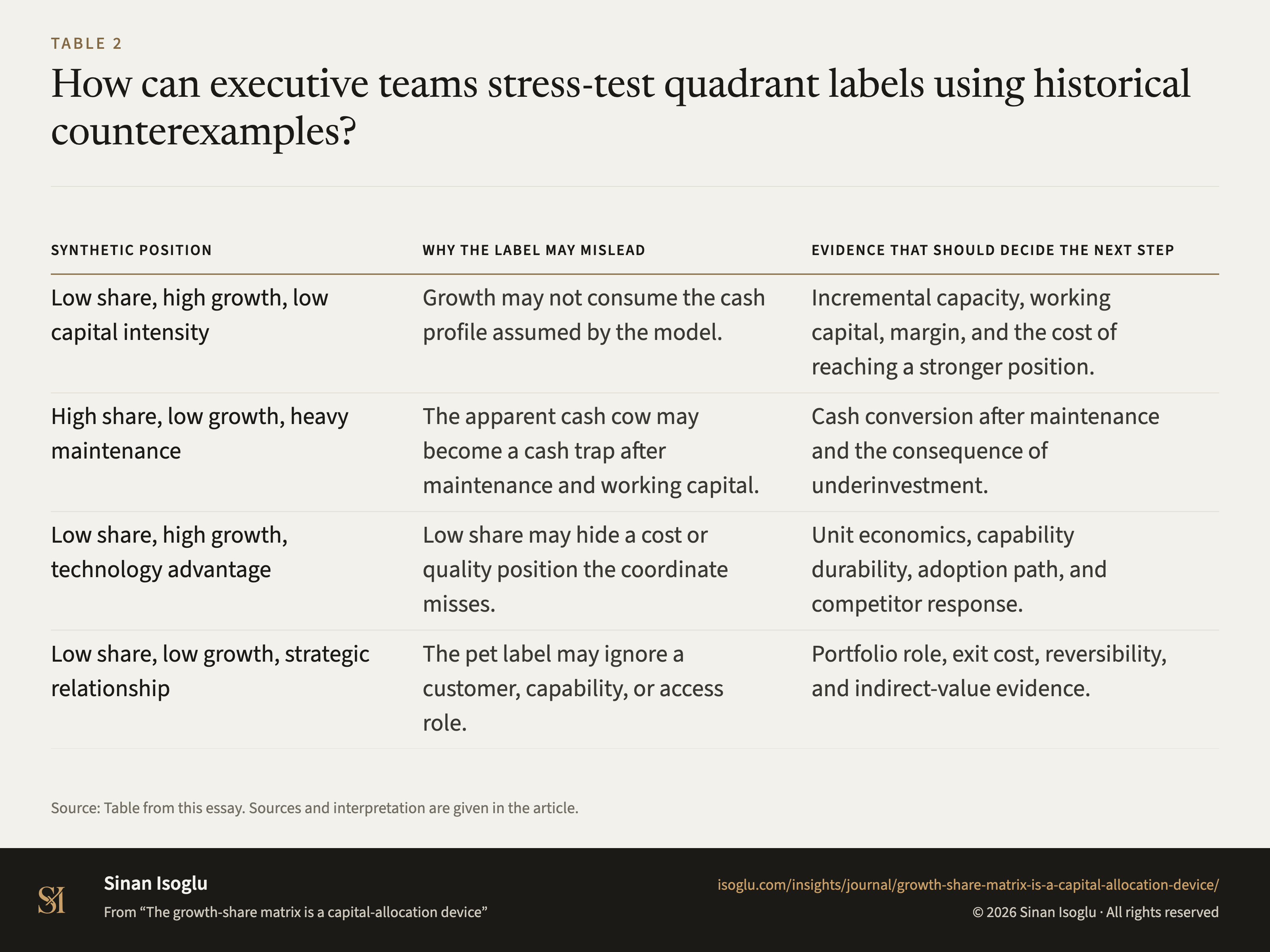
Table 1Table
How can executive teams stress-test quadrant labels using historical counterexamples?
The growth-share matrix is a capital-allocation device

Table 1Table
The growth-loop evidence ledger
Acquisition growth loops need a declared entry event
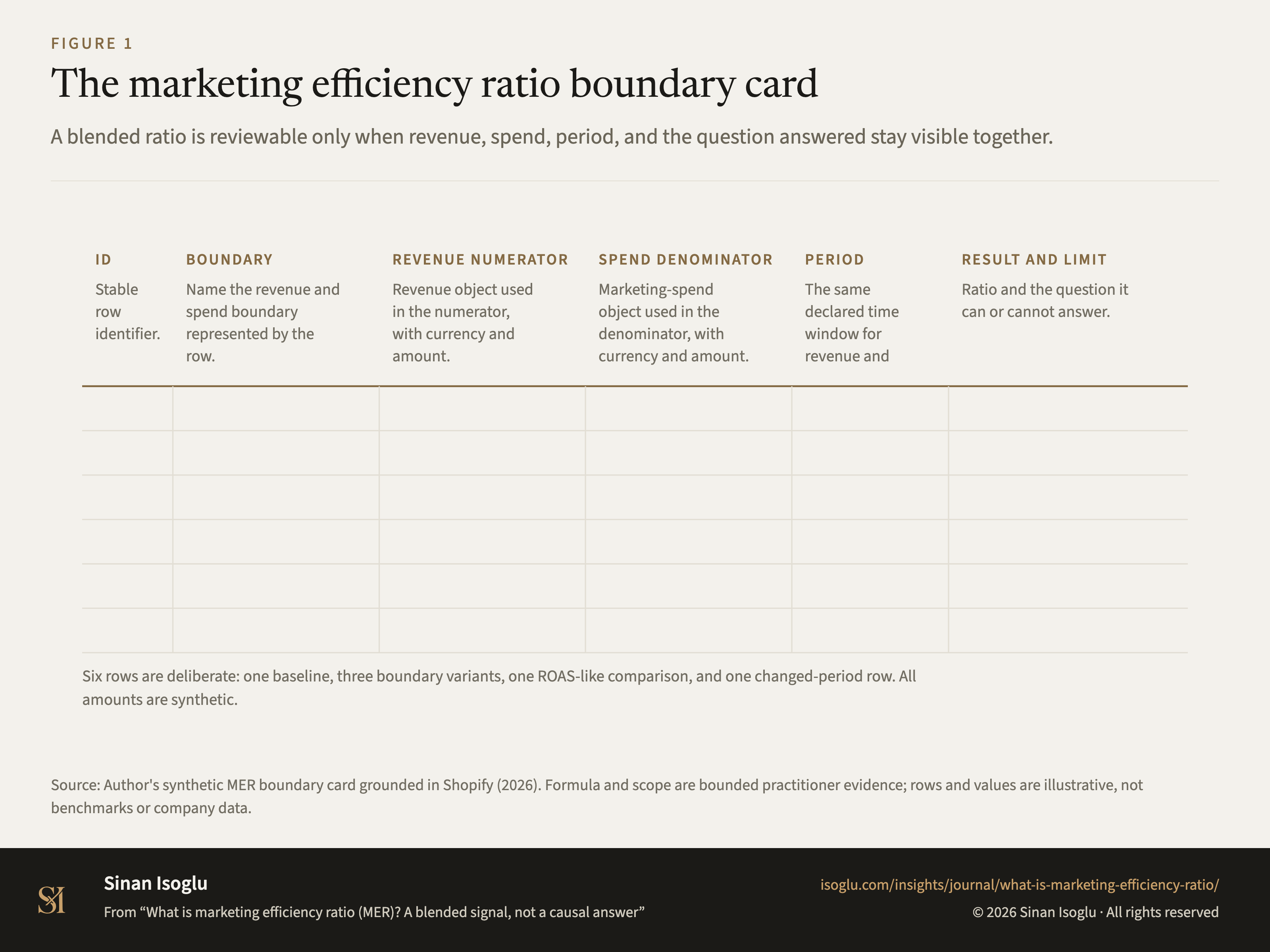
Figure 1Figure
The marketing efficiency ratio boundary card
What is marketing efficiency ratio (MER)? A blended signal, not a causal answer
Contact
Bring the question you're working on.
Research, a guest lecture, or a commercial question.