Figure 1From “False positives in churn models have a cost”
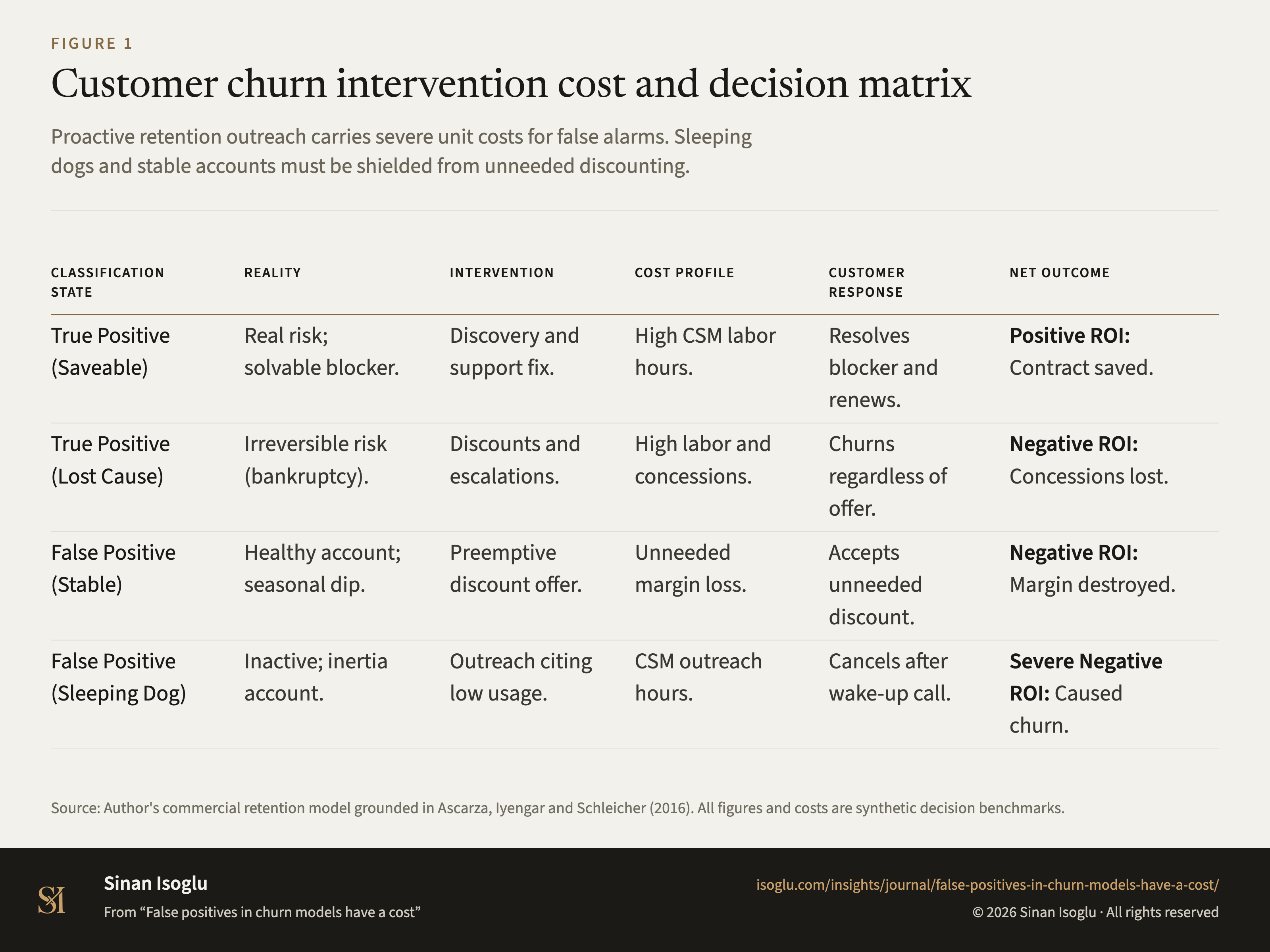
Customer churn intervention cost and decision matrix
Proactive retention outreach carries severe unit costs for false alarms. Sleeping dogs and stable accounts must be shielded from unneeded discounting.
Figure 1Customer churn intervention cost and decision matrix
| Classification state | Reality | Intervention | Cost profile | Customer response | Net outcome |
|---|---|---|---|---|---|
| True Positive (Saveable) | Real risk; solvable blocker. | Discovery and support fix. | High CSM labor hours. | Resolves blocker and renews. | Positive ROI: Contract saved. |
| True Positive (Lost Cause) | Irreversible risk (bankruptcy). | Discounts and escalations. | High labor and concessions. | Churns regardless of offer. | Negative ROI: Concessions lost. |
| False Positive (Stable) | Healthy account; seasonal dip. | Preemptive discount offer. | Unneeded margin loss. | Accepts unneeded discount. | Negative ROI: Margin destroyed. |
| False Positive (Sleeping Dog) | Inactive; inertia account. | Outreach citing low usage. | CSM outreach hours. | Cancels after wake-up call. | Severe Negative ROI: Caused churn. |
Swipe or scroll horizontally if the table is wider than your screen.
Source: Author's commercial retention model grounded in Ascarza, Iyengar and Schleicher (2016). All figures and costs are synthetic decision benchmarks.
Source and evidence
Each line names a claim related to this exhibit, its source, and how it was checked.
- A AIS16-C1 The backfire, verbatim: encouraging customers to switch to cost-minimising plans can "increase rather than decrease customer churn"Ascarza, Iyengar & Schleicher. (2016)
- A AIS16-C2 The proposed mechanisms are the authors' own: the campaign increased churn "by lowering customers" inertia to switch plans and by increasing the salience of past-usage patternsAscarza, Iyengar & Schleicher. (2016)
Grades: A, verified against the printed page of the primary source · B, primary source, text layer only · C, authoritative secondary · D, reported.
From the essay
Revenue operations & AI
False positives in churn models have a cost
Machine learning churn models prioritize recall, but false alarms trigger unneeded discounts, wasted customer success hours, and wake-up churn effects.
Read the essayThis exhibit belongs to an essay: the numbers live here, the argument lives there.
Cite or embed
Related exhibits
Figure 1Figure
The sales enablement capability matrix
What is sales enablement?
Figure 1Figure
The NRR decision worksheet
Net revenue retention is a cohort definition
Figure 3Figure
Four tests, two instruments, no survivor
What AI did to cost of goods sold is not visible in the line everyone quotes.
Contact
Bring the question you're working on.
Research, a guest lecture, or a commercial question.