Figure 1From “What is usage-based pricing?”
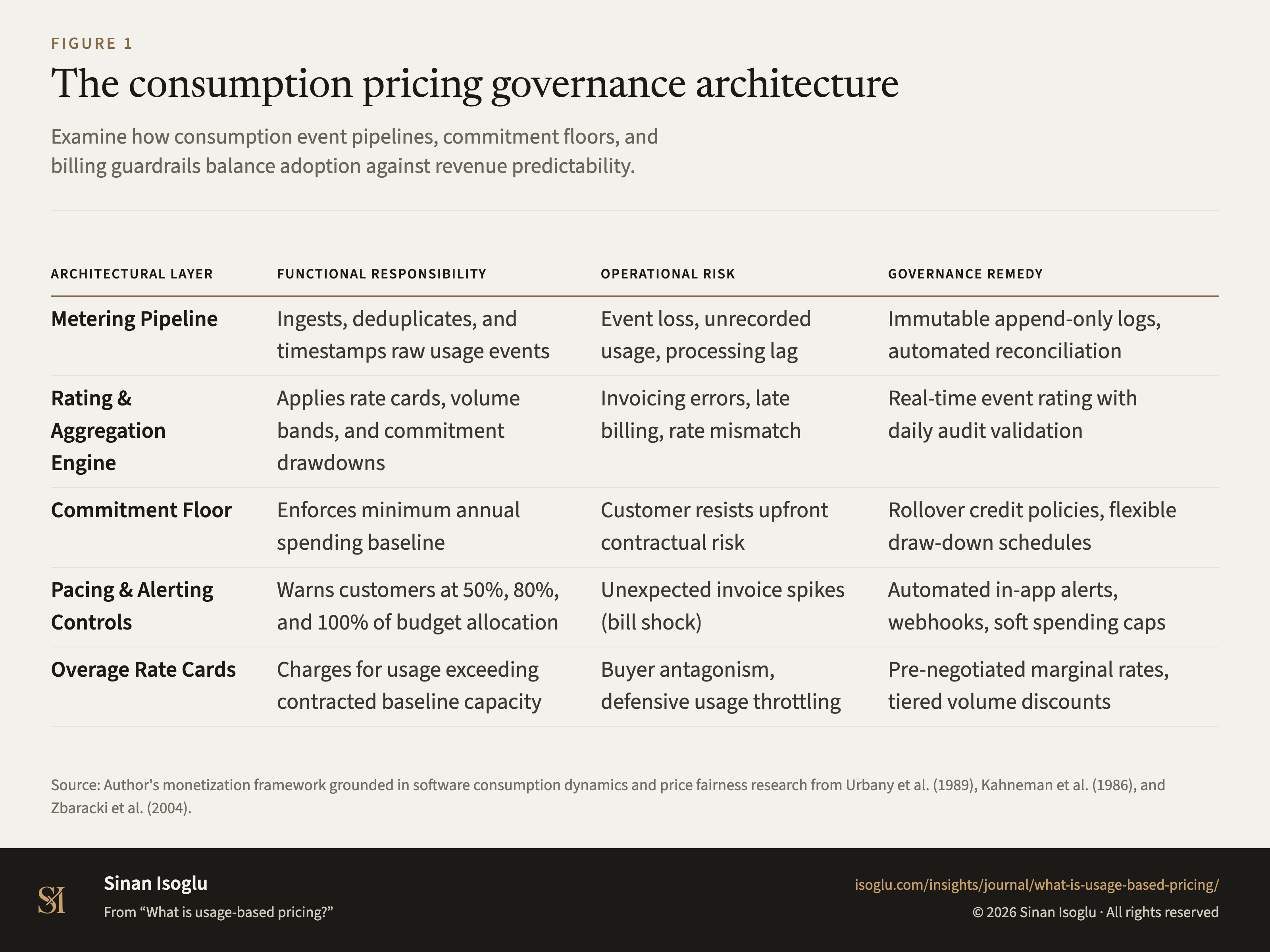
The consumption pricing governance architecture
Examine how consumption event pipelines, commitment floors, and billing guardrails balance adoption against revenue predictability.
Figure 1The consumption pricing governance architecture
| Architectural layer | Functional responsibility | Operational risk | Governance remedy |
|---|---|---|---|
| Metering Pipeline | Ingests, deduplicates, and timestamps raw usage events | Event loss, unrecorded usage, processing lag | Immutable append-only logs, automated reconciliation |
| Rating & Aggregation Engine | Applies rate cards, volume bands, and commitment drawdowns | Invoicing errors, late billing, rate mismatch | Real-time event rating with daily audit validation |
| Commitment Floor | Enforces minimum annual spending baseline | Customer resists upfront contractual risk | Rollover credit policies, flexible draw-down schedules |
| Pacing & Alerting Controls | Warns customers at 50%, 80%, and 100% of budget allocation | Unexpected invoice spikes (bill shock) | Automated in-app alerts, webhooks, soft spending caps |
| Overage Rate Cards | Charges for usage exceeding contracted baseline capacity | Buyer antagonism, defensive usage throttling | Pre-negotiated marginal rates, tiered volume discounts |
Swipe or scroll horizontally if the table is wider than your screen.
Source: Author's monetization framework grounded in software consumption dynamics and price fairness research from Urbany et al. (1989), Kahneman et al. (1986), and Zbaracki et al. (2004).
From the essay
Pricing & revenue architecture
What is usage-based pricing?
Usage-based pricing charges customers based on actual consumption. Balance variable revenue, metering architecture, and customer budget predictability.
Read the essayThis exhibit belongs to an essay: the numbers live here, the argument lives there.
Cite or embed
Contact
Bring the question you're working on.
Research, a guest lecture, or a commercial question.