Table 5From “What is revenue leakage? The gap between promised and collected revenue”
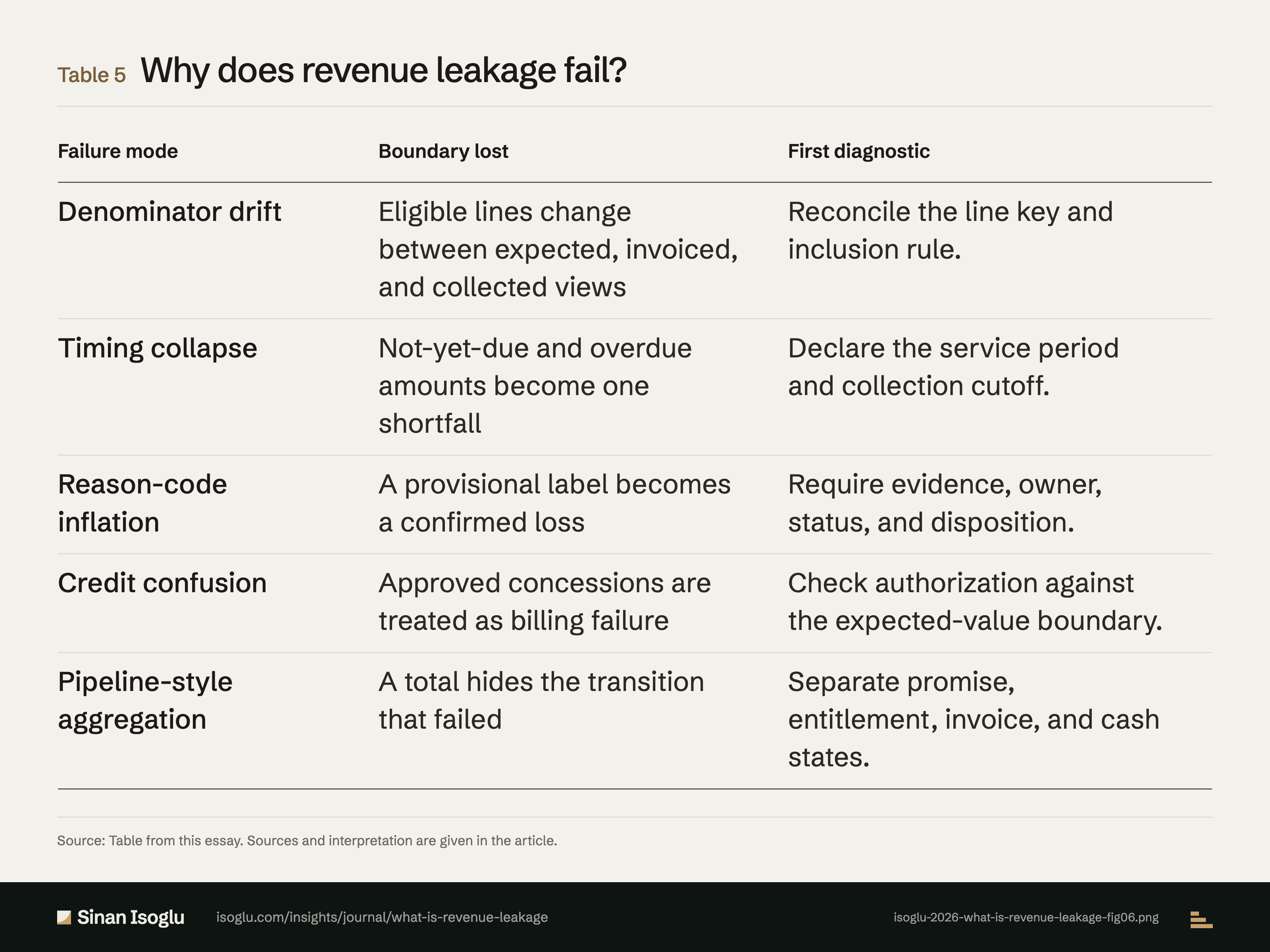
Why does revenue leakage fail?
Table 5Why does revenue leakage fail?
| Failure mode | Boundary lost | First diagnostic |
|---|---|---|
| Denominator drift | Eligible lines change between expected, invoiced, and collected views | Reconcile the line key and inclusion rule. |
| Timing collapse | Not-yet-due and overdue amounts become one shortfall | Declare the service period and collection cutoff. |
| Reason-code inflation | A provisional label becomes a confirmed loss | Require evidence, owner, status, and disposition. |
| Credit confusion | Approved concessions are treated as billing failure | Check authorization against the expected-value boundary. |
| Pipeline-style aggregation | A total hides the transition that failed | Separate promise, entitlement, invoice, and cash states. |
Swipe or scroll horizontally if the table is wider than your screen.
Source: Table from this essay. Sources and interpretation are given in the article.
From the essay
Pricing & revenue architecture
What is revenue leakage? The gap between promised and collected revenue
Revenue leakage is a reconciliation gap, not a synonym for discounting: name the expected value, invoice, cash, reason code, and recovery boundary.
Read the essayThis exhibit belongs to an essay: the numbers live here, the argument lives there.
Cite or embed
Related exhibits
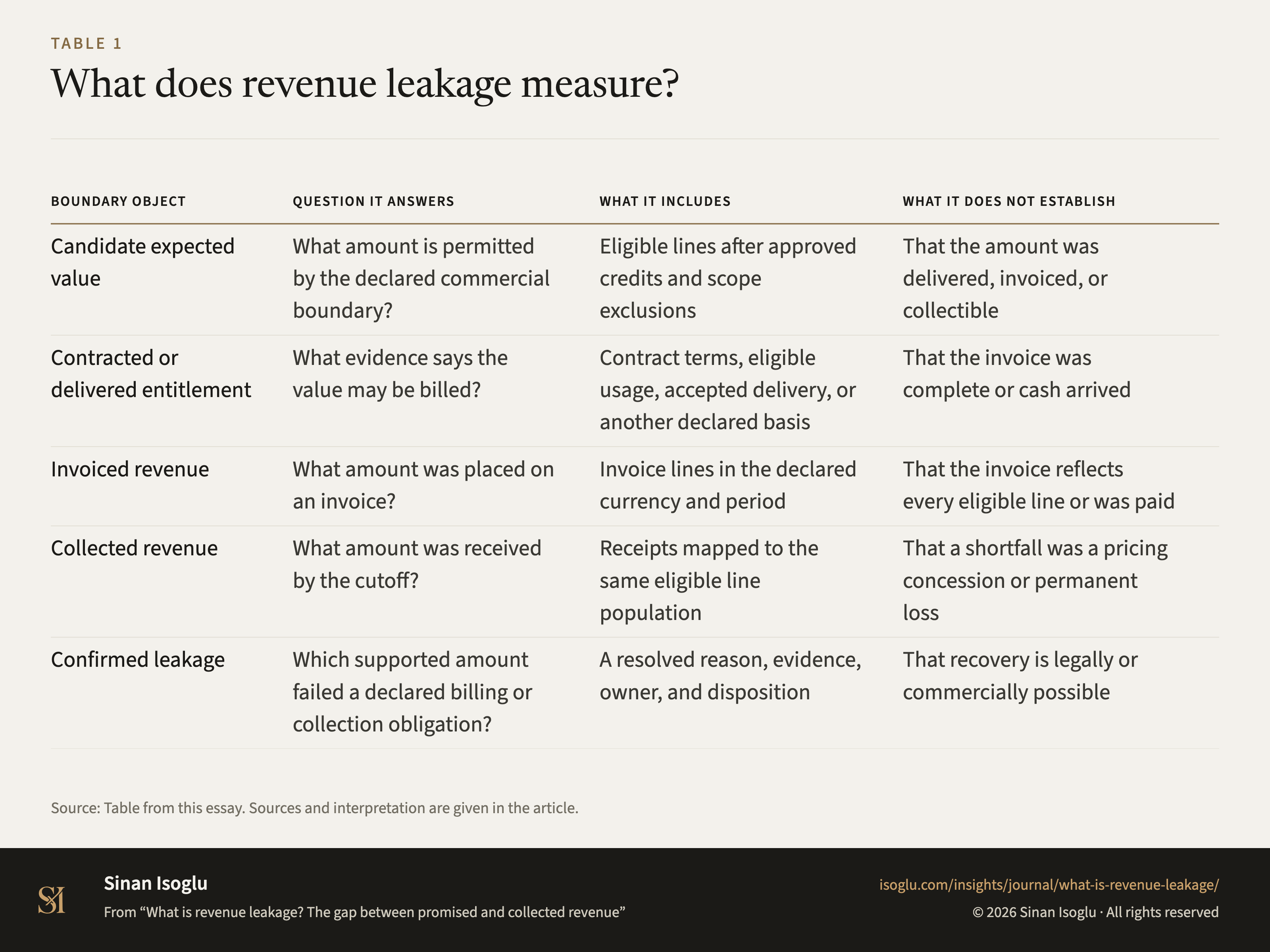
Table 1Table
What does revenue leakage measure?
What is revenue leakage? The gap between promised and collected revenue
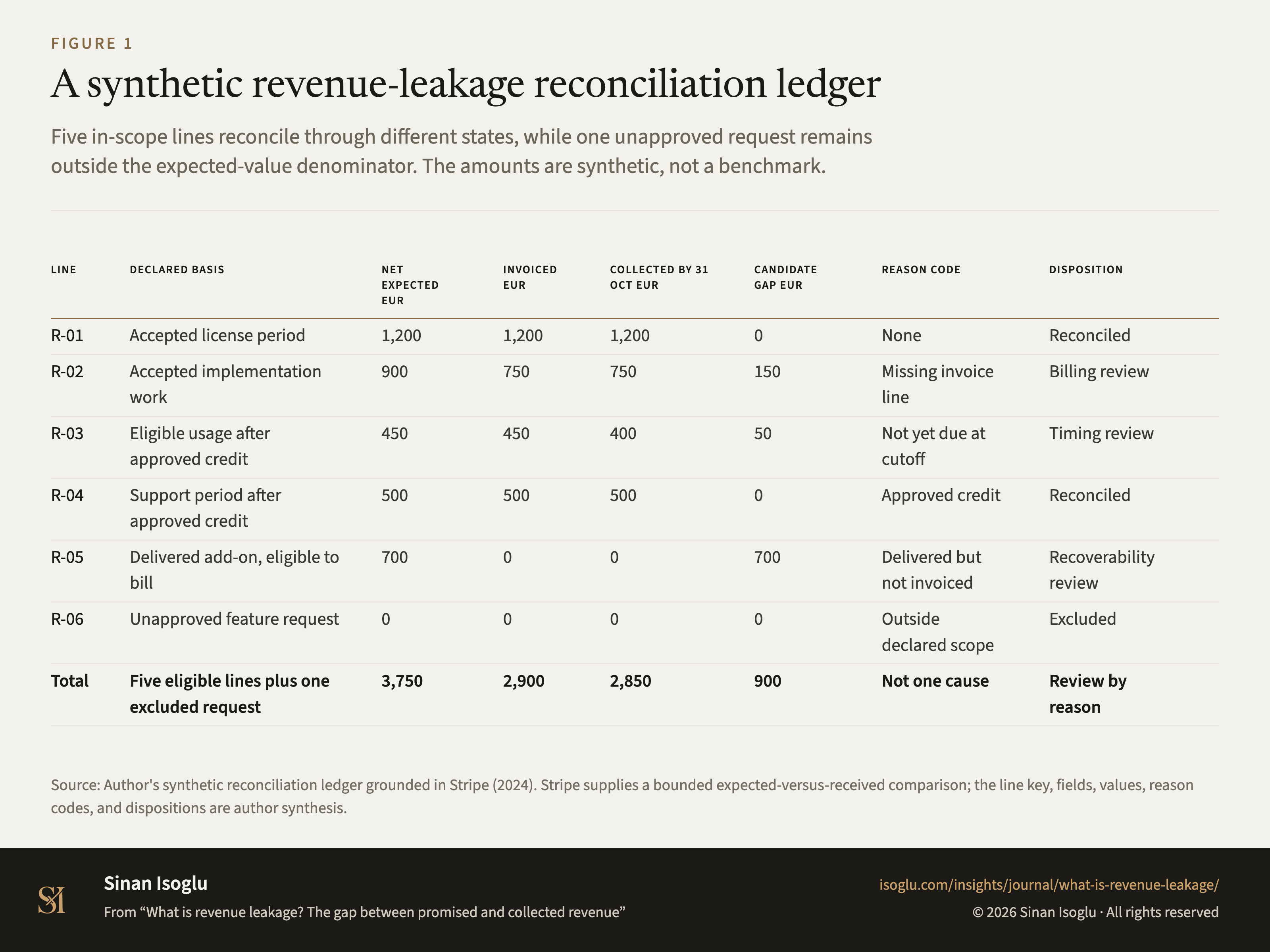
Figure 1Figure
A synthetic revenue-leakage reconciliation ledger
What is revenue leakage? The gap between promised and collected revenue
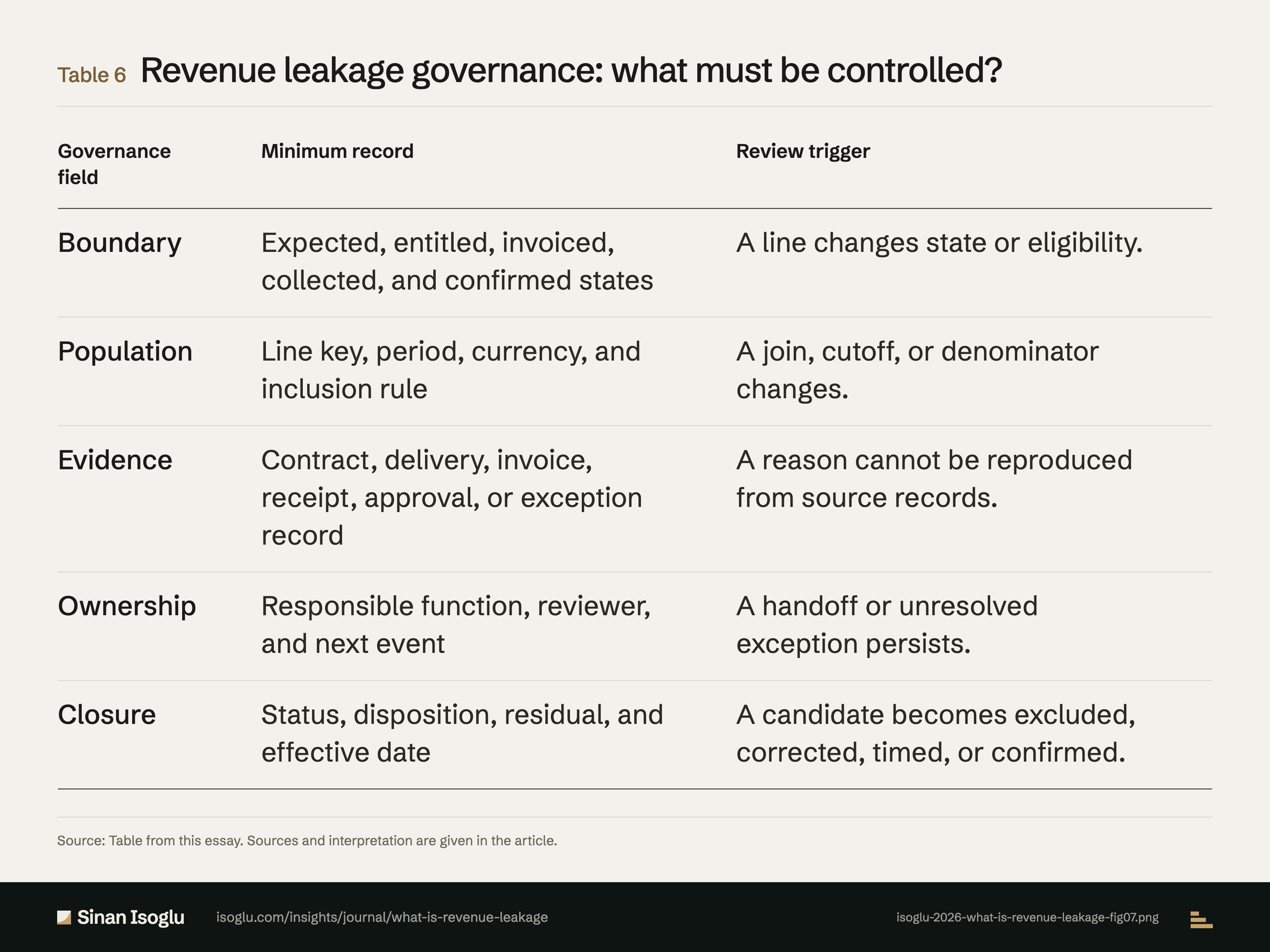
Table 6Table
Revenue leakage governance: what must be controlled?
What is revenue leakage? The gap between promised and collected revenue
Contact
Bring the question you're working on.
Research, a guest lecture, or a commercial question.