Table 4From “What is post-merger integration? M&A operational execution, synergy capture, and governance”
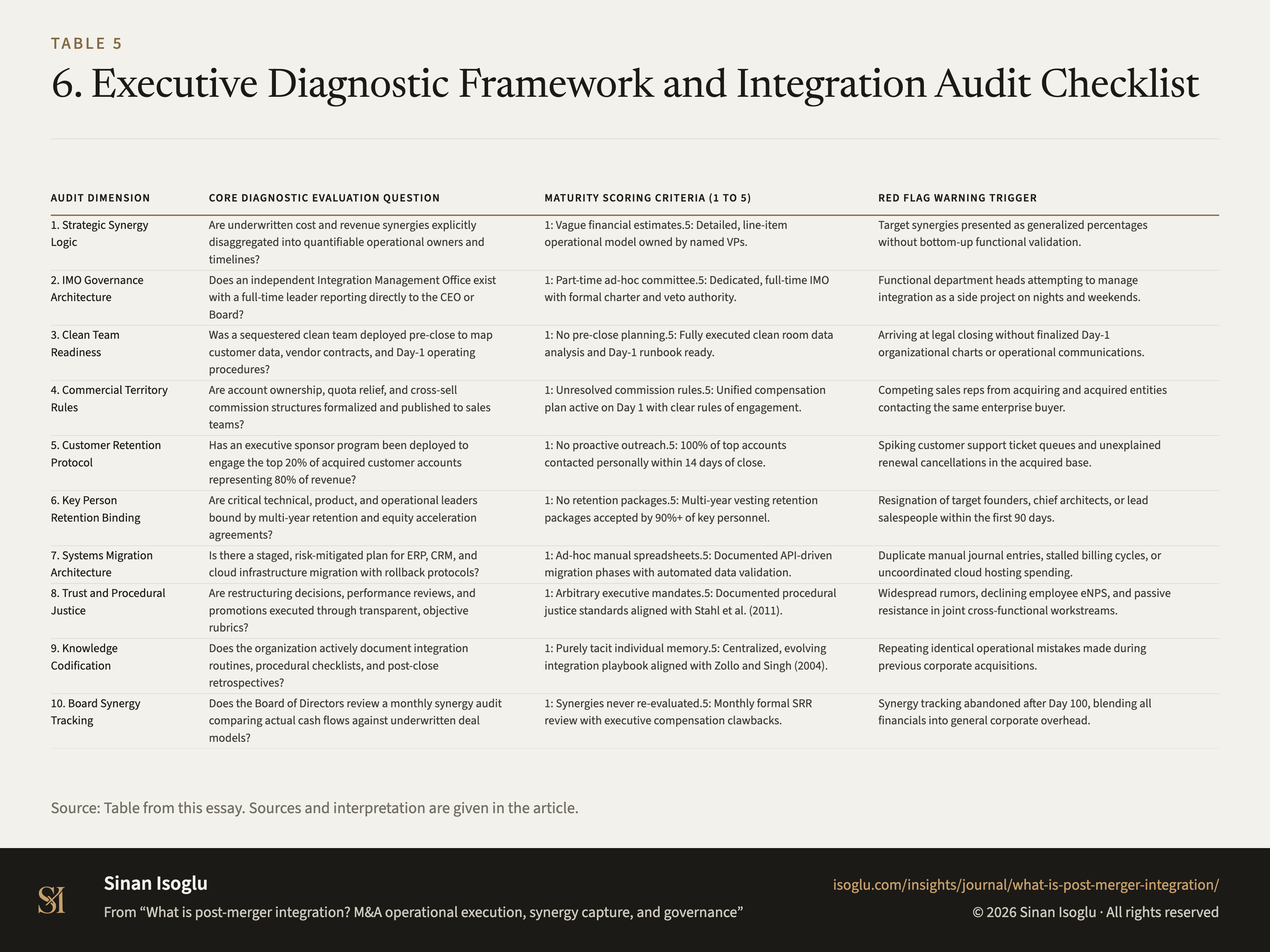
How do you stress-test integration readiness before signing?
Table 4How do you stress-test integration readiness before signing?
| Audit Dimension | Core Diagnostic Evaluation Question | Maturity Scoring Criteria (1 to 5) | Red Flag Warning Trigger |
|---|---|---|---|
| 1. Strategic Synergy Logic | Are underwritten cost and revenue synergies explicitly disaggregated into quantifiable operational owners and timelines? | 1: Vague financial estimates. 5: Detailed, line-item operational model owned by named VPs. | Target synergies presented as generalized percentages without bottom-up functional validation. |
| 2. IMO Governance Architecture | Does an independent Integration Management Office exist with a full-time leader reporting directly to the CEO or Board? | 1: Part-time ad-hoc committee. 5: Dedicated, full-time IMO with formal charter and veto authority. | Functional department heads attempting to manage integration as a side project on nights and weekends. |
| 3. Clean Team Readiness | Was a sequestered clean team deployed pre-close to map customer data, vendor contracts, and Day-1 operating procedures? | 1: No pre-close planning. 5: Fully executed clean room data analysis and Day-1 runbook ready. | Arriving at legal closing without finalized Day-1 organizational charts or operational communications. |
| 4. Commercial Territory Rules | Are account ownership, quota relief, and cross-sell commission structures formalized and published to sales teams? | 1: Unresolved commission rules. 5: Unified compensation plan active on Day 1 with clear rules of engagement. | Competing sales reps from acquiring and acquired entities contacting the same enterprise buyer. |
| 5. Customer Retention Protocol | Has an executive sponsor program been deployed to engage the top 20% of acquired customer accounts representing 80% of revenue? | 1: No proactive outreach. 5: 100% of top accounts contacted personally within 14 days of close. | Spiking customer support ticket queues and unexplained renewal cancellations in the acquired base. |
| 6. Key Person Retention Binding | Are critical technical, product, and operational leaders bound by multi-year retention and equity acceleration agreements? | 1: No retention packages. 5: Multi-year vesting retention packages accepted by 90%+ of key personnel. | Resignation of target founders, chief architects, or lead salespeople within the first 90 days. |
| 7. Systems Migration Architecture | Is there a staged, risk-mitigated plan for ERP, CRM, and cloud infrastructure migration with rollback protocols? | 1: Ad-hoc manual spreadsheets. 5: Documented API-driven migration phases with automated data validation. | Duplicate manual journal entries, stalled billing cycles, or uncoordinated cloud hosting spending. |
| 8. Trust and Procedural Justice | Are restructuring decisions, performance reviews, and promotions executed through transparent, objective rubrics? | 1: Arbitrary executive mandates. 5: Documented procedural justice standards aligned with Stahl et al. (2011). | Widespread rumors, declining employee eNPS, and passive resistance in joint cross-functional workstreams. |
| 9. Knowledge Codification | Does the organization actively document integration routines, procedural checklists, and post-close retrospectives? | 1: Purely tacit individual memory. 5: Centralized, evolving integration playbook aligned with Zollo and Singh (2004). | Repeating identical operational mistakes made during previous corporate acquisitions. |
| 10. Board Synergy Tracking | Does the Board of Directors review a monthly synergy audit comparing actual cash flows against underwritten deal models? | 1: Synergies never re-evaluated. 5: Monthly formal SRR review with executive compensation clawbacks. | Synergy tracking abandoned after Day 100, blending all financials into general corporate overhead. |
Swipe or scroll horizontally if the table is wider than your screen.
Source: Table from this essay. Sources and interpretation are given in the article.
From the essay
Go-to-market strategy
What is post-merger integration? M&A operational execution, synergy capture, and governance
Post-merger integration is the systematic alignment of operating models, technology, and commercial teams to capture deal synergies after an acquisition.
Read the essayThis exhibit belongs to an essay: the numbers live here, the argument lives there.
Cite or embed
Related exhibits
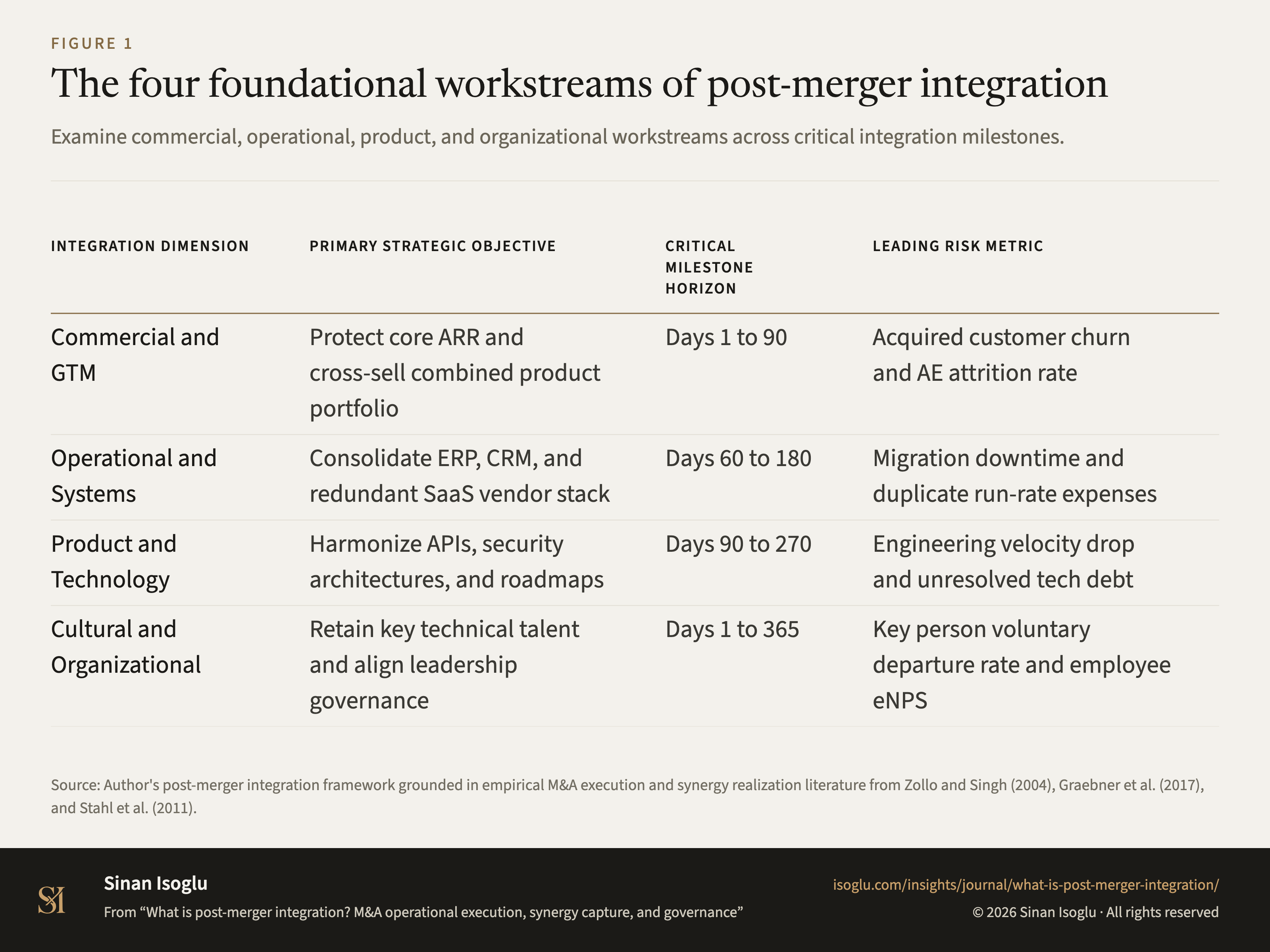
Figure 1Figure
The four foundational workstreams of post-merger integration
What is post-merger integration? M&A operational execution, synergy capture, and governance
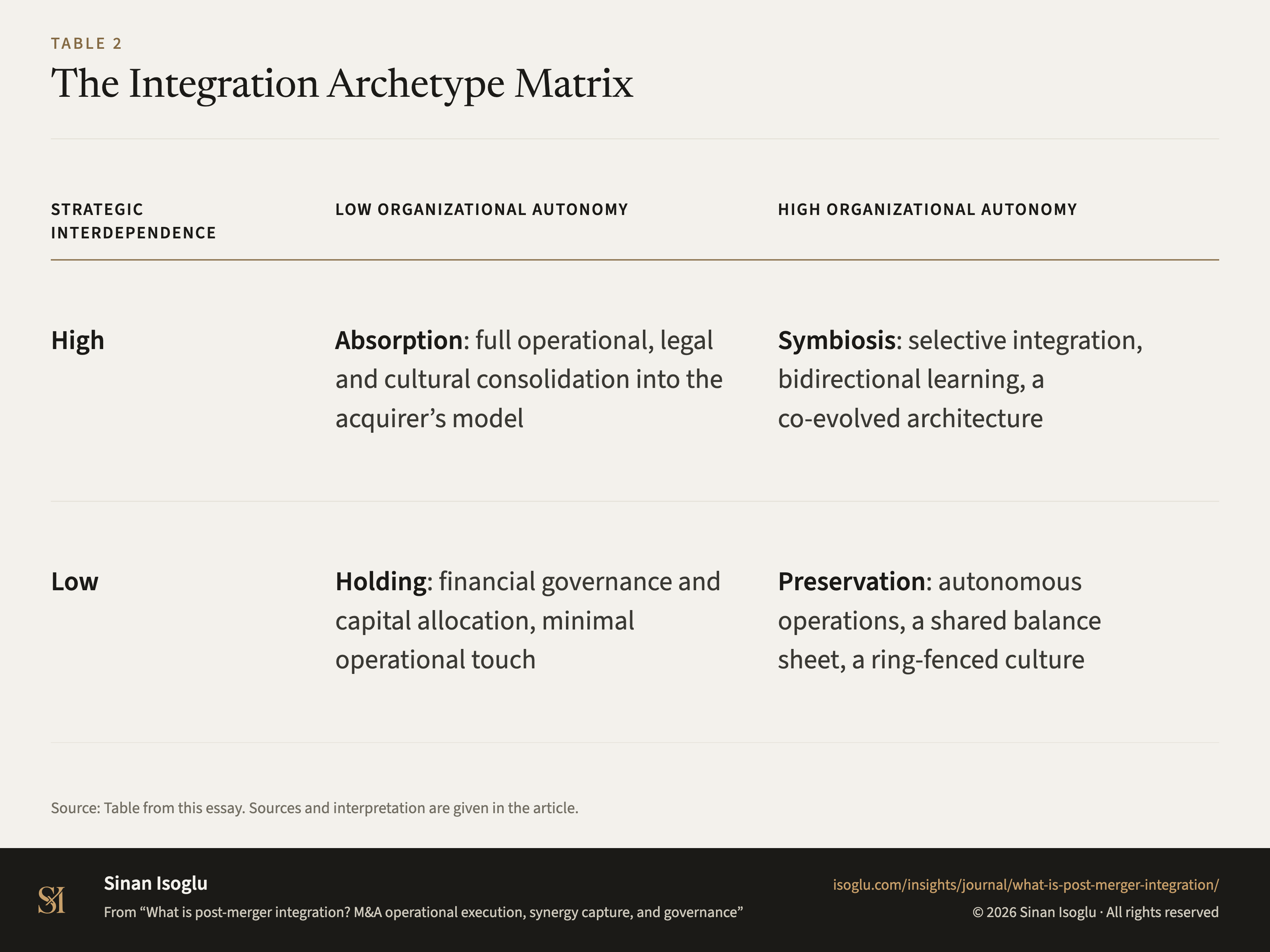
Table 1Table
The Integration Archetype Matrix
What is post-merger integration? M&A operational execution, synergy capture, and governance
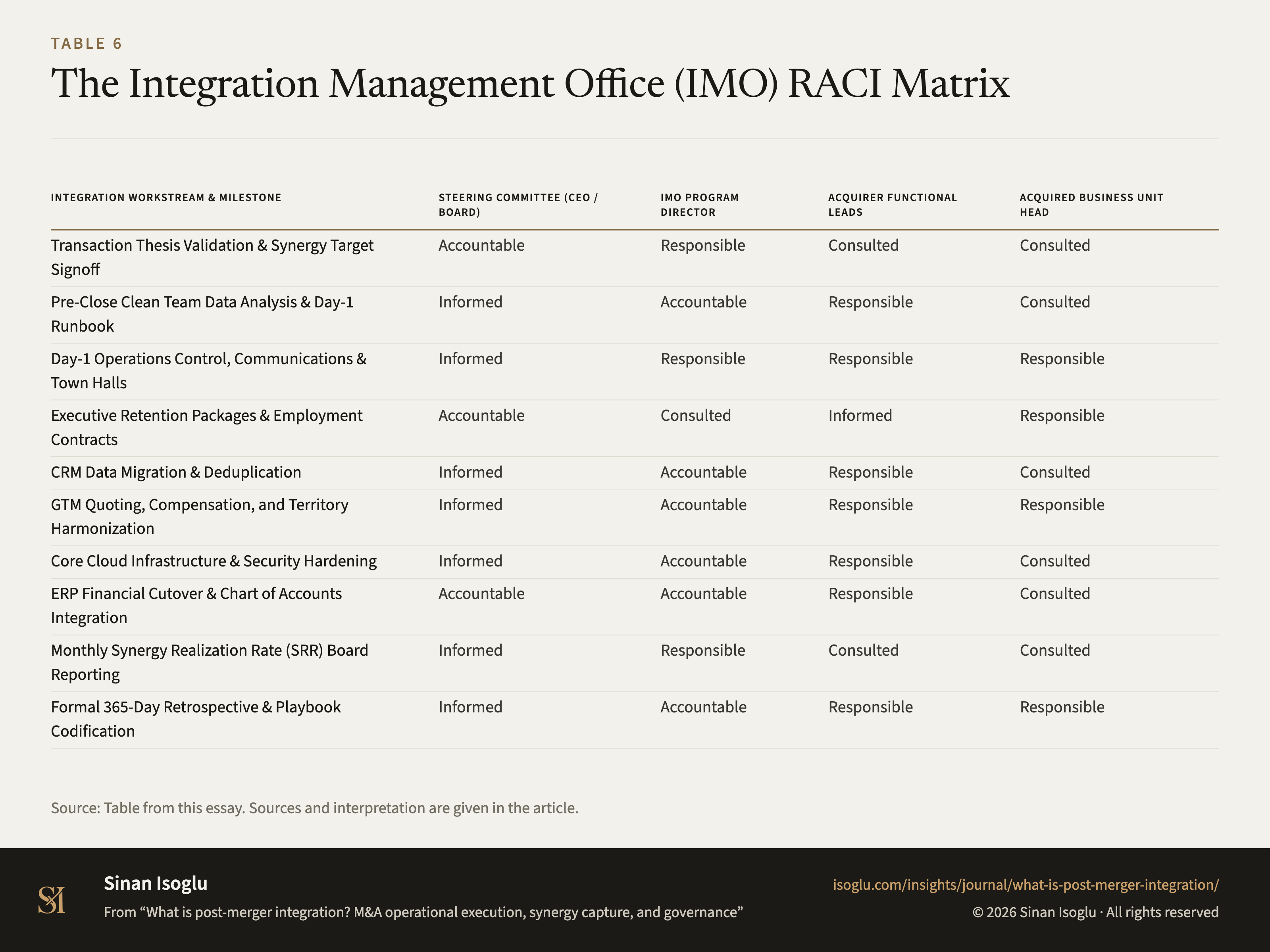
Table 5Table
The Integration Management Office (IMO) RACI Matrix
What is post-merger integration? M&A operational execution, synergy capture, and governance
Contact
Bring the question you're working on.
Research, a guest lecture, or a commercial question.