Figure 1From “What is lead routing? Assignment is a measurement boundary”
The lead-assignment worksheet
Keep eligibility, rule version, capacity, owner, response, reassignment, and outcome in one reviewable worksheet row.
Figure 1The lead-assignment worksheet
Source: Author's synthetic assignment worksheet grounded in Virtanen, Parvinen, and Rollins (2015), Friend, Curasi, Boles, and Bellenger (2014), and Friend, Ranjan, and Johnson (2019). The fields are prompts; the example values are illustrative, not benchmarks or service levels.
Source and evidence
Each line names a claim related to this exhibit, its source, and how it was checked.
- A V07-VPR-C2 Virtanen et al. classify leads as won, lost, or canceled, with canceled separate from a customer decision to purchase elsewhereVirtanen, Parvinen, and Rollins (2015), full-text receipt
- A V07-VPR-C3 Their study combines salesperson interviews, CRM analysis, and executive discussion and does not provide a general close-rate benchmark or individual lead explanationVirtanen, Parvinen, and Rollins (2015), full-text receipt
- A V07-FCB-C2 A buyer-side account is a distinct evidence layer from seller explanation, and the qualitative study is not a universal reason taxonomyFriend, Curasi, Boles, and Bellenger (2014), full-text receipt
- A V07-FRJ-C1 Friend, Ranjan, and Johnson describe failing fast as collecting prospect intent, interpreting it, and deciding whether to stop pursuing earlyFriend, Ranjan, and Johnson (2019), full-text receipt
- B V07-OWN-C1 Lead routing is the rule that assigns an eligible lead to an owner or queue under a declared population and time boundaryAuthor framework
- B V07-OWN-C2 Lead capture, qualification, routing, follow-up, reassignment, and outcome are different process objectsAuthor taxonomy
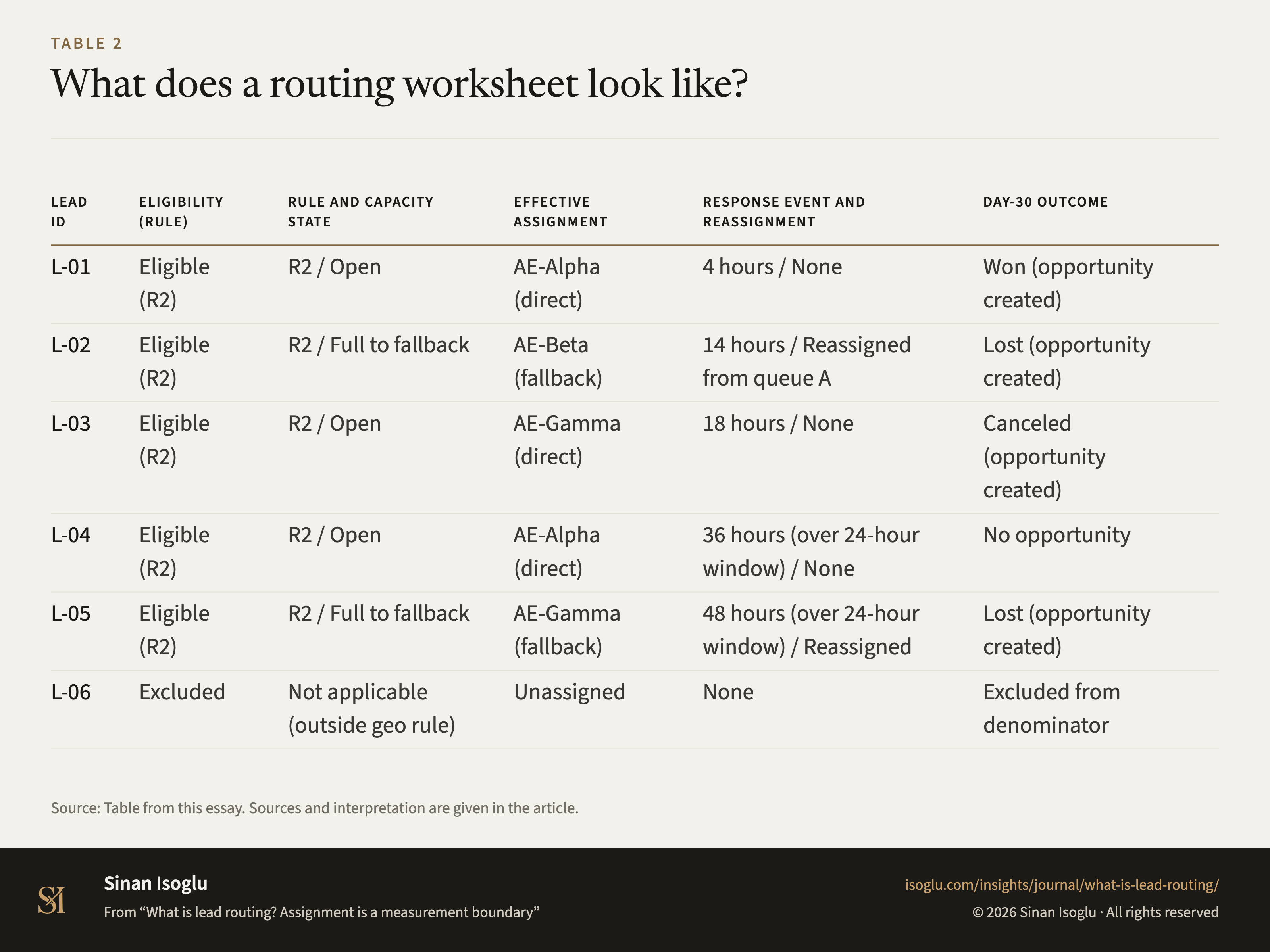
- B V07-OWN-C4 The synthetic six-lead ledger produces 100% assignment coverage, 60% response completion, 80% opportunity creation, 20% wins per eligible lead, and 25% wins per created opportunityAuthor synthetic arithmetic
Grades: A, verified against the printed page of the primary source · B, primary source, text layer only · C, authoritative secondary · D, reported.
From the essay
Revenue operations & AI
What is lead routing? Assignment is a measurement boundary
Lead routing assigns an eligible lead to an owner or queue. The rule, capacity state, response event, and outcome window make it reviewable.
Read the essayThis exhibit belongs to an essay: the numbers live here, the argument lives there.
Cite or embed
Related exhibits
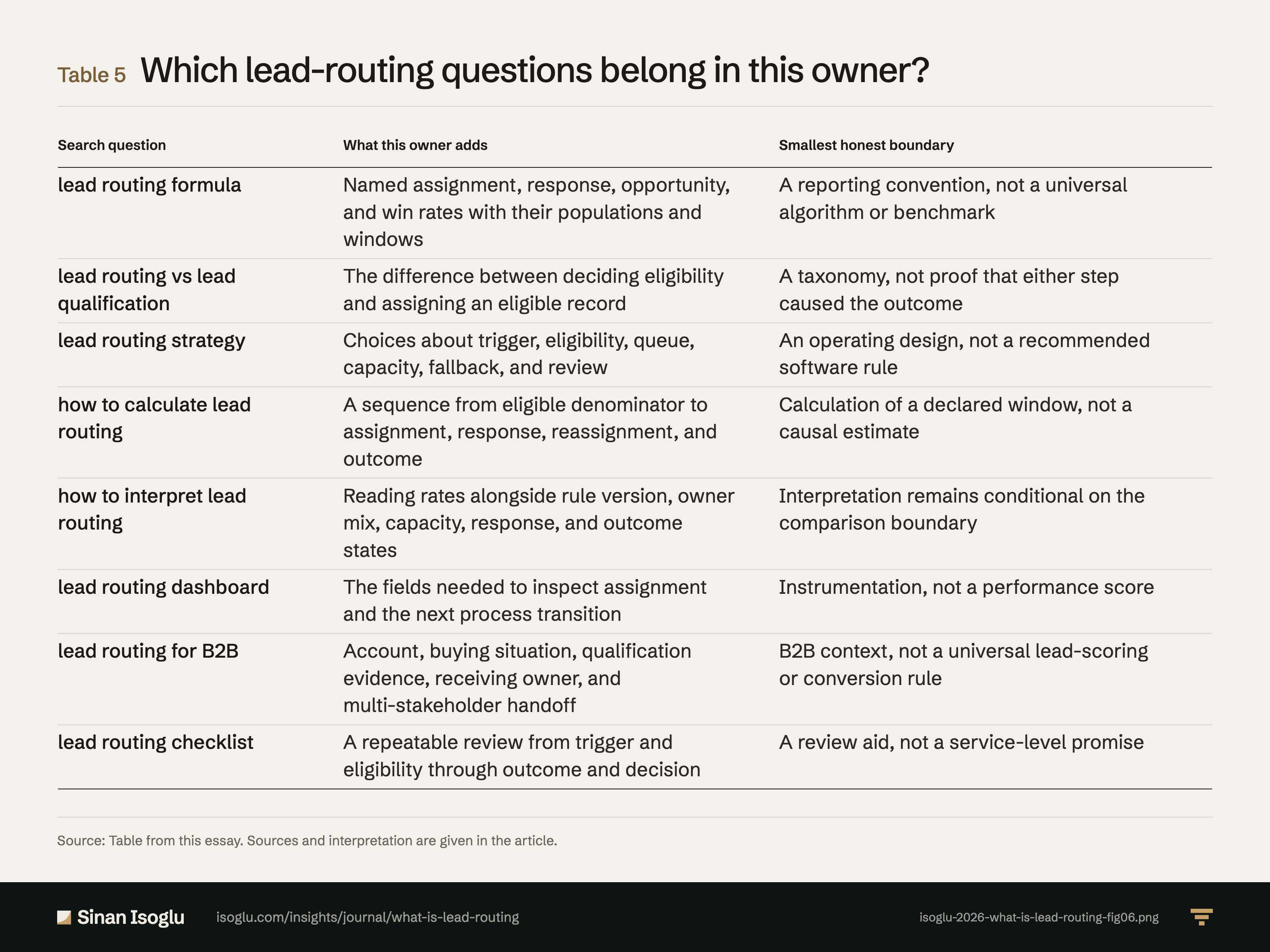
Table 5Table
Which lead-routing questions belong in this owner?
What is lead routing? Assignment is a measurement boundary
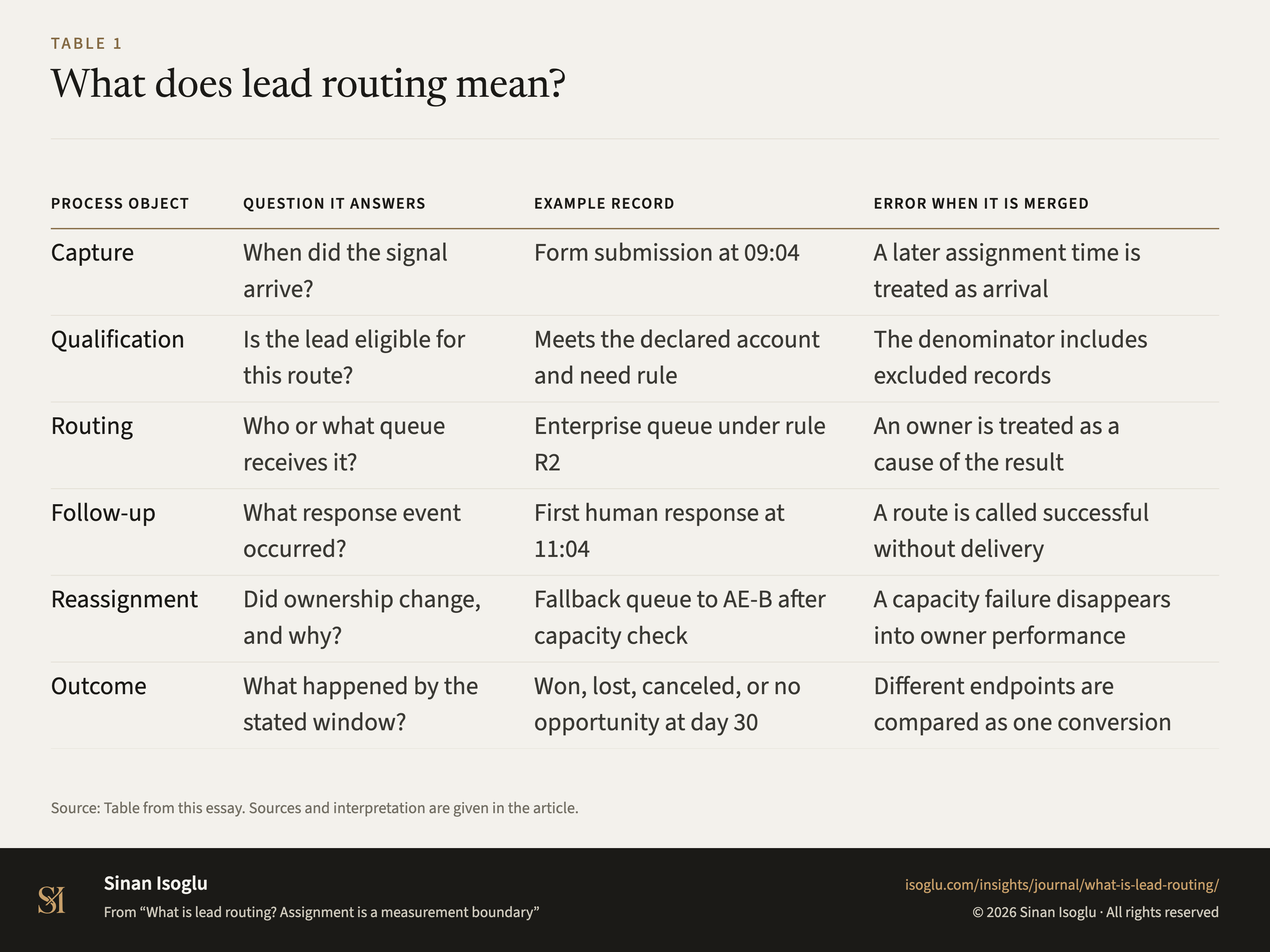
Table 1Table
What does lead routing mean?
What is lead routing? Assignment is a measurement boundary
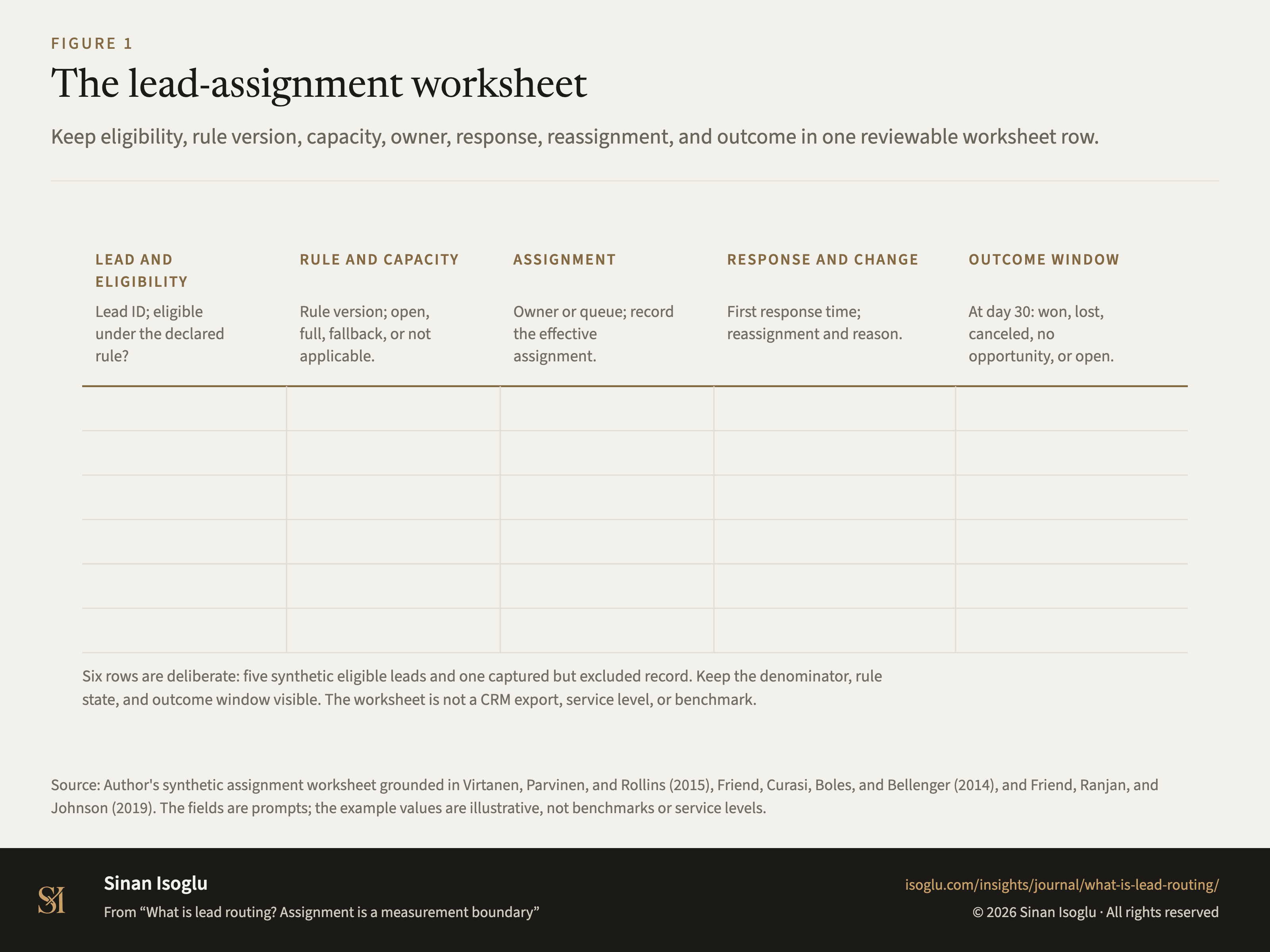
Table 2Table
What do integrated lead processes add to routing?
What is lead routing? Assignment is a measurement boundary
Contact
Bring the question you're working on.
Research, a guest lecture, or a commercial question.