Figure 1From “What is data lineage? The transformations behind a result”
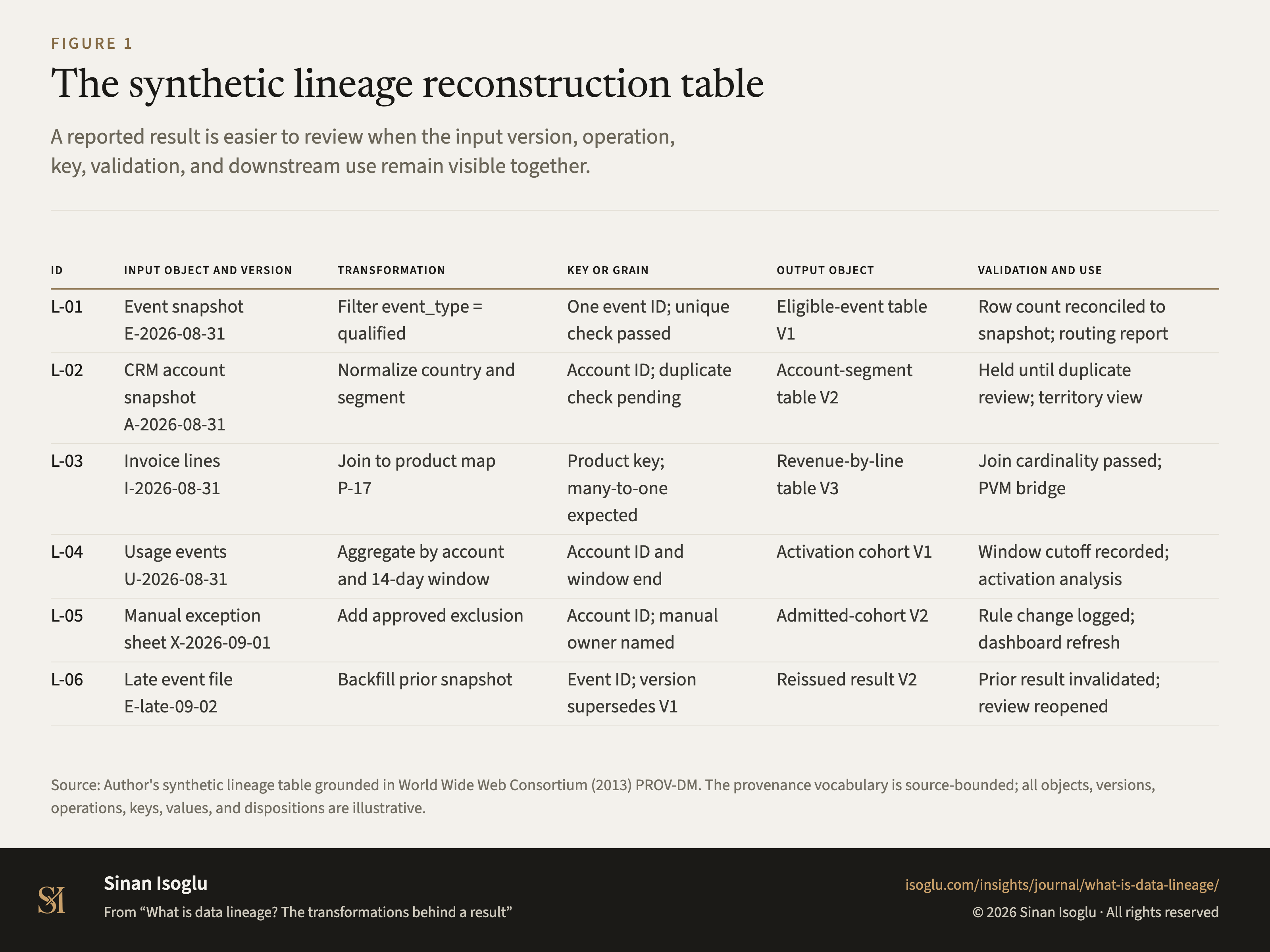
The synthetic lineage reconstruction table
A reported result is easier to review when the input version, operation, key, validation, and downstream use remain visible together.
Figure 1The synthetic lineage reconstruction table
| ID | Input object and version | Transformation | Key or grain | Output object | Validation and use |
|---|---|---|---|---|---|
| L-01 | Event snapshot E-2026-08-31 | Filter event_type = qualified | One event ID; unique check passed | Eligible-event table V1 | Row count reconciled to snapshot; routing report |
| L-02 | CRM account snapshot A-2026-08-31 | Normalize country and segment | Account ID; duplicate check pending | Account-segment table V2 | Held until duplicate review; territory view |
| L-03 | Invoice lines I-2026-08-31 | Join to product map P-17 | Product key; many-to-one expected | Revenue-by-line table V3 | Join cardinality passed; PVM bridge |
| L-04 | Usage events U-2026-08-31 | Aggregate by account and 14-day window | Account ID and window end | Activation cohort V1 | Window cutoff recorded; activation analysis |
| L-05 | Manual exception sheet X-2026-09-01 | Add approved exclusion | Account ID; manual owner named | Admitted-cohort V2 | Rule change logged; dashboard refresh |
| L-06 | Late event file E-late-09-02 | Backfill prior snapshot | Event ID; version supersedes V1 | Reissued result V2 | Prior result invalidated; review reopened |
Swipe or scroll horizontally if the table is wider than your screen.
Source: Author's synthetic lineage table grounded in World Wide Web Consortium (2013) PROV-DM. The provenance vocabulary is source-bounded; all objects, versions, operations, keys, values, and dispositions are illustrative.
Source and evidence
Each line names a claim related to this exhibit, its source, and how it was checked.
- A W3C13-C1 "Provenance is information about entities, activities, and people involved in producing a piece of data or thing", used to assess its quality, reliability or trustworthinessW3C. (2013). PROV-DM The PROV Data Model captured 2026-09-06
- A W3C13-C3 The model is organised in six components, among them "derivations of entities from entities", alongside generation, usage, association and attributionW3C. (2013). PROV-DM The PROV Data Model captured 2026-09-06
- A W3C13-C5 Provenance is input to a judgement, not a warrant: information "which can be used to form assessments about its quality, reliability or trustworthiness". It certifies nothingW3C. (2013). PROV-DM The PROV Data Model captured 2026-09-06
- B R03-OWN-C1 Data lineage is a trace from a declared output or decision back through inputs, transformations, joins, filters, aggregations, and versionsAuthor framework grounded in W3C13-C1 to W3C13-C4
- B R03-OWN-C3 A lineage record must declare input and output dataset versions, operation, timestamp, owner or process, and the decision or field that consumes the outputAuthor framework
- B R03-OWN-C4 A snapshot is a time-bounded observation and must not be silently treated as the same thing as an event stream or current tableAuthor data rule
- B R03-OWN-C8 The synthetic lineage table contains six illustrative edges and no production dataset, customer record, or observed business resultAuthor synthetic object
- B R03-OWN-C9 A lineage review should preserve the input, operation, output, validation, exception, and downstream-use fields togetherAuthor operating framework
Grades: A, verified against the printed page of the primary source · B, primary source, text layer only · C, authoritative secondary · D, reported.
From the essay
From the research bench
What is data lineage? The transformations behind a result
Data lineage traces a reported result through inputs, joins, filters, and transformations. Name every version before calling a number reproducible.
Read the essayThis exhibit belongs to an essay: the numbers live here, the argument lives there.
Cite or embed
Related exhibits
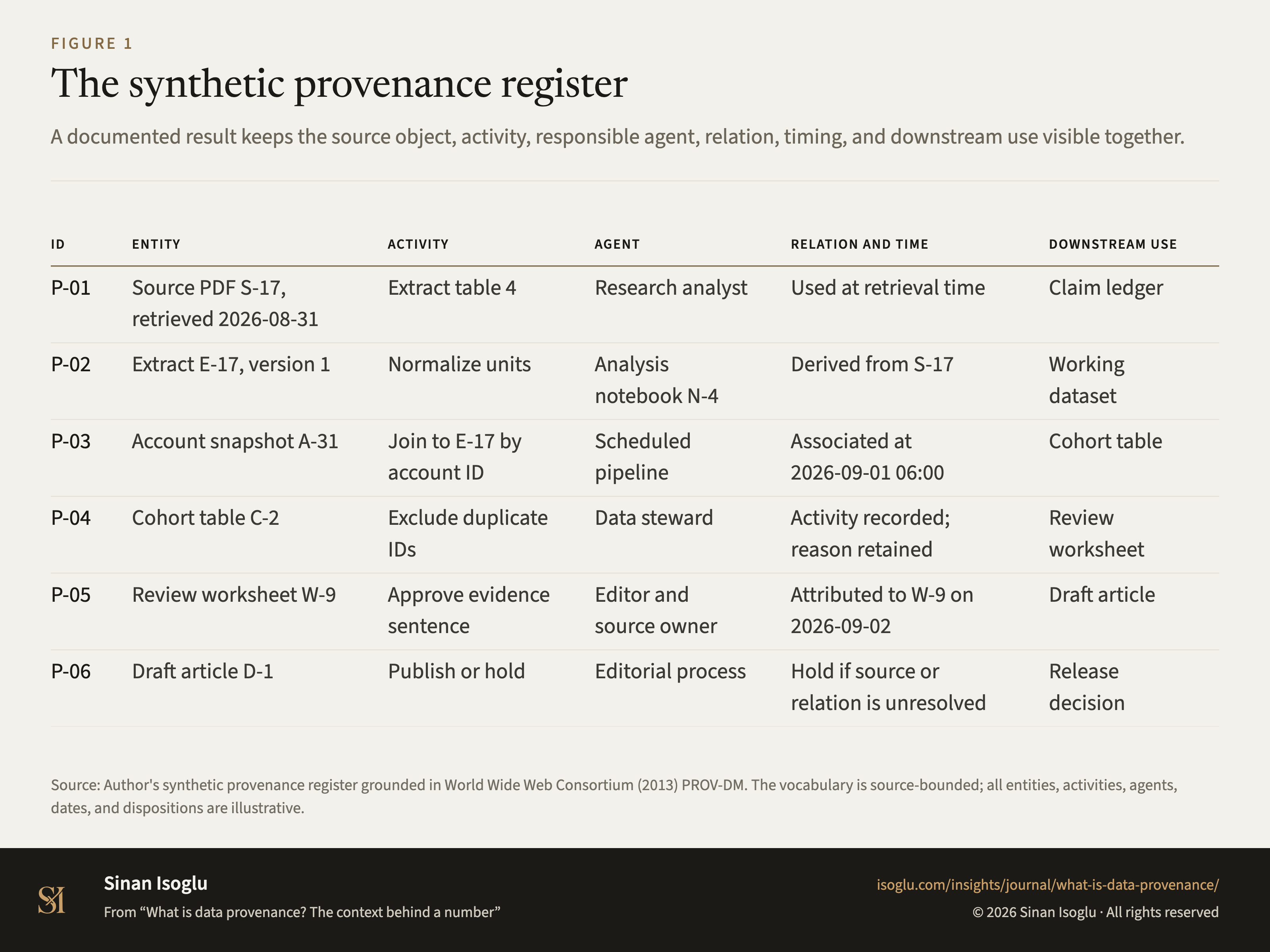
Figure 1Figure
The synthetic provenance register
What is data provenance? The context behind a number
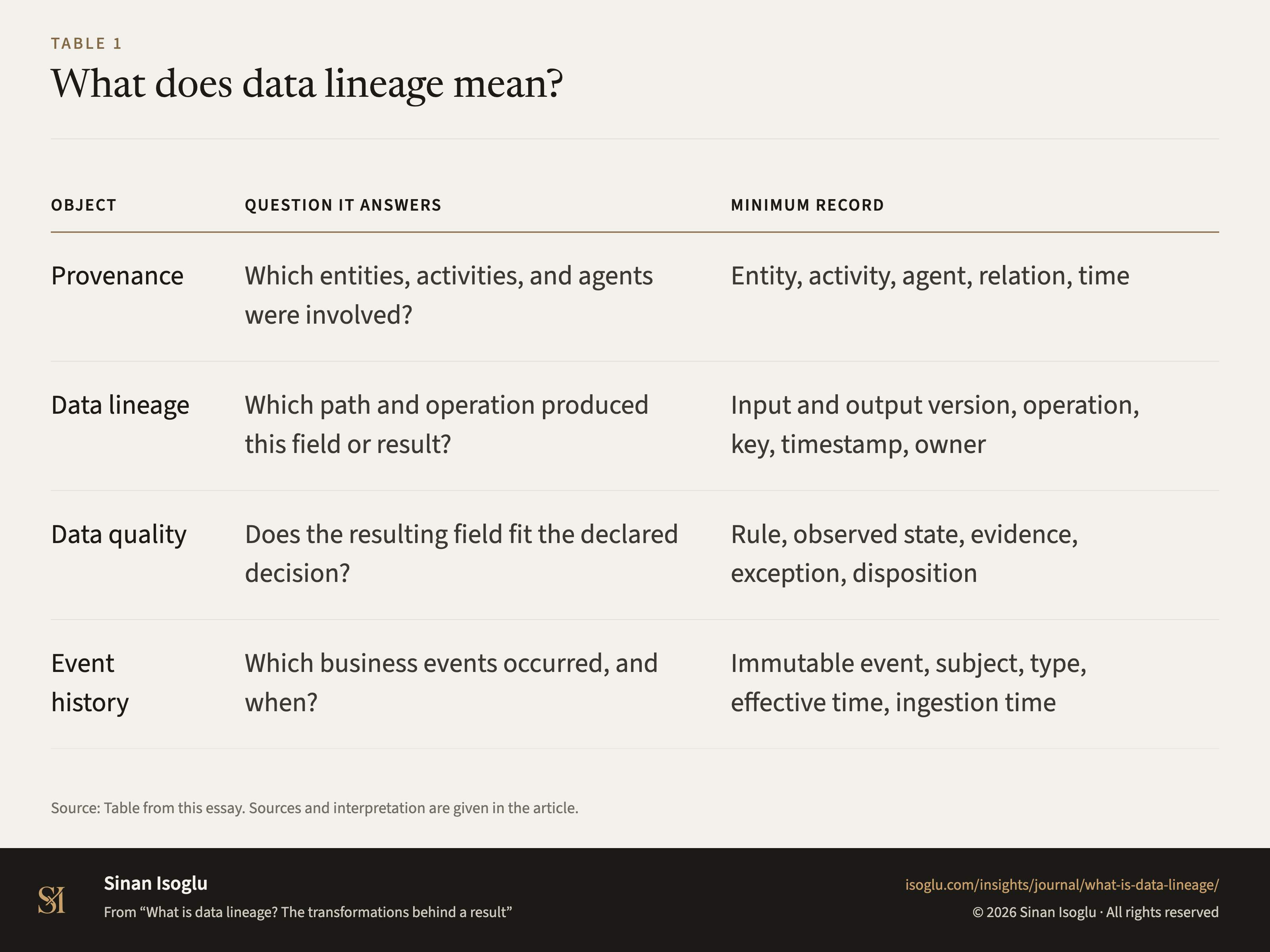
Table 1Table
What does data lineage mean?
What is data lineage? The transformations behind a result
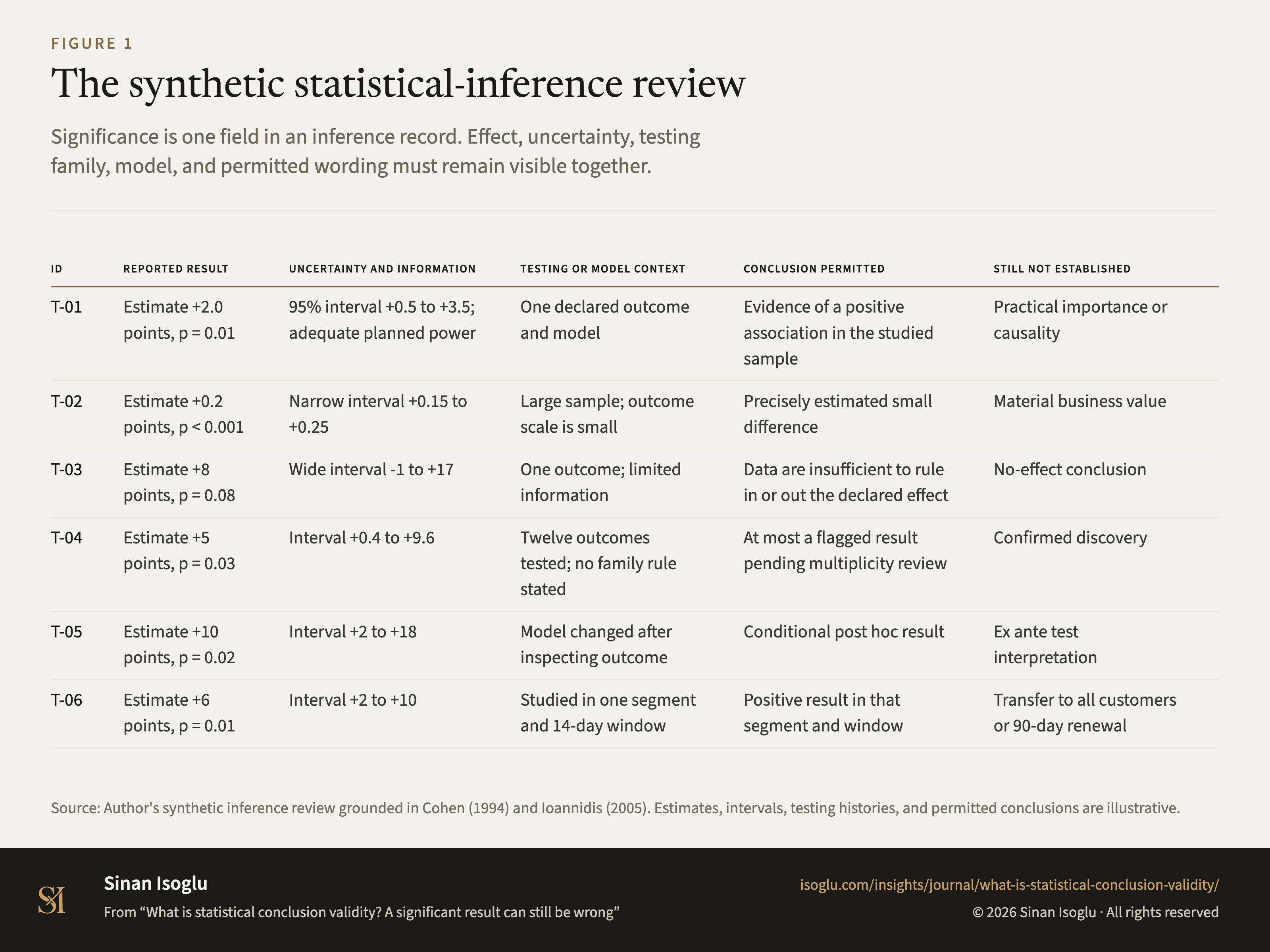
Figure 1Figure
The synthetic statistical-inference review
What is statistical conclusion validity? A significant result can still be wrong
Contact
Bring the question you're working on.
Research, a guest lecture, or a commercial question.