Table 5From “What is a revenue process? The handoffs that make the funnel measurable”
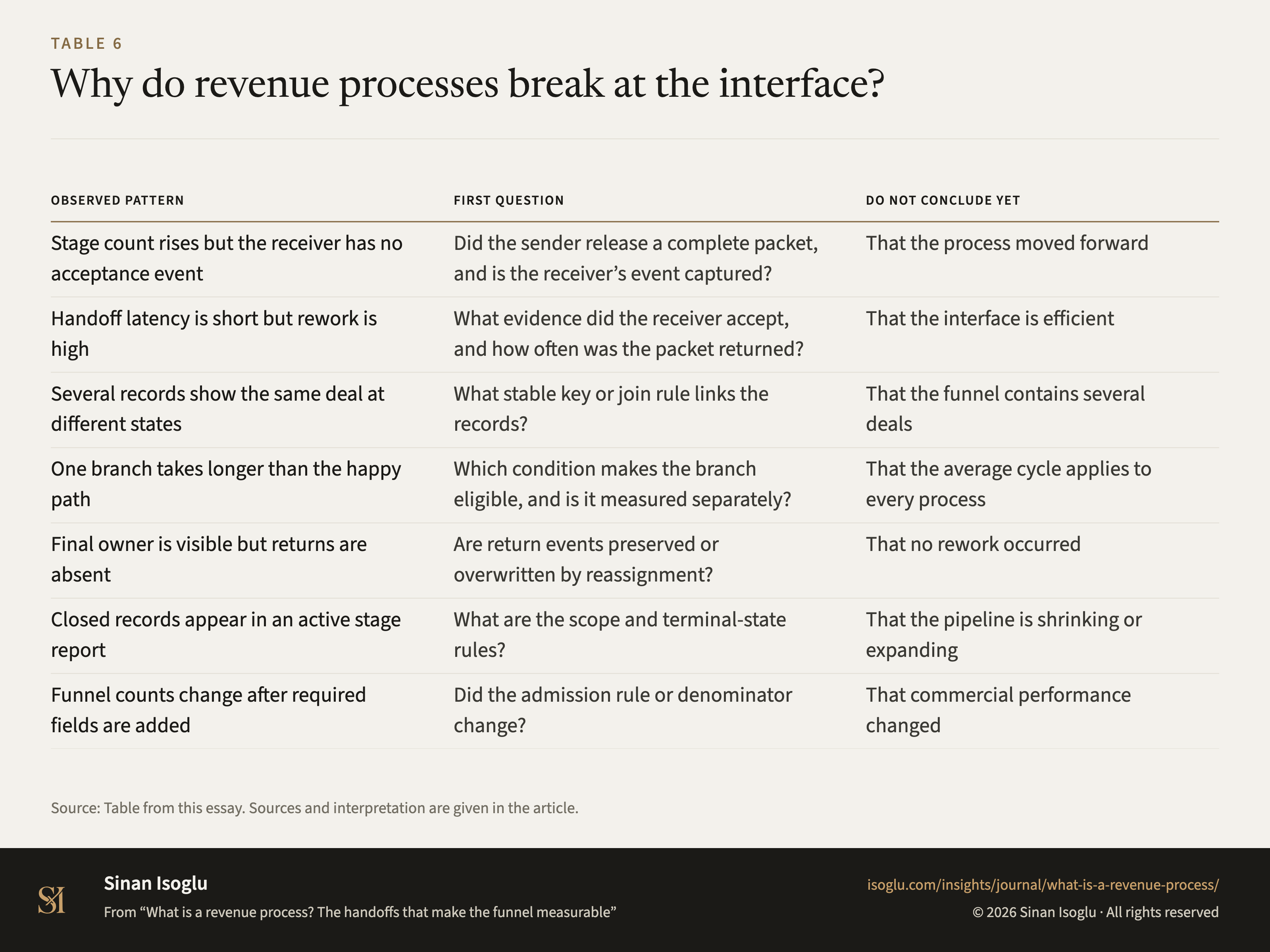
Why do revenue processes break at the interface?
Table 5Why do revenue processes break at the interface?
| Observed pattern | First question | Do not conclude yet |
|---|---|---|
| Stage count rises but the receiver has no acceptance event | Did the sender release a complete packet, and is the receiver's event captured? | That the process moved forward |
| Handoff latency is short but rework is high | What evidence did the receiver accept, and how often was the packet returned? | That the interface is efficient |
| Several records show the same deal at different states | What stable key or join rule links the records? | That the funnel contains several deals |
| One branch takes longer than the happy path | Which condition makes the branch eligible, and is it measured separately? | That the average cycle applies to every process |
| Final owner is visible but returns are absent | Are return events preserved or overwritten by reassignment? | That no rework occurred |
| Closed records appear in an active stage report | What are the scope and terminal-state rules? | That the pipeline is shrinking or expanding |
| Funnel counts change after required fields are added | Did the admission rule or denominator change? | That commercial performance changed |
Swipe or scroll horizontally if the table is wider than your screen.
Source: Table from this essay. Sources and interpretation are given in the article.
From the essay
Revenue operations & AI
What is a revenue process? The handoffs that make the funnel measurable
A revenue process is a sequence of states, decisions, and handoffs with evidence, owners, acceptance events, and outcomes.
Read the essayThis exhibit belongs to an essay: the numbers live here, the argument lives there.
Cite or embed
Related exhibits
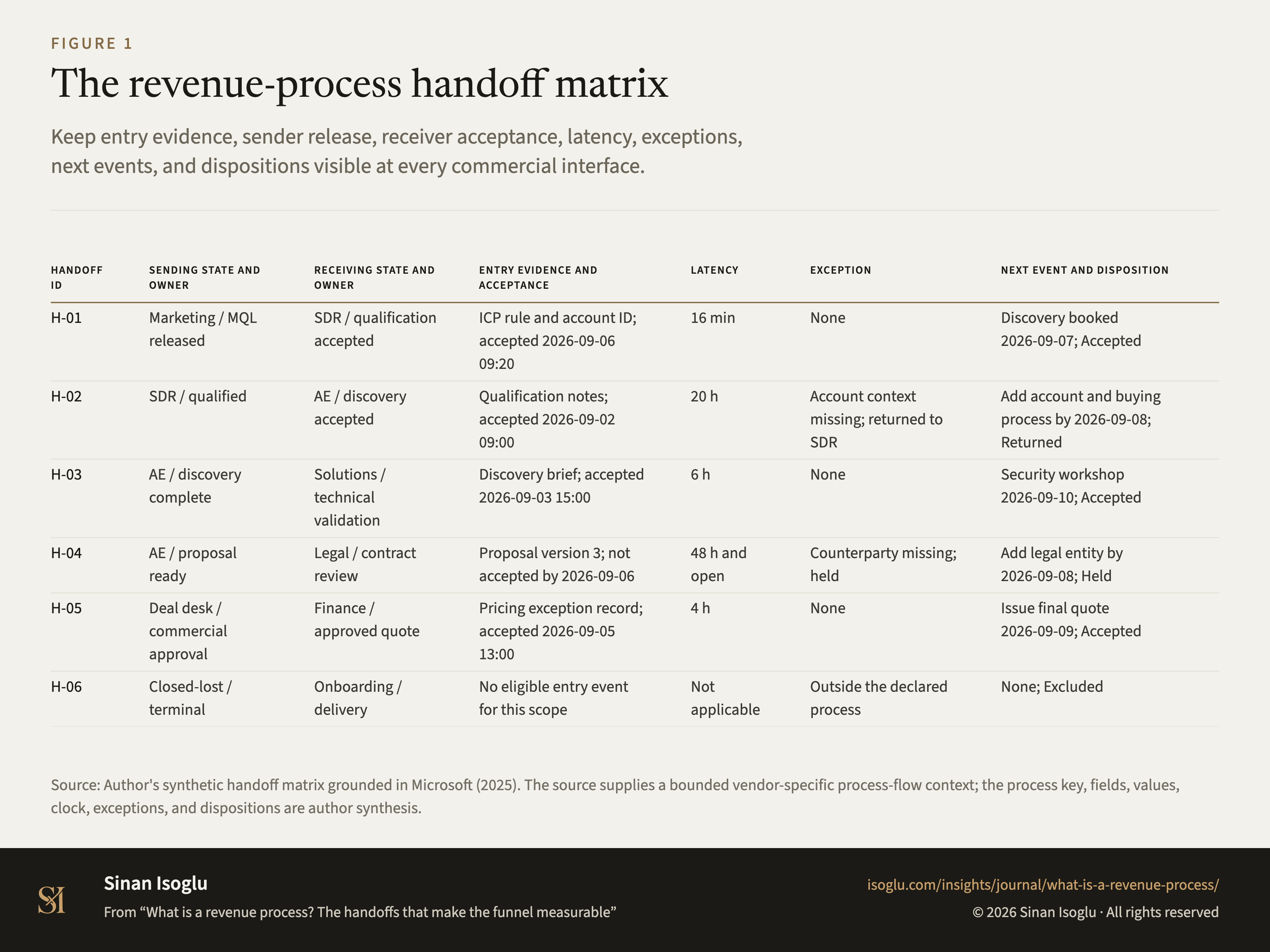
Figure 1Figure
The revenue-process handoff matrix
What is a revenue process? The handoffs that make the funnel measurable
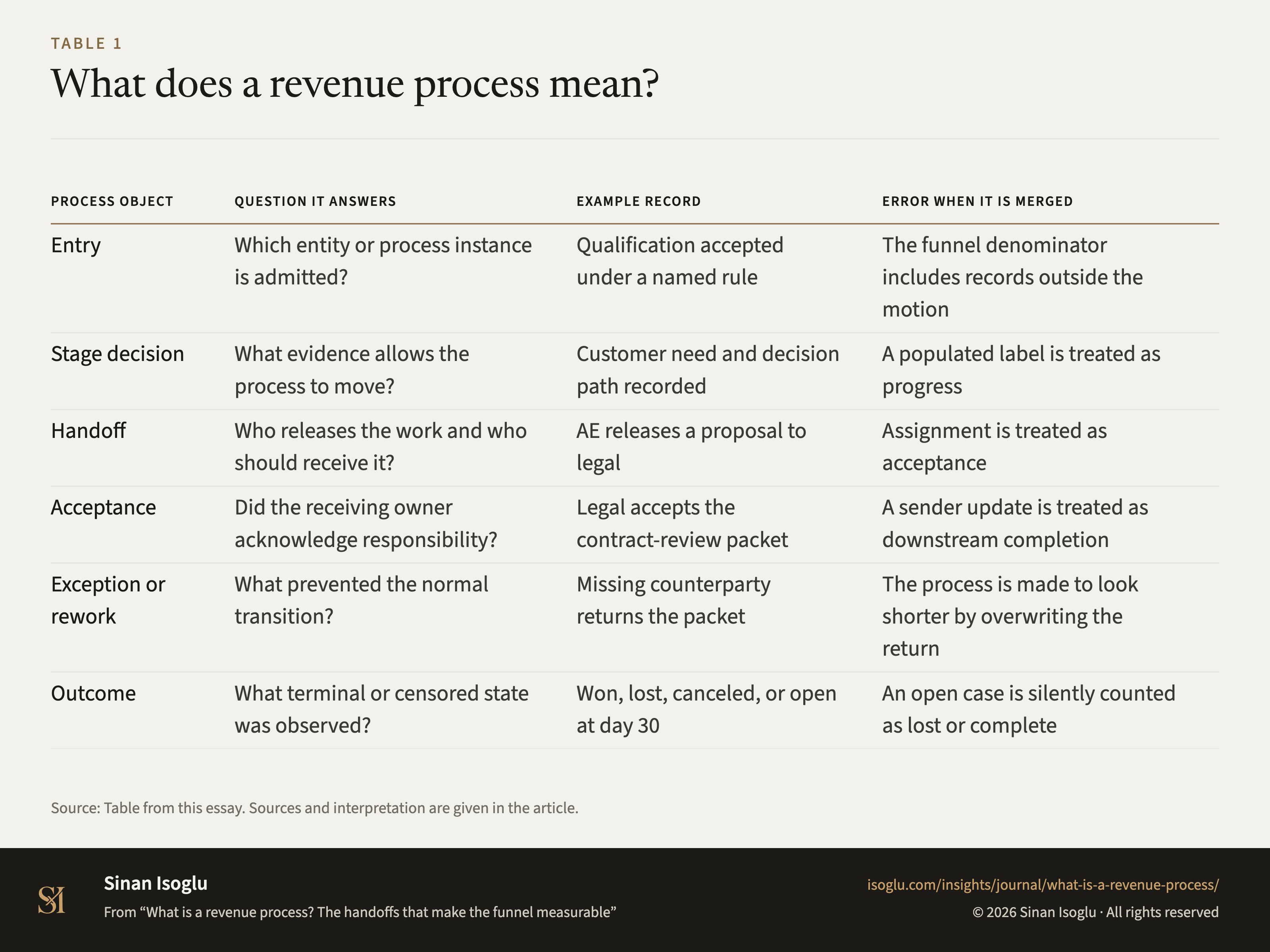
Table 1Table
What does a revenue process mean?
What is a revenue process? The handoffs that make the funnel measurable
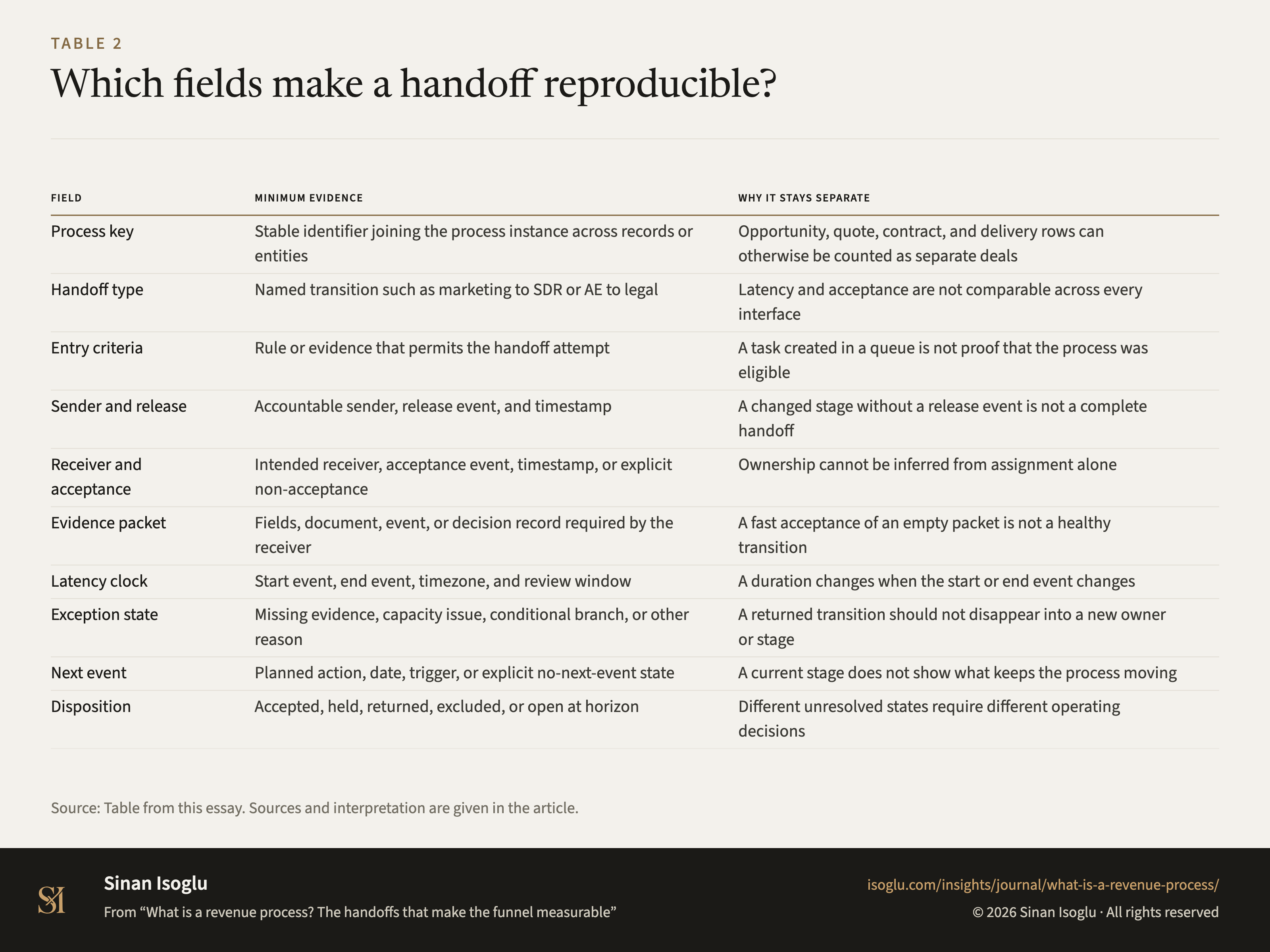
Table 2Table
Which fields make a handoff reproducible?
What is a revenue process? The handoffs that make the funnel measurable
Contact
Bring the question you're working on.
Research, a guest lecture, or a commercial question.