Table 3From “What is a revenue process? The handoffs that make the funnel measurable”
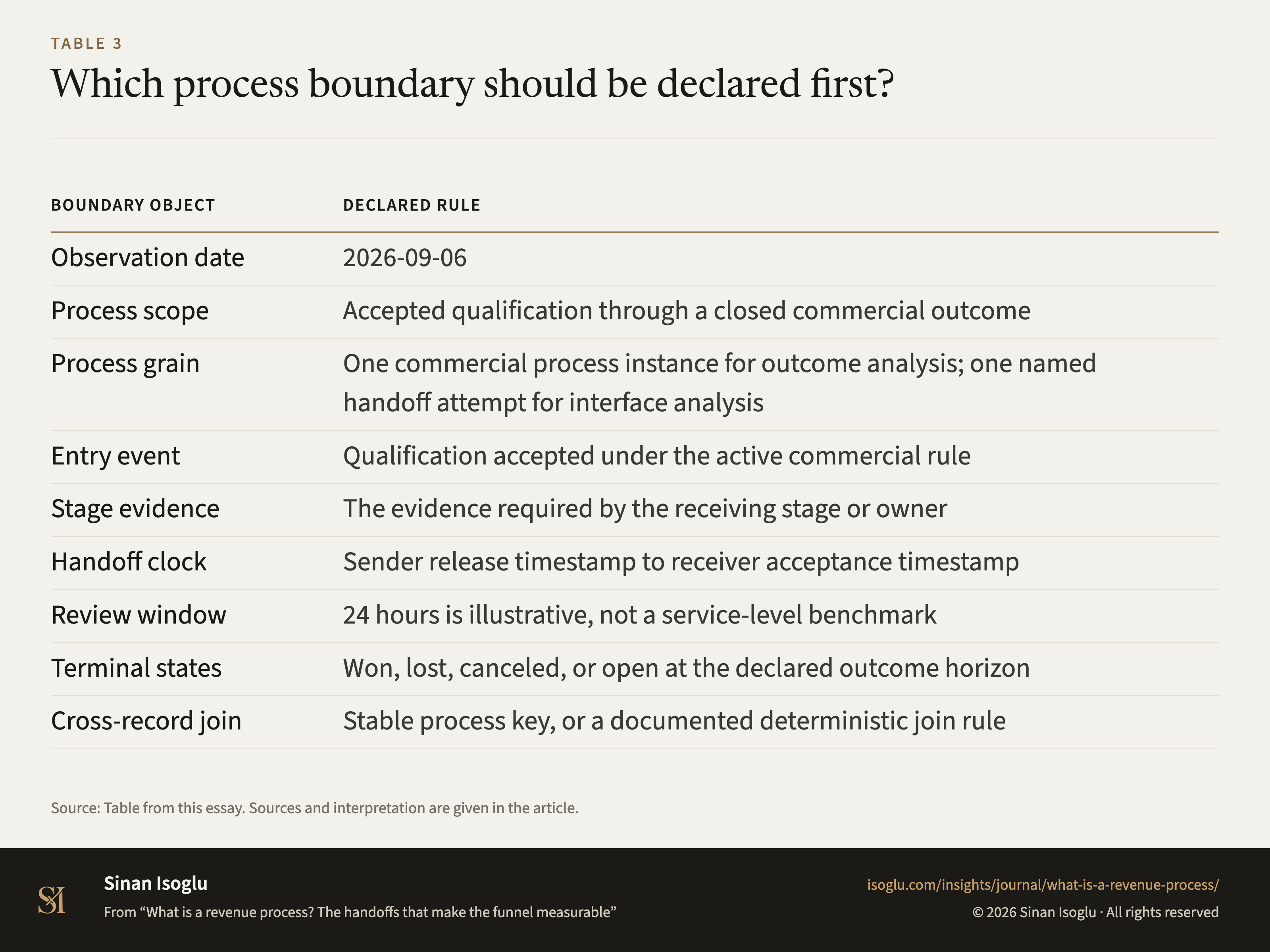
Which process boundary should be declared first?
Table 3Which process boundary should be declared first?
| Boundary object | Declared rule |
|---|---|
| Observation date | 2026-09-06 |
| Process scope | Accepted qualification through a closed commercial outcome |
| Process grain | One commercial process instance for outcome analysis; one named handoff attempt for interface analysis |
| Entry event | Qualification accepted under the active commercial rule |
| Stage evidence | The evidence required by the receiving stage or owner |
| Handoff clock | Sender release timestamp to receiver acceptance timestamp |
| Review window | 24 hours is illustrative, not a service-level benchmark |
| Terminal states | Won, lost, canceled, or open at the declared outcome horizon |
| Cross-record join | Stable process key, or a documented deterministic join rule |
Swipe or scroll horizontally if the table is wider than your screen.
Source: Table from this essay. Sources and interpretation are given in the article.
From the essay
Revenue operations & AI
What is a revenue process? The handoffs that make the funnel measurable
A revenue process is a sequence of states, decisions, and handoffs with evidence, owners, acceptance events, and outcomes.
Read the essayThis exhibit belongs to an essay: the numbers live here, the argument lives there.
Cite or embed
Related exhibits
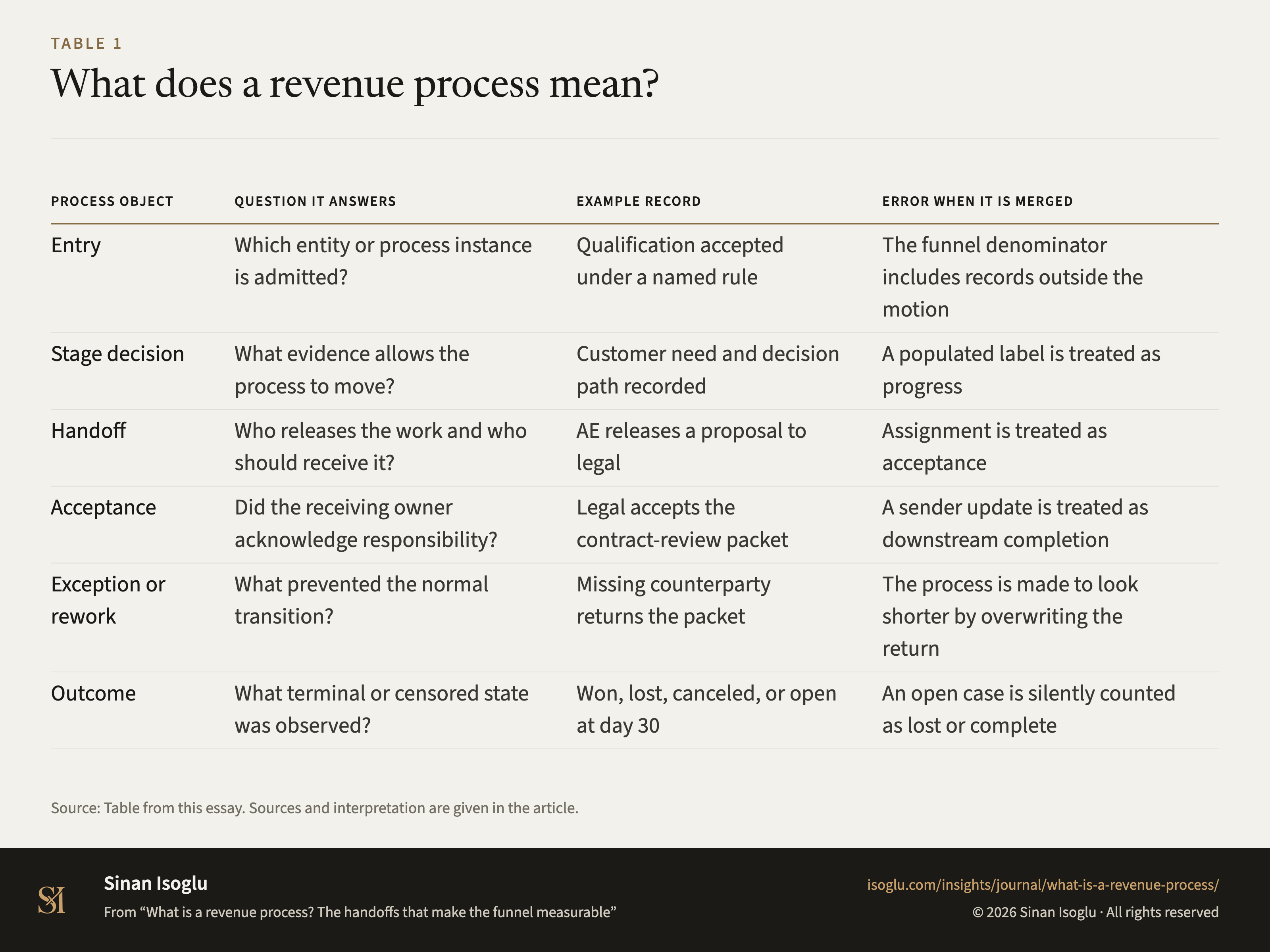
Table 1Table
What does a revenue process mean?
What is a revenue process? The handoffs that make the funnel measurable
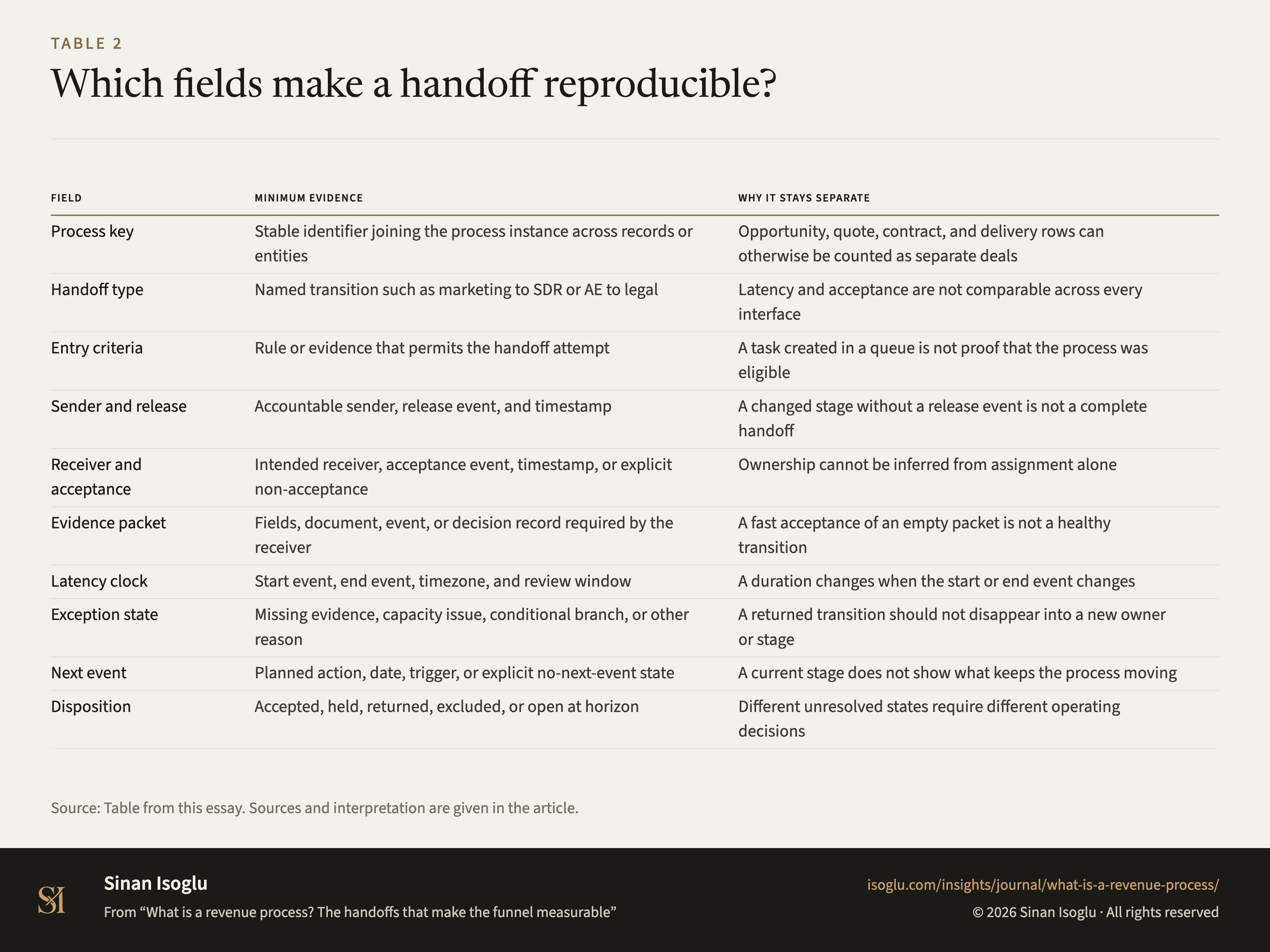
Table 2Table
Which fields make a handoff reproducible?
What is a revenue process? The handoffs that make the funnel measurable
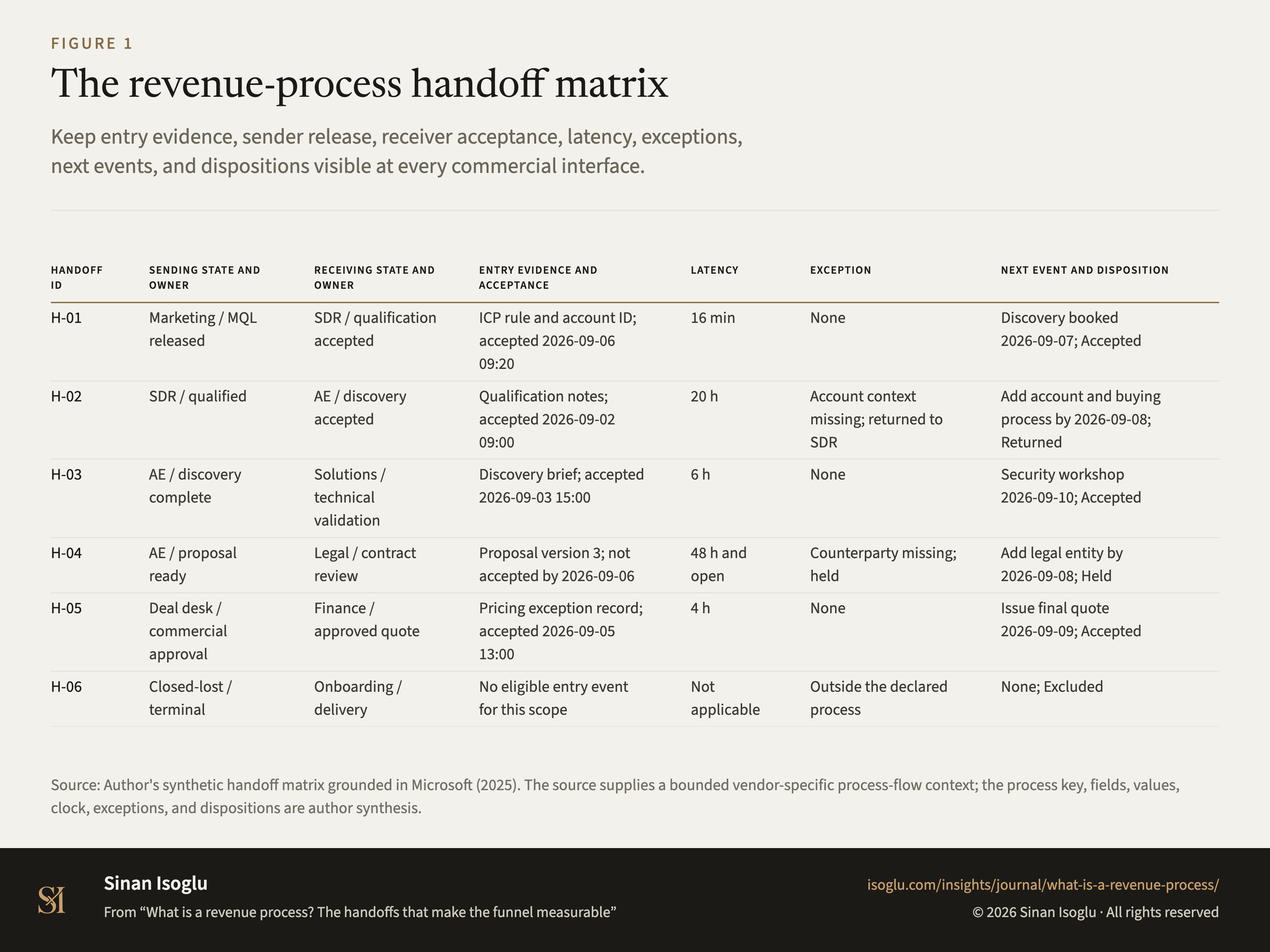
Figure 1Figure
The revenue-process handoff matrix
What is a revenue process? The handoffs that make the funnel measurable
Contact
Bring the question you're working on.
Research, a guest lecture, or a commercial question.