Table 9From “Revenue lifecycle stages are state boundaries, not a funnel list”
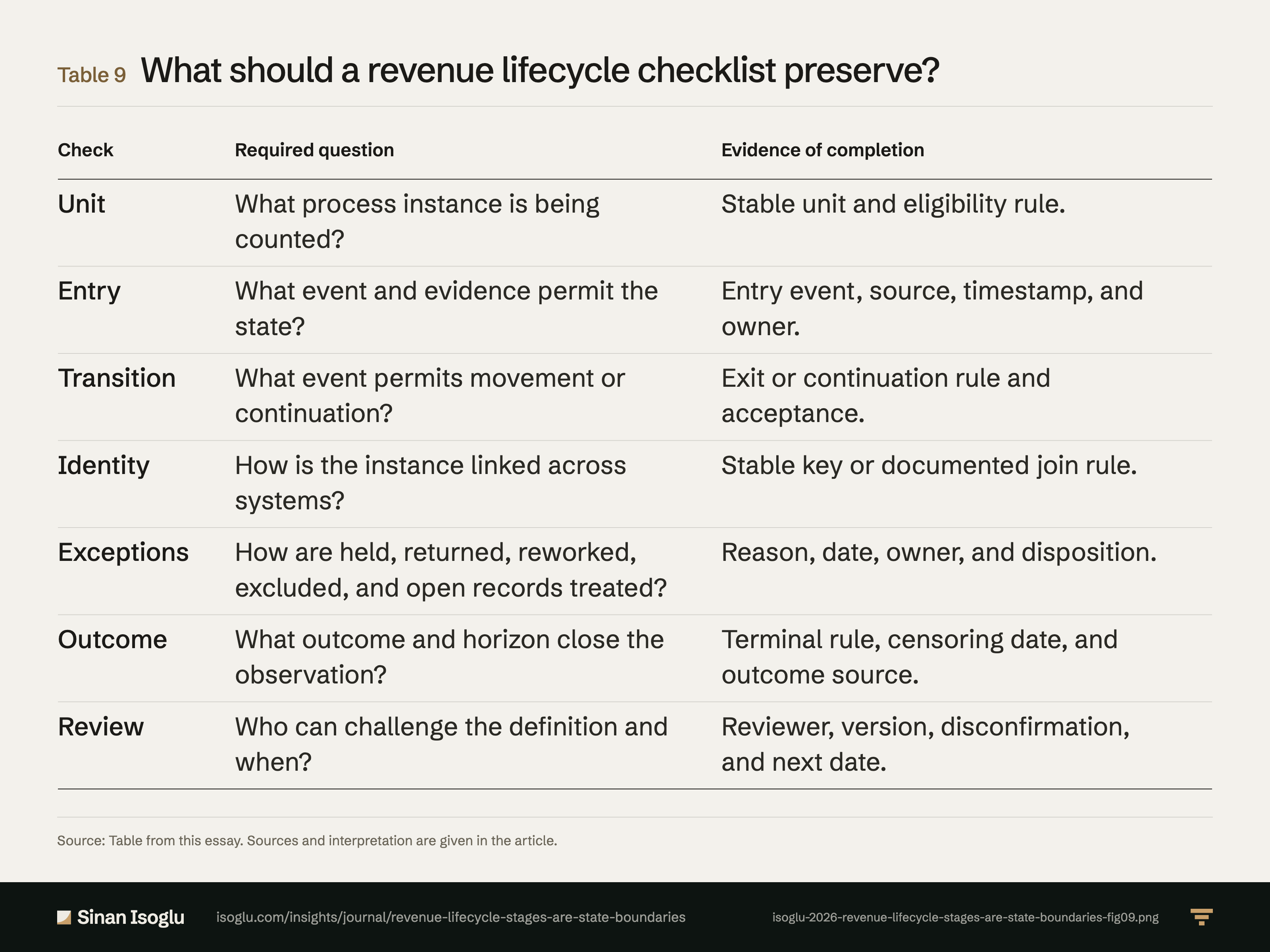
What should a revenue lifecycle checklist preserve?
Table 9What should a revenue lifecycle checklist preserve?
| Check | Required question | Evidence of completion |
|---|---|---|
| Unit | What process instance is being counted? | Stable unit and eligibility rule. |
| Entry | What event and evidence permit the state? | Entry event, source, timestamp, and owner. |
| Transition | What event permits movement or continuation? | Exit or continuation rule and acceptance. |
| Identity | How is the instance linked across systems? | Stable key or documented join rule. |
| Exceptions | How are held, returned, reworked, excluded, and open records treated? | Reason, date, owner, and disposition. |
| Outcome | What outcome and horizon close the observation? | Terminal rule, censoring date, and outcome source. |
| Review | Who can challenge the definition and when? | Reviewer, version, disconfirmation, and next date. |
Swipe or scroll horizontally if the table is wider than your screen.
Source: Table from this essay. Sources and interpretation are given in the article.
From the essay
Revenue operations & AI
Revenue lifecycle stages are state boundaries, not a funnel list
Revenue lifecycle stages become measurable when entry evidence, owners, exit rules, exceptions, and outcome horizons stay visible.
Read the essayThis exhibit belongs to an essay: the numbers live here, the argument lives there.
Cite or embed
Related exhibits
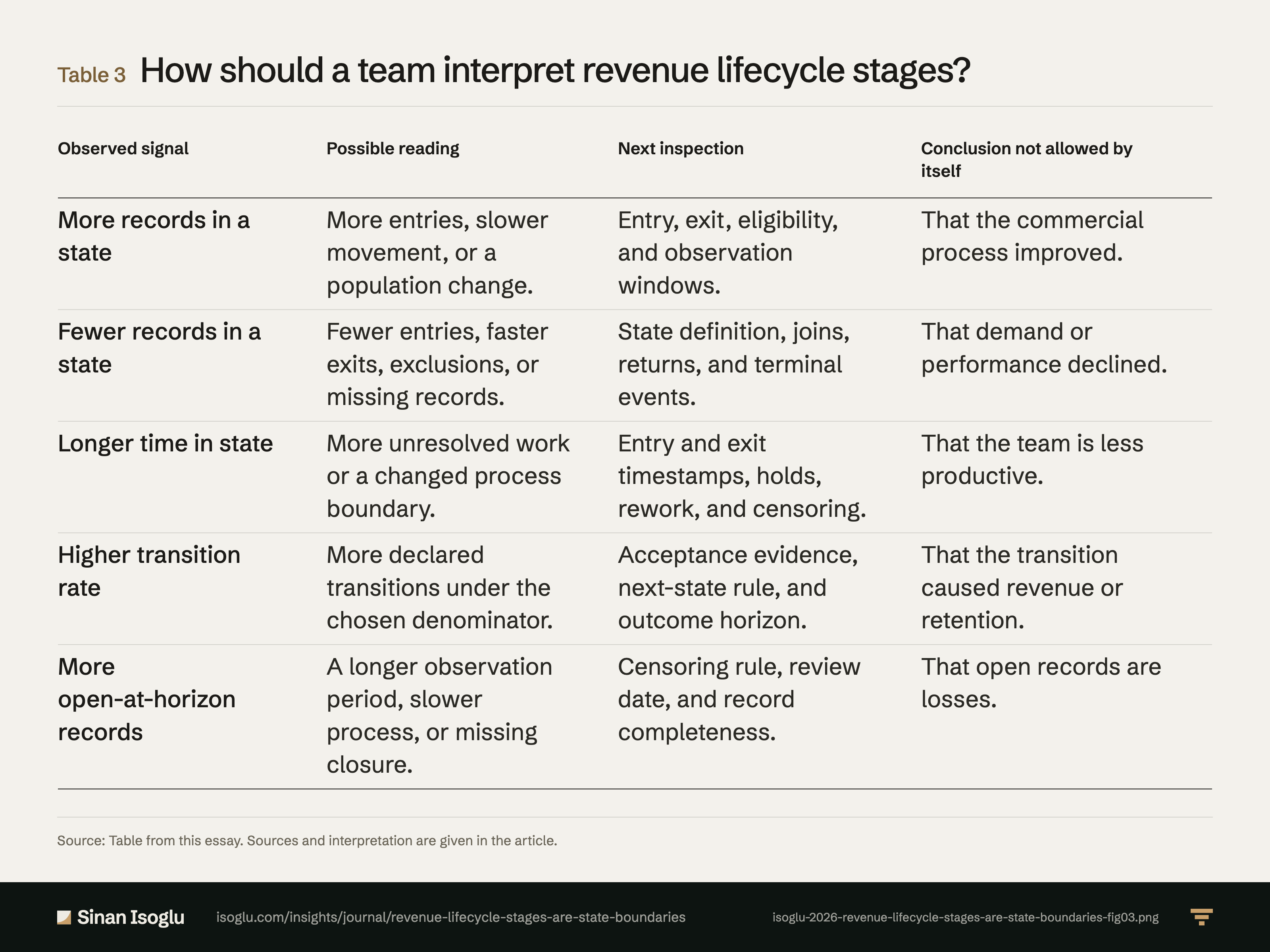
Table 3Table
How should a team interpret revenue lifecycle stages?
Revenue lifecycle stages are state boundaries, not a funnel list
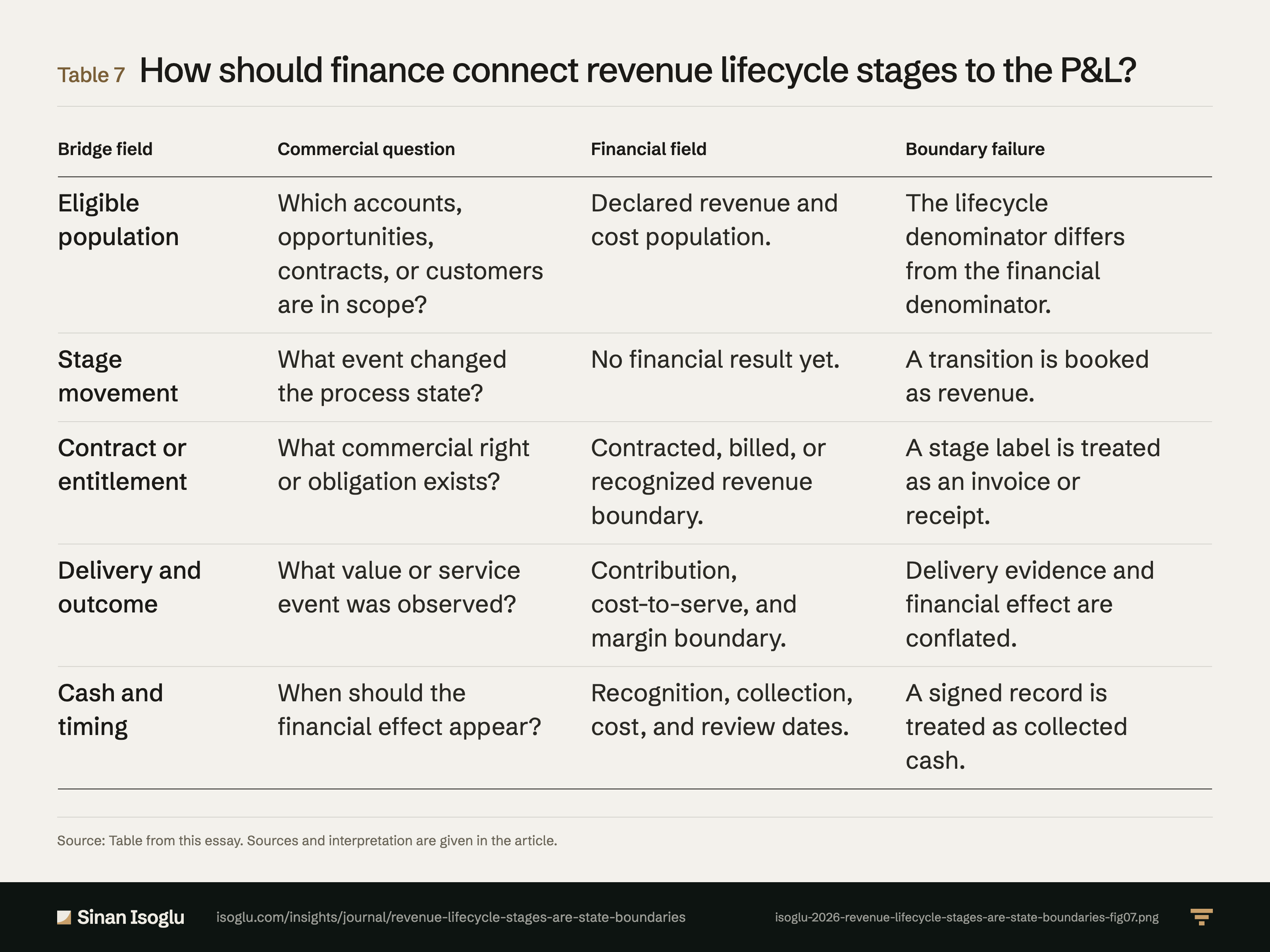
Table 7Table
How should finance connect revenue lifecycle stages to the P&L?
Revenue lifecycle stages are state boundaries, not a funnel list
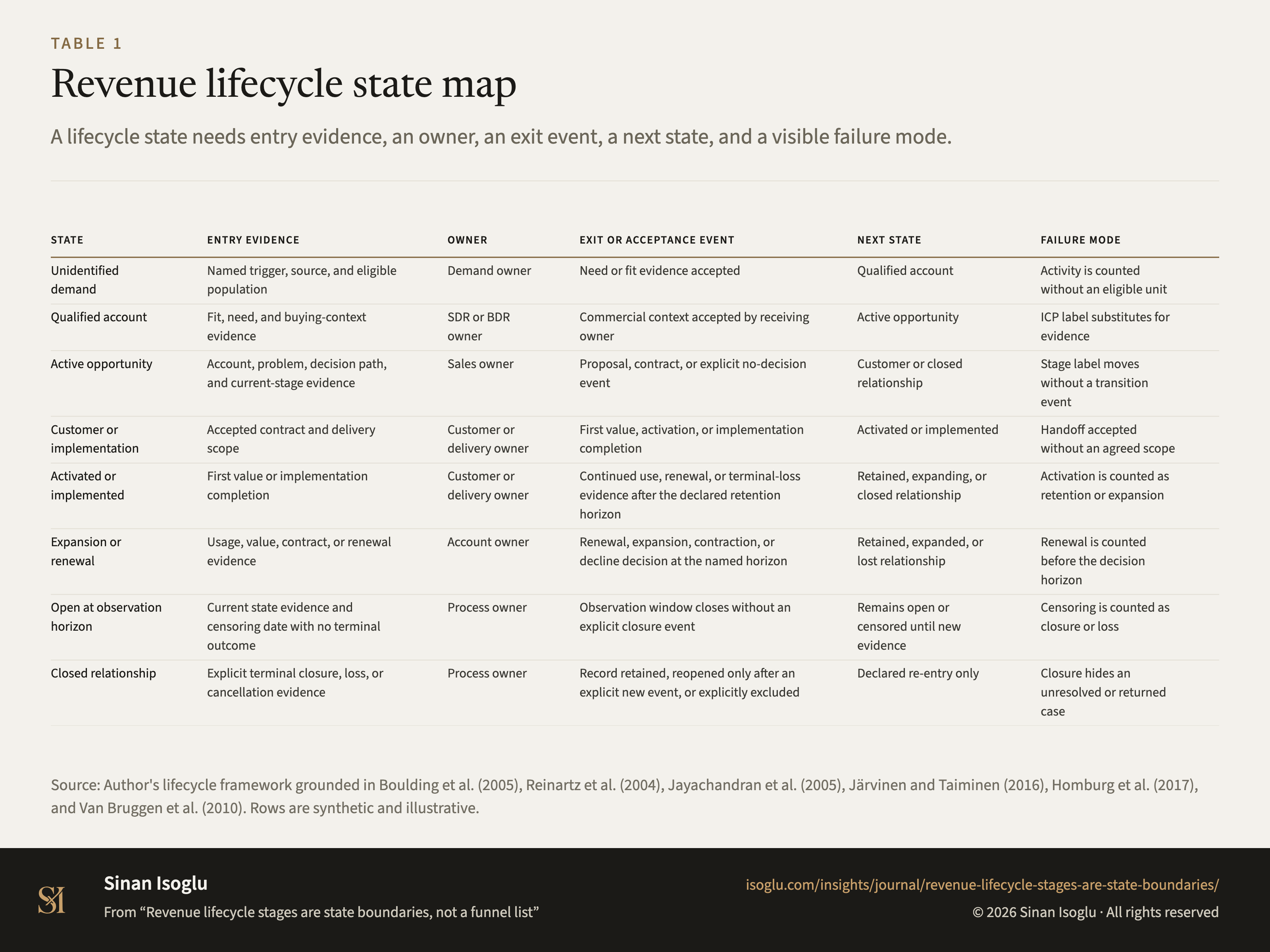
Table 1Table
Revenue lifecycle state map
Revenue lifecycle stages are state boundaries, not a funnel list
Contact
Bring the question you're working on.
Research, a guest lecture, or a commercial question.