← Every exhibit
Table 1From “The one number a commercial team should share.”
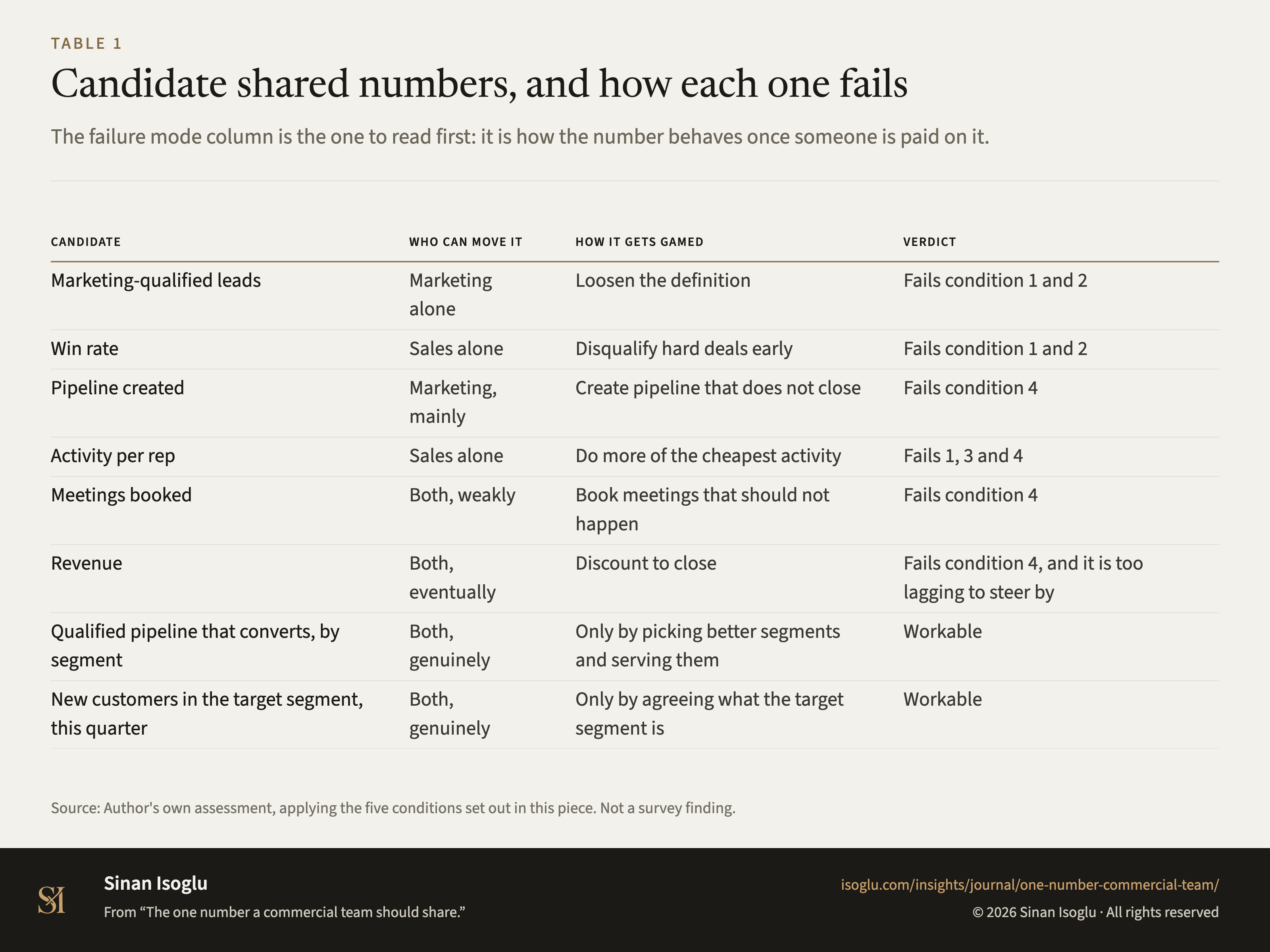
Candidate shared numbers, and how each one fails
The failure mode column is the one to read first: it is how the number behaves once someone is paid on it.
Table 1Candidate shared numbers, and how each one fails
| Candidate | Who can move it | How it gets gamed | Verdict |
|---|---|---|---|
| Marketing-qualified leads | Marketing alone | Loosen the definition | Fails condition 1 and 2 |
| Win rate | Sales alone | Disqualify hard deals early | Fails condition 1 and 2 |
| Pipeline created | Marketing, mainly | Create pipeline that does not close | Fails condition 4 |
| Activity per rep | Sales alone | Do more of the cheapest activity | Fails 1, 3 and 4 |
| Meetings booked | Both, weakly | Book meetings that should not happen | Fails condition 4 |
| Revenue | Both, eventually | Discount to close | Fails condition 4, and it is too lagging to steer by |
| Qualified pipeline that converts, by segment | Both, genuinely | Only by picking better segments and serving them | Workable |
| New customers in the target segment, this quarter | Both, genuinely | Only by agreeing what the target segment is | Workable |
Swipe or scroll horizontally if the table is wider than your screen.
Source: Author's own assessment, applying the five conditions set out in this piece. Not a survey finding.
PNG4:3, 1600 × 1200, with the title, the source line and the attribution set in the image isoglu-2026-one-number-commercial-team-fig01.png
From the essay
Revenue operations & AI
The one number a commercial team should share.
Alignment is not agreement, and it is not a workshop. It is one number both sides can move, both sides are judged on, and neither side can move alone.
Read the essayThis exhibit belongs to an essay: the numbers live here, the argument lives there.
Cite or embed
Related exhibits
Contact
Bring the question you're working on.
Research, a guest lecture, or a commercial question.