Abbildung 1Aus „Was ist Littles Gesetz?“
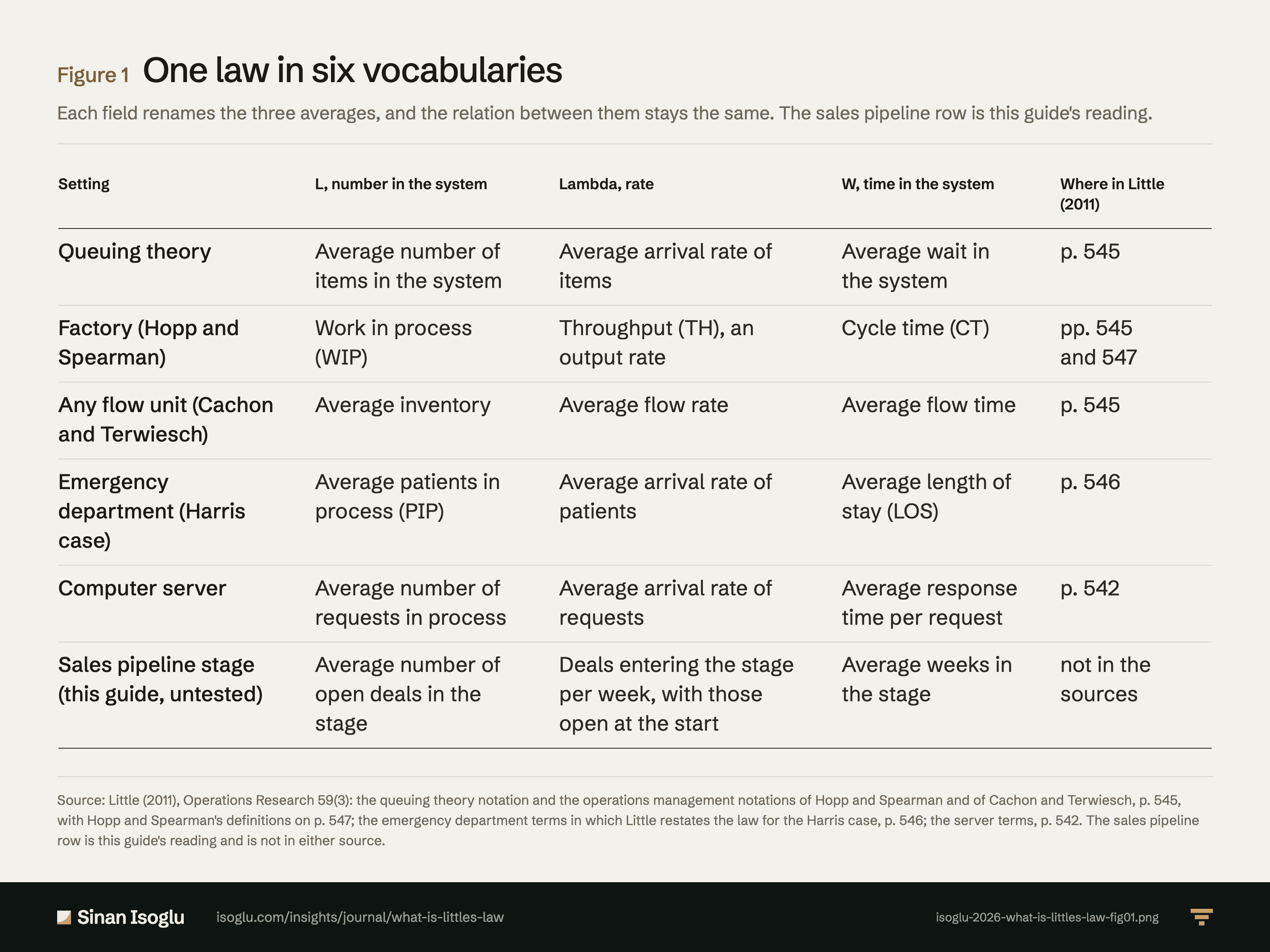
Ein Gesetz in sechs Begriffswelten
Jedes Fachgebiet benennt die drei Mittelwerte anders, die Beziehung zwischen ihnen bleibt dieselbe. Die Zeile zur Vertriebspipeline ist die Lesart dieses Leitfadens.
Abbildung 1Ein Gesetz in sechs Begriffswelten
| Anwendungsfeld | L, Zahl im System | Lambda, Rate | W, Zeit im System | Fundstelle in Little (2011) |
|---|---|---|---|---|
| Warteschlangentheorie | Durchschnittliche Zahl der Einheiten im System | Durchschnittliche Ankunftsrate der Einheiten | Durchschnittliche Verweilzeit im System | S. 545 |
| Fertigung (Hopp und Spearman) | Umlaufbestand (Work in Process, WIP) | Durchsatz (Throughput, TH), eine Ausbringungsrate | Durchlaufzeit (Cycle Time, CT) | S. 545 und 547 |
| Beliebige Flusseinheit (Cachon und Terwiesch) | Durchschnittlicher Bestand | Durchschnittliche Flussrate | Durchschnittliche Flusszeit | S. 545 |
| Notaufnahme (Fall Harris) | Durchschnittliche Zahl der Patienten in Behandlung (PIP) | Durchschnittliche Ankunftsrate der Patienten | Durchschnittliche Aufenthaltsdauer (LOS) | S. 546 |
| Computerserver | Durchschnittliche Zahl der Anfragen in Bearbeitung | Durchschnittliche Ankunftsrate der Anfragen | Durchschnittliche Antwortzeit je Anfrage | S. 542 |
| Phase einer Vertriebspipeline (dieser Leitfaden, ungeprüft) | Durchschnittliche Zahl offener Deals in der Phase | Zugänge in die Phase pro Woche, einschließlich der zu Beginn offenen | Durchschnittliche Wochen in der Phase | nicht in den Quellen |
Bei breiten Tabellen horizontal wischen oder scrollen.
Quelle: Little (2011), Operations Research 59(3): die Notation der Warteschlangentheorie und die Notationen des Operations Management nach Hopp und Spearman sowie nach Cachon und Terwiesch, S. 545, mit den Definitionen von Hopp und Spearman auf S. 547; die Begriffe, in denen Little das Gesetz für den Fall Harris formuliert, S. 546; die Begriffe des Servers, S. 542. Die Zeile zur Vertriebspipeline ist die Lesart dieses Leitfadens und steht in keiner der beiden Quellen.
Quelle und Evidenz
Jede Zeile nennt eine Aussage zu dieser Abbildung, ihre Quelle und die Art ihrer Prüfung.
- A LIT11-C9 The law in field vocabularies: queuing theory L, λ, W; Hopp and Spearman TH = WIP/CT with throughput, work in process and cycle time, which Little quotes as the average output of a production process per unit time, the inventory between the start and end points of a routing, and the time from release of a job at the beginning of the routing to its end; Cachon and Terwiesch average inventory, flow rate and flow time; emergency department patients in process, arrival rate and length of stay, the terms in which Little himself restates the law for the Harris case, borrowing operations management terminology for patients in process; the held source does not say which terms Harris used (revised after G5 F6); server requests in process, arrival rate of requests and response time; operations management states the law with the output rate rather than the arrival rate, and in many settings the arrival process is in effect endogenous; operations management applications draw their vocabulary from the client setting (G5 N6) (pp. 542, 545 to 547): "average number of requests in process"; "average response time per request"; "throughput (items/unit time)"; "work in process (items)"; "cycle time (time units/item)"; "Average Inventory = Average Flow Rate"; "Average Flow Time"; "rate or flow rate for the system, rather than the arrival rate"; "In effect, the arrival process is endogenous"; "LOS fits easily into Little's Law"; "average patients in process"; "given the acronym PIP. So, rewriting Little"; "the average output of a production process"; "the inventory between the start and end points"; "time from release of a job at the beginning of the routing"; "One of the characteristics of OM applications of"; "Law is to draw the vocabulary for the application from"; "jargon of the client setting"Little (2011) · Little. (2011)
- B LLAW-OWN-C3 A pipeline stage read with the finite-period law (author's example, invented numbers, untested): the system is one stage bounded by its entry event and every exit (advanced, moved back to an earlier stage, won, lost, disqualified), a deal moved back into the stage counts as a new arrival; over 13 weeks, 120 deals open on day one and 270 entries give 390 deals, 1,560 deal-weeks give L = 120, λ = 30 per week, W = 4 weeks (day-one count revised after G5 N7, exits after N8); two of the three give the third; without dates, averaged weekly counts approximate L, and divided by λ, which includes the deals open on day one, they give W, while dividing by the entries alone gives a different number (5.8 weeks on these numbers), not the finite-period W (G5 F2); computed from one set of dates the three agree by construction; a gap with the CRM's own figures points to the records or the definitions (rewritten entry dates, a CRM time in stage taken only from deals that left), and lost deals left open show as a slower stage, not as a gap (revised after G5 F1); at a constant λ of 30 deals a week, a rise from 120 to 150 open deals means W rose from 4 to 5 weeks; the law cannot say why, nor give win rates, values or forecasts; Figure 1's last row and the Figure 2 worksheet.Author worksheet grounded in LIT61-C4, LIT11-C6, LIT11-C7 and LIT11-C10; untested
Prüfgrade: A, gegen die gedruckte Seite der Primärquelle geprüft · B, Primärquelle, nur Textebene · C, belastbare Sekundärquelle · D, berichtet.
Aus dem Beitrag
Revenue Operations & KI
Was ist Littles Gesetz?
Littles Gesetz, L = λW, verknüpft drei Mittelwerte: Einheiten im System, ihre Ankunftsrate und ihre Verweilzeit. Es misst, aber es erklärt nicht.
Den Beitrag lesenDiese Abbildung gehört zu einem Essay: Die Zahlen stehen hier, das Argument dort.
Zitieren oder einbetten
Verwandte Abbildungen
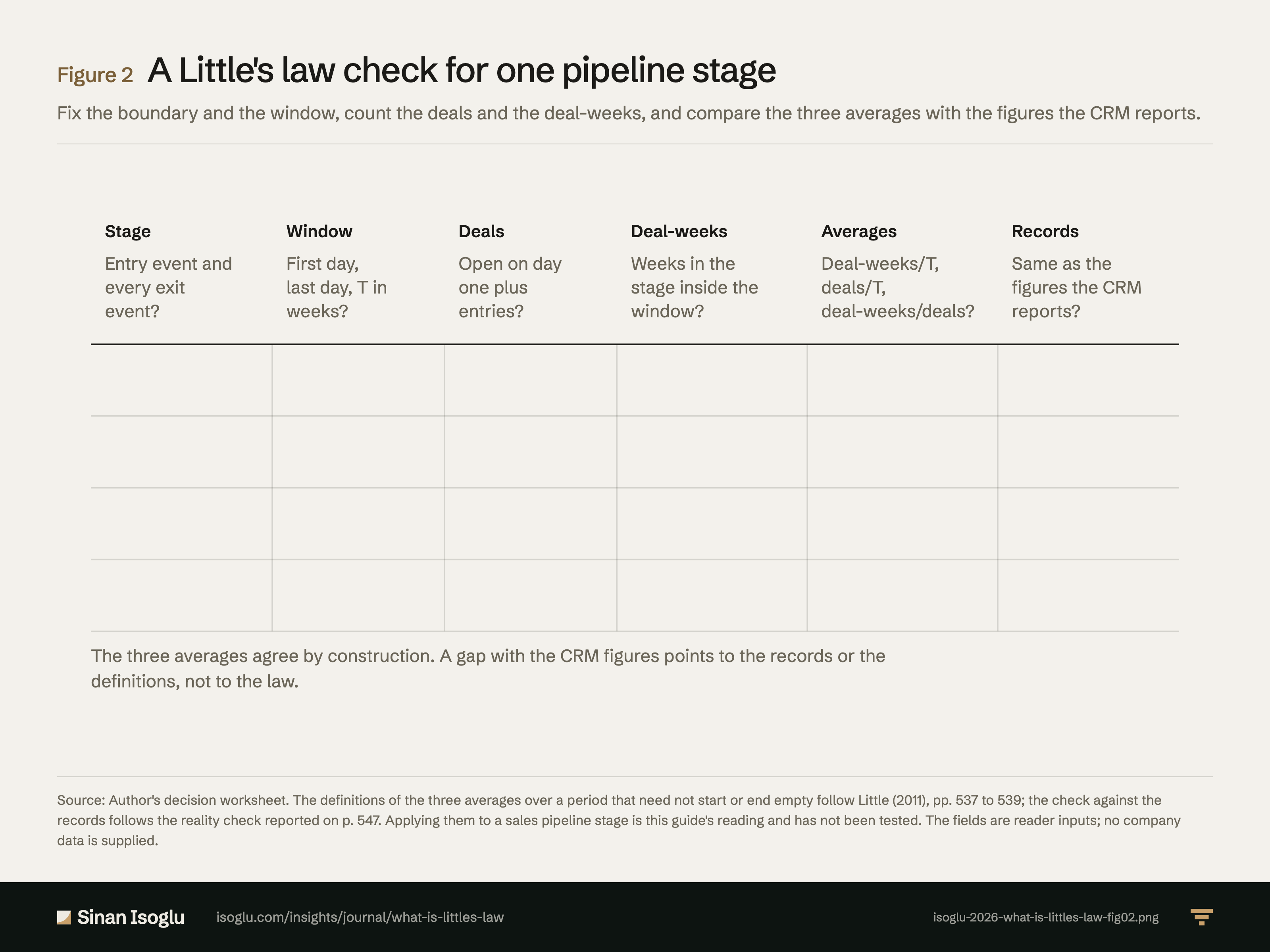
Abbildung 2Grafik
Ein Abgleich nach Littles Gesetz für eine Pipeline-Phase
Was ist Littles Gesetz?
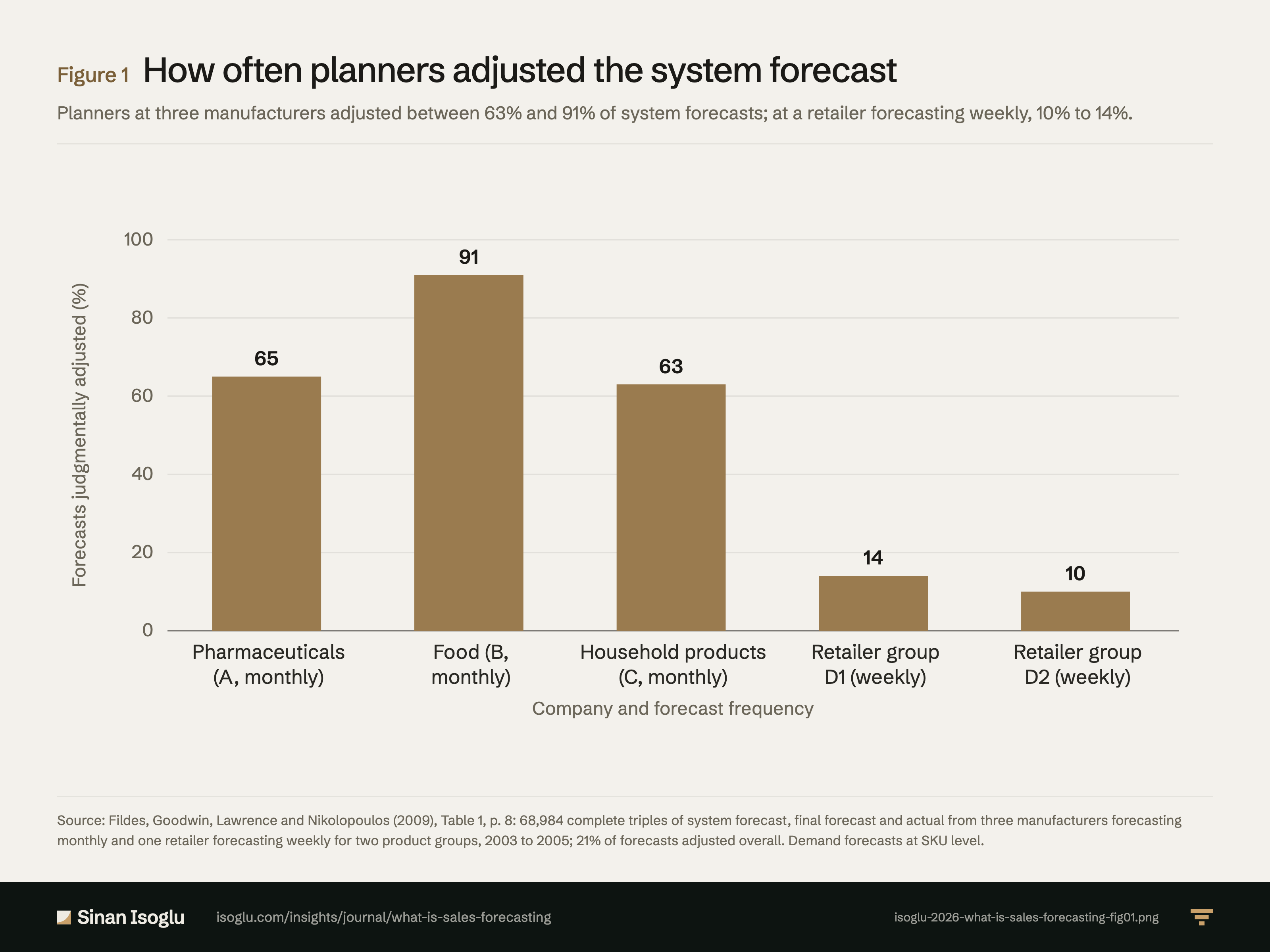
Abbildung 1Grafik
Wie oft Planer die Systemprognose anpassten
Was ist eine Vertriebsprognose?
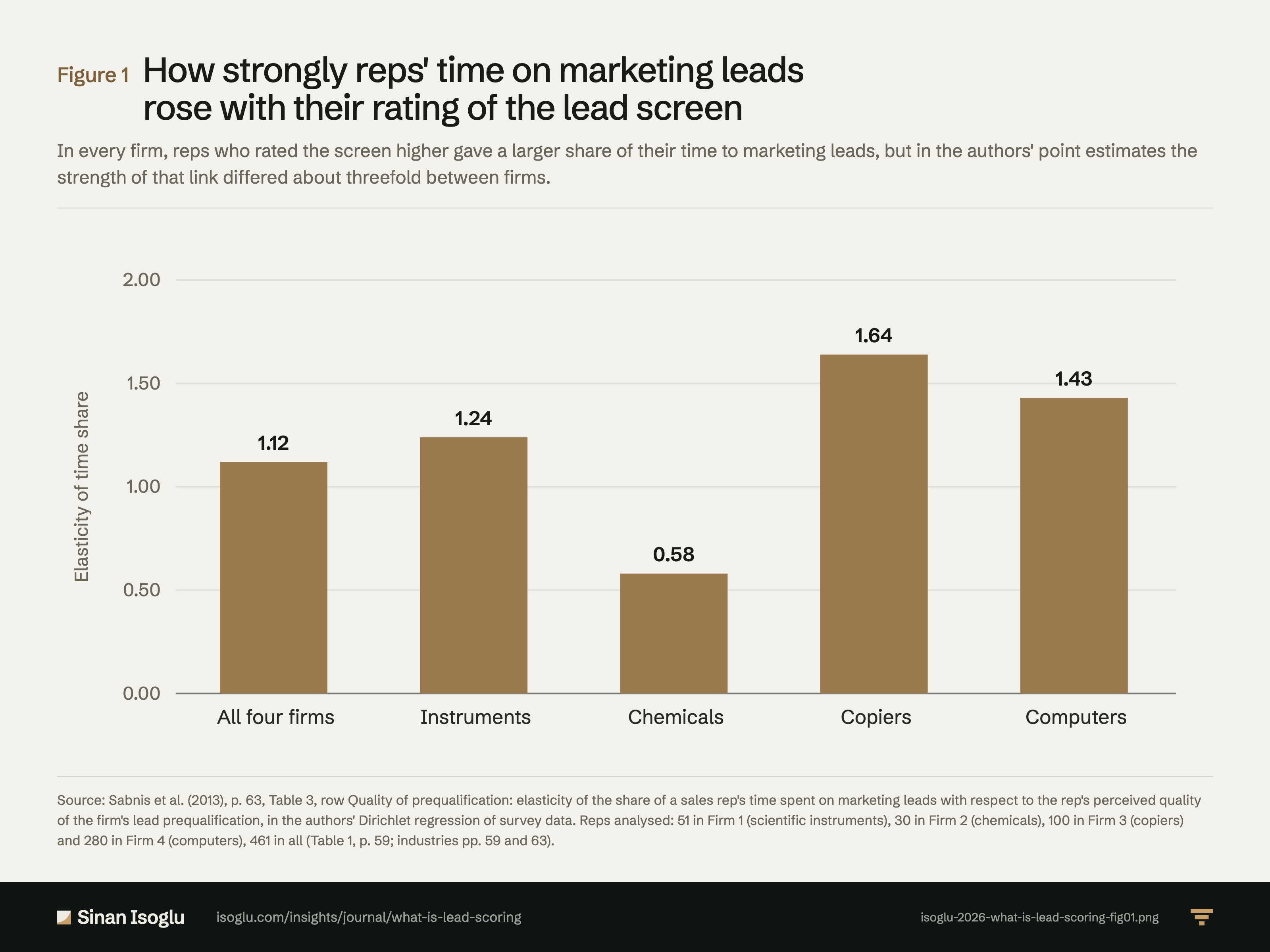
Abbildung 1Grafik
Wie stark der Zeitanteil für Marketing-Leads mit der Bewertung der Vorauswahl stieg
Was ist Lead-Scoring?
Kontakt
Schicken Sie die Frage, an der Sie arbeiten.
Forschung, ein Gastvortrag oder eine Frage aus der Praxis.