Abbildung 3Aus „Was ist ein Earn-Out? Der Preisteil, der sich erst beweisen muss“
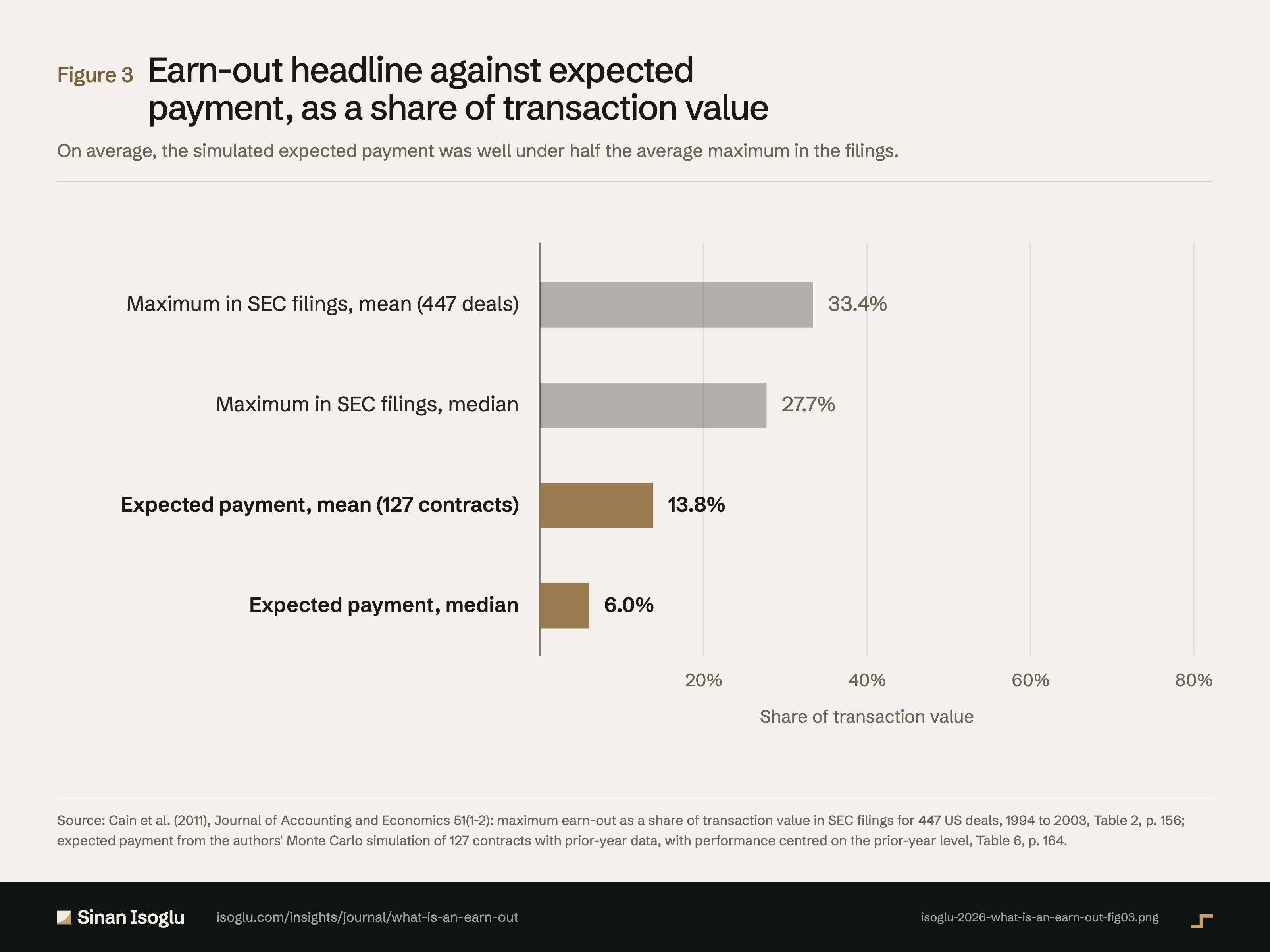
Earn-Out-Nominalbetrag gegenüber erwarteter Zahlung, als Anteil am Transaktionswert
Im Mittel lag die simulierte erwartete Zahlung deutlich unter der Hälfte des mittleren Höchstbetrags laut SEC-Unterlagen.
Abbildung 3Earn-Out-Nominalbetrag gegenüber erwarteter Zahlung, als Anteil am Transaktionswert
Quelle: Cain u. a. (2011), Journal of Accounting and Economics 51(1–2): maximaler Earn-Out als Anteil am Transaktionswert laut SEC-Unterlagen für 447 US-Übernahmen, 1994 bis 2003, Tabelle 2, S. 156; erwartete Zahlung aus der Monte-Carlo-Simulation der Autoren für 127 Verträge mit Vorjahreszahlen, mit der Leistung um den Vorjahreswert gestreut, Tabelle 6, S. 164.
Quelle und Evidenz
Jede Zeile nennt eine Aussage zu dieser Abbildung, ihre Quelle und die Art ihrer Prüfung.
- A A gegen die gedruckte Seite der Primärquelle geprüftB Primärquelle, nur TextebeneC belastbare SekundärquelleD berichtet Contract size and shape: maximum earn-out $21 million on average, median $5 million; 33% of transaction value on average if paid in full (median 28%; Table 2, p. 156, read on the page image: 447 deals, mean 33.4%, median 27.7%; SDC-reported 990 deals, mean 32.7%, median 28.6%); 90% contingent on the target alone; linear (42%) or stepwise (40%) to a cap; the median target must grow 18% before any payment and over a quarter need no growth (pp. 152, 154 to 156): "the maximum earnout that could be paid per acquisition is $21 million, with a median of $5 million"; "Conditional on the maximum being paid, the earnout constitutes 33% of the total transaction value"; "the earnout is contingent on the performance of the target firm only"; "a linear function of the target's performance subject to a maximum (42% of the sample)"; "a stepwise function of the target's performance subject to a maximum (40% of the sample)"; "the median target must improve its performance by 18% relative to the prior year's level"; "over 25% of the targets need not improve performance at all"Cain, Denis and Denis (2011)
- A A gegen die gedruckte Seite der Primärquelle geprüftB Primärquelle, nur TextebeneC belastbare SekundärquelleD berichtet A Monte Carlo of 127 contracts with prior-year data, drawing performance from a distribution centred on the prior-year level (no growth), puts the expected payment at 13.8% of transaction value on average (median 6.0%, Table 6, p. 164, read on the page image) against the SDC-recorded 32.7% for all deals; about 19% expect zero; the SDC figures are an upper bound in most acquisitions (pp. 163, 164): "assuming a normal distribution with a mean equal to the pre-acquisition performance level"; "the expected earnout payment is equal to $2.4 million and constitutes 13.8% of the total transaction value"; "the SDC-reported earnout contracts represented an average amount of $22.3 million, or 32.7% of transaction value"; "these numbers appear to represent an upper bound, rather than an expectation of the potential earnout payoffs in most acquisitions"; "about 19% of our sample firms exhibit an expected earnout payoff of zero"Cain, Denis and Denis (2011)
Aus dem Beitrag
Go-to-Market-Strategie
Was ist ein Earn-Out? Der Preisteil, der sich erst beweisen muss
Ein Earn-Out zahlt Teile des Kaufpreises erst, wenn das gekaufte Unternehmen Ziele erreicht. Häufig bei schwer bewertbaren Firmen, heikel bei Integration.
Den Beitrag lesenDiese Abbildung gehört zu einem Essay: Die Zahlen stehen hier, das Argument dort.
Zitieren oder einbetten
Verwandte Abbildungen
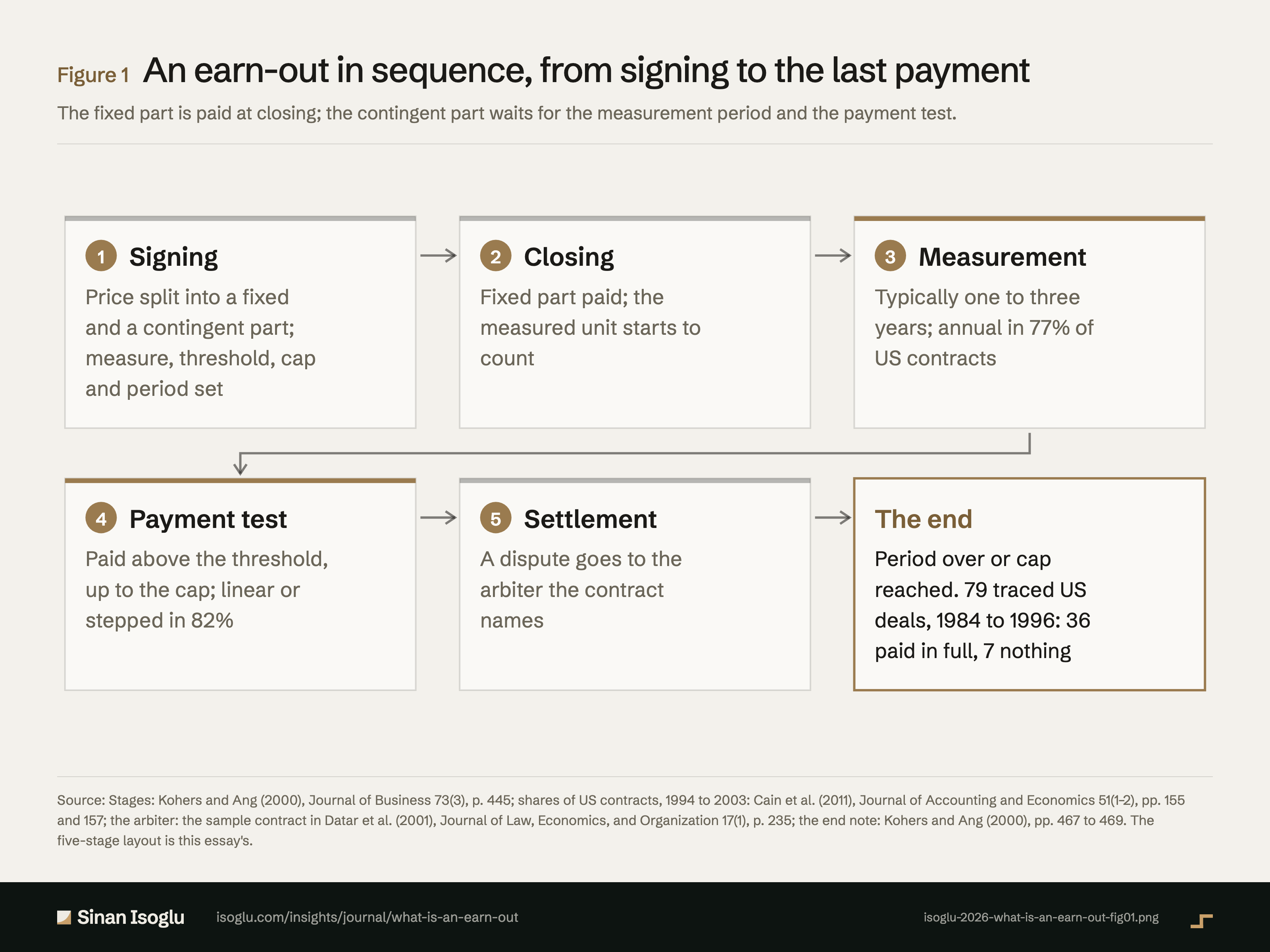
Abbildung 1Grafik
Ein Earn-Out im Ablauf, von der Unterzeichnung bis zur letzten Zahlung
Was ist ein Earn-Out? Der Preisteil, der sich erst beweisen muss
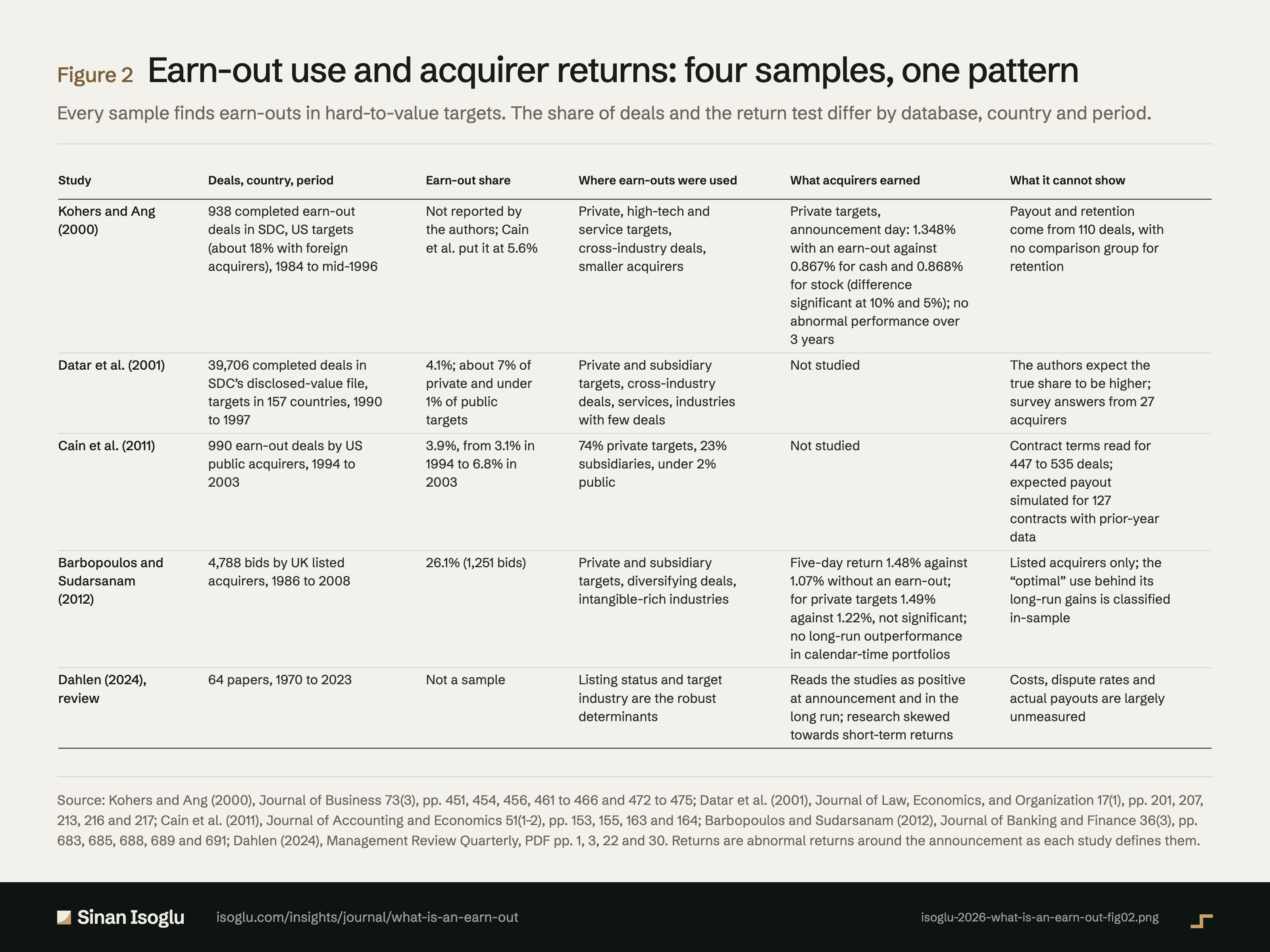
Abbildung 2Grafik
Earn-Out-Nutzung und Käuferrenditen: vier Stichproben, ein Muster
Was ist ein Earn-Out? Der Preisteil, der sich erst beweisen muss
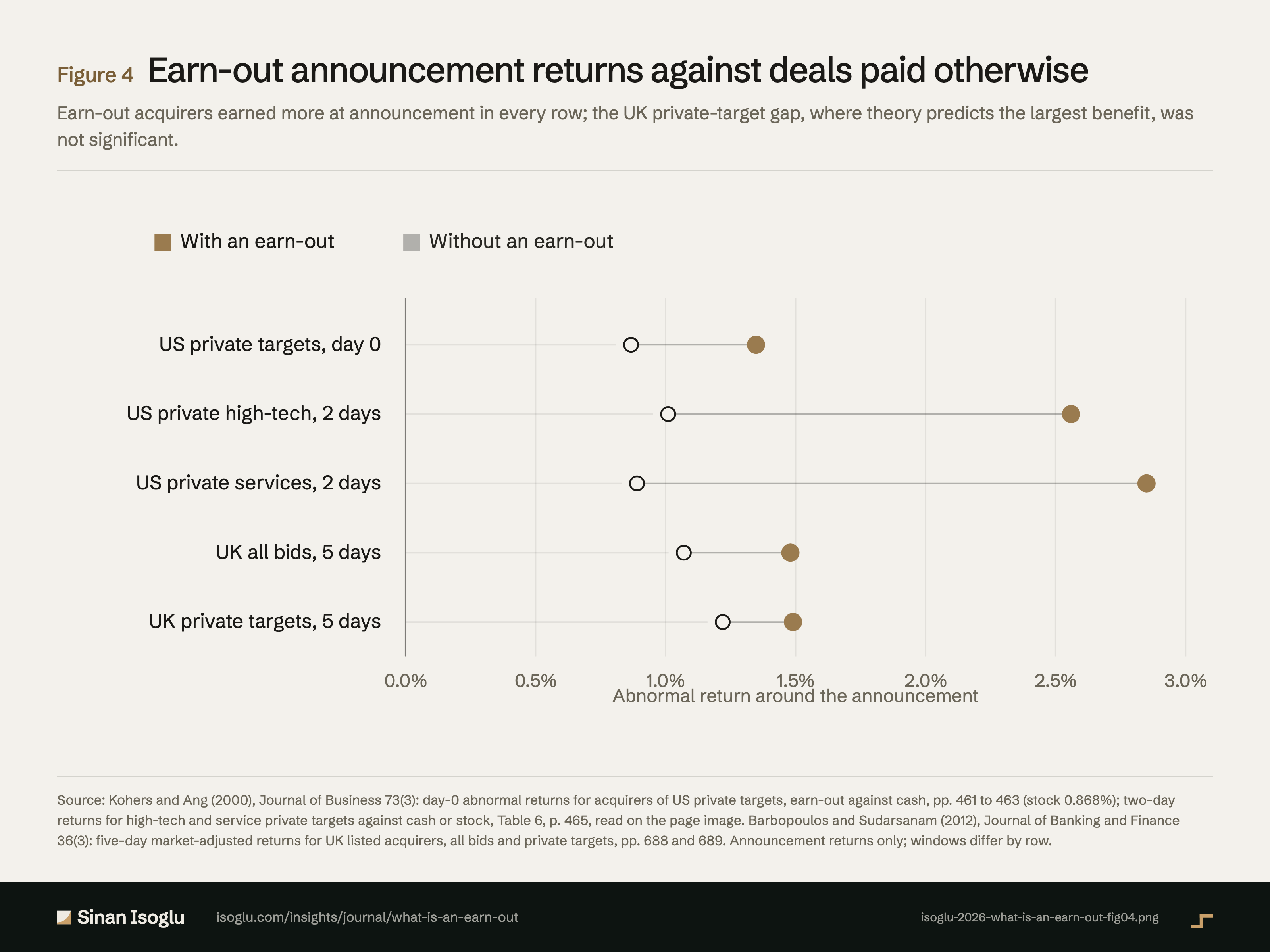
Abbildung 4Grafik
Earn-Out-Ankündigungsrenditen gegenüber anders bezahlten Übernahmen
Was ist ein Earn-Out? Der Preisteil, der sich erst beweisen muss
Kontakt
Schicken Sie die Frage, an der Sie arbeiten.
Forschung, ein Gastvortrag oder eine Frage aus der Praxis.