Abbildung 4Aus „Porters Five Forces: warum die Firma mehr zählt als die Branche“
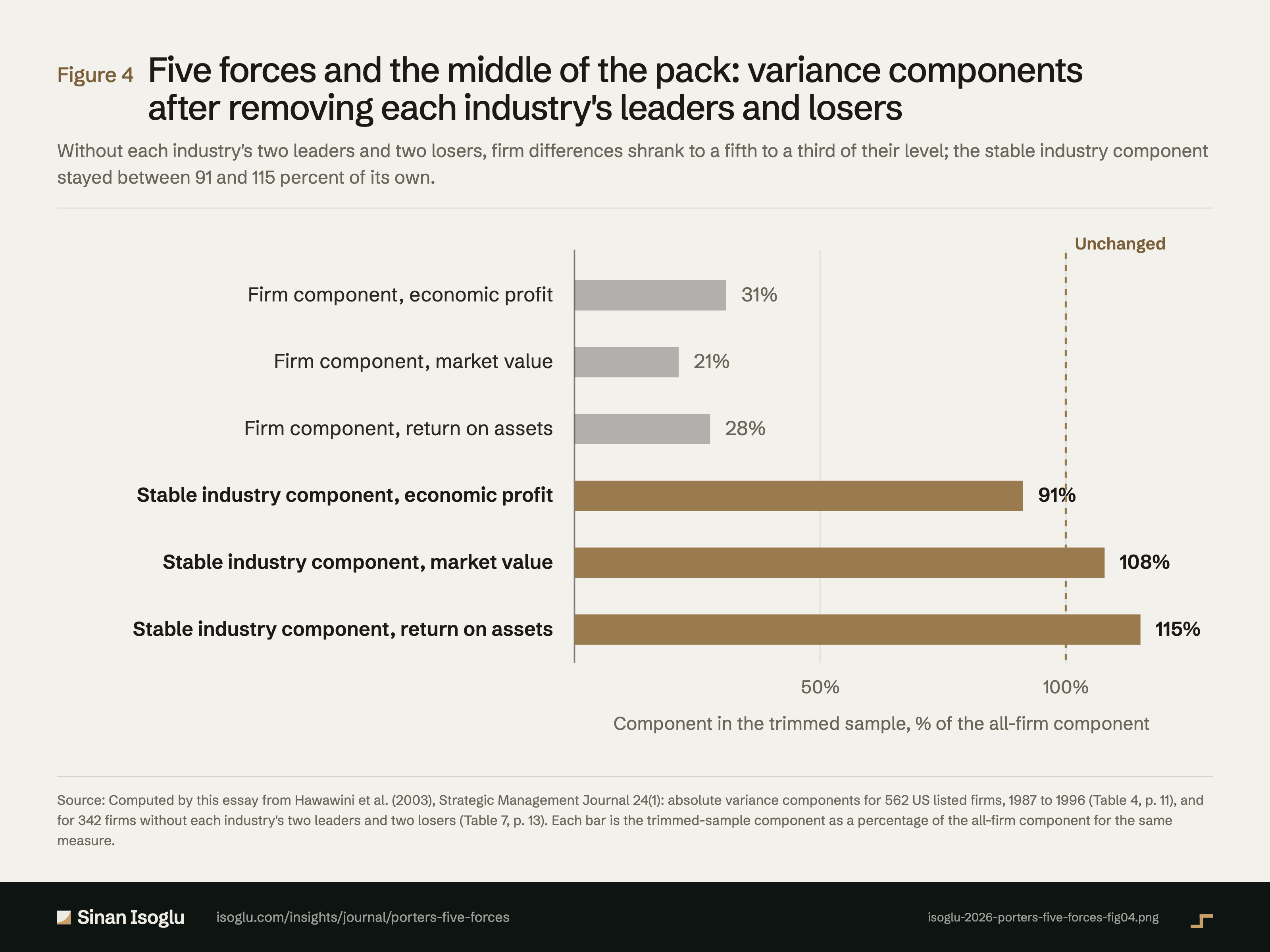
Five Forces und das Mittelfeld: Varianzkomponenten ohne die Spitzenreiter und Schlusslichter jeder Branche
Ohne die zwei Spitzenreiter und die zwei Schlusslichter jeder Branche schrumpften die Unterschiede zwischen Unternehmen auf ein Fünftel bis ein Drittel; die dauerhafte Branchenkomponente blieb bei 91 bis 115 Prozent ihres Werts.
Abbildung 4Five Forces und das Mittelfeld: Varianzkomponenten ohne die Spitzenreiter und Schlusslichter jeder Branche
Quelle: Eigene Berechnung nach Hawawini u. a. (2003), Strategic Management Journal 24(1): absolute Varianzkomponenten für 562 börsennotierte US-Unternehmen, 1987 bis 1996 (Tabelle 4, S. 11), und für 342 Unternehmen ohne die zwei Spitzenreiter und die zwei Schlusslichter jeder Branche (Tabelle 7, S. 13). Jeder Balken zeigt die Komponente der Stichprobe ohne Spitzenreiter und Schlusslichter in Prozent der Komponente aller Unternehmen für dasselbe Maß.
Quelle und Evidenz
Jede Zeile nennt eine Aussage zu dieser Abbildung, ihre Quelle und die Art ihrer Prüfung.
- A A gegen die gedruckte Seite der Primärquelle geprüftB Primärquelle, nur TextebeneC belastbare SekundärquelleD berichtet Leaders and losers: a leader has the best result in its industry for the most years (ties by cumulative value), a loser the worst; the reduced sample drops each industry’s top two and bottom two by the measure used, leaving 342 firms and 3,420 observations (pp. 10, 11, 13): "a reduced sample that excludes the top two value leaders and bottom two value losers in the industry"; "The reduced sample contains 3420 observations for 342 firms across the 55 industry classifications"; "a firm’s performance must be the highest in its industry for the maximum number of years over the sample period"; "excludes each industry’s top two leaders and bottom two losers according to the performance measure used"Hawawini, Subramanian and Verdin (2003)
- A A gegen die gedruckte Seite der Primärquelle geprüftB Primärquelle, nur TextebeneC belastbare SekundärquelleD berichtet Absolute components, Tables 4 and 7: the firm component falls on all three measures while the industry component rises for ROA and TMV/CE and stays about the same for EP/CE; a few firms dominate intra-industry variance and firm effects (pp. 11 to 13): "In terms of variance component estimates, the firm factor contributes less across all three measures of performance, while industry factors increase for ROA and TMV/CE, and remain almost the same for EP/CE"; "only a few firms that capture or destroy a large part of industry’s value dominate intra-industry variance and firm effects"Hawawini, Subramanian and Verdin (2003)
- B A gegen die gedruckte Seite der Primärquelle geprüftB Primärquelle, nur TextebeneC belastbare SekundärquelleD berichtet Figure 4 arithmetic from Hawawini Tables 4 and 7: firm 0.000820/0.002650 = 30.9%, 0.232559/1.095386 = 21.2%, 5.697587/20.643661 = 27.6%; stable industry 0.000578/0.000633 = 91.3%, 0.412727/0.382606 = 107.9%, 5.413565/4.700882 = 115.2%; the stable-only comparison from Table 8 (G5 F1); what collapsed was the firm component, the industry component changed little and rose on two measures as the authors note (G5 F7); trimming by the outcome narrows dispersion by constructionAuthor computation
Aus dem Beitrag
Go-to-Market-Strategie
Porters Five Forces: warum die Firma mehr zählt als die Branche
Die Five Forces nach Porter erfassen den Druck auf Branchengewinne. In drei Studien unterscheiden sich Firmen stärker als Branchen, im Mittelfeld kaum.
Den Beitrag lesenDiese Abbildung gehört zu einem Essay: Die Zahlen stehen hier, das Argument dort.
Zitieren oder einbetten
Verwandte Abbildungen
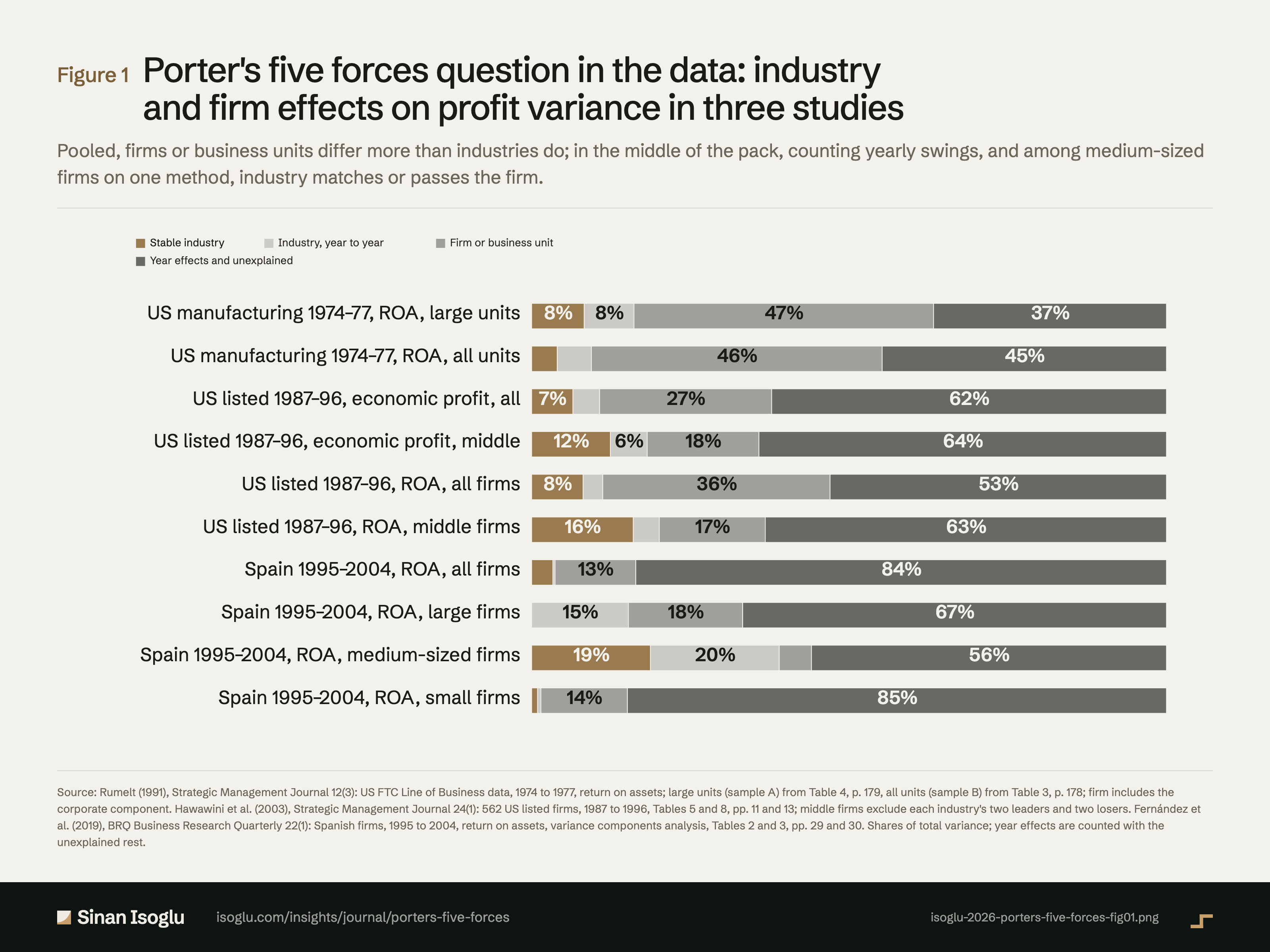
Abbildung 1Grafik
Die Five-Forces-Frage in den Daten: Branchen- und Unternehmenseffekte in drei Studien
Porters Five Forces: warum die Firma mehr zählt als die Branche
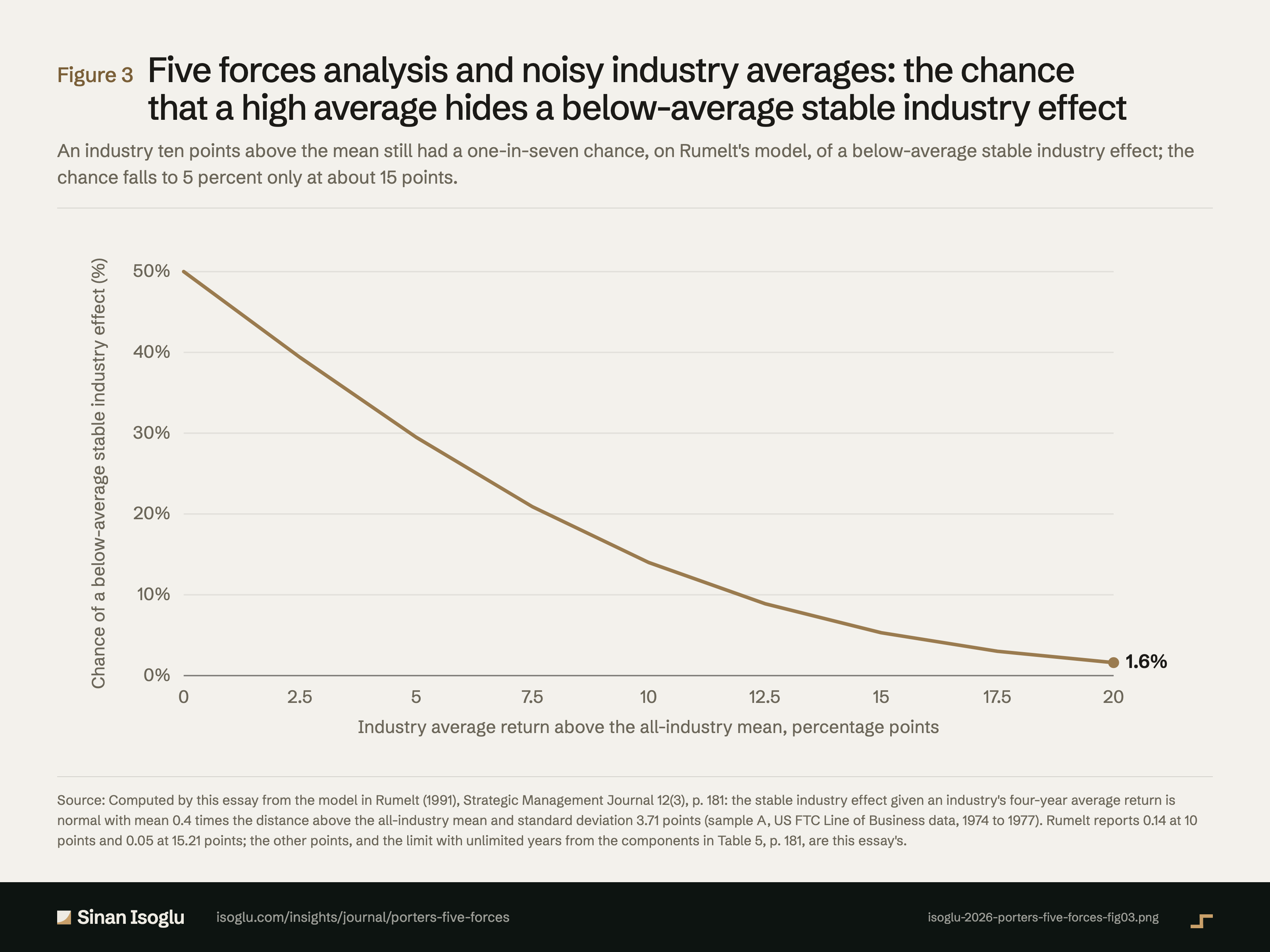
Abbildung 3Grafik
Five-Forces-Analyse und verrauschte Branchendurchschnitte: Wahrscheinlichkeit, dass ein hoher Durchschnitt einen unterdurchschnittlichen dauerhaften Brancheneffekt verdeckt
Porters Five Forces: warum die Firma mehr zählt als die Branche
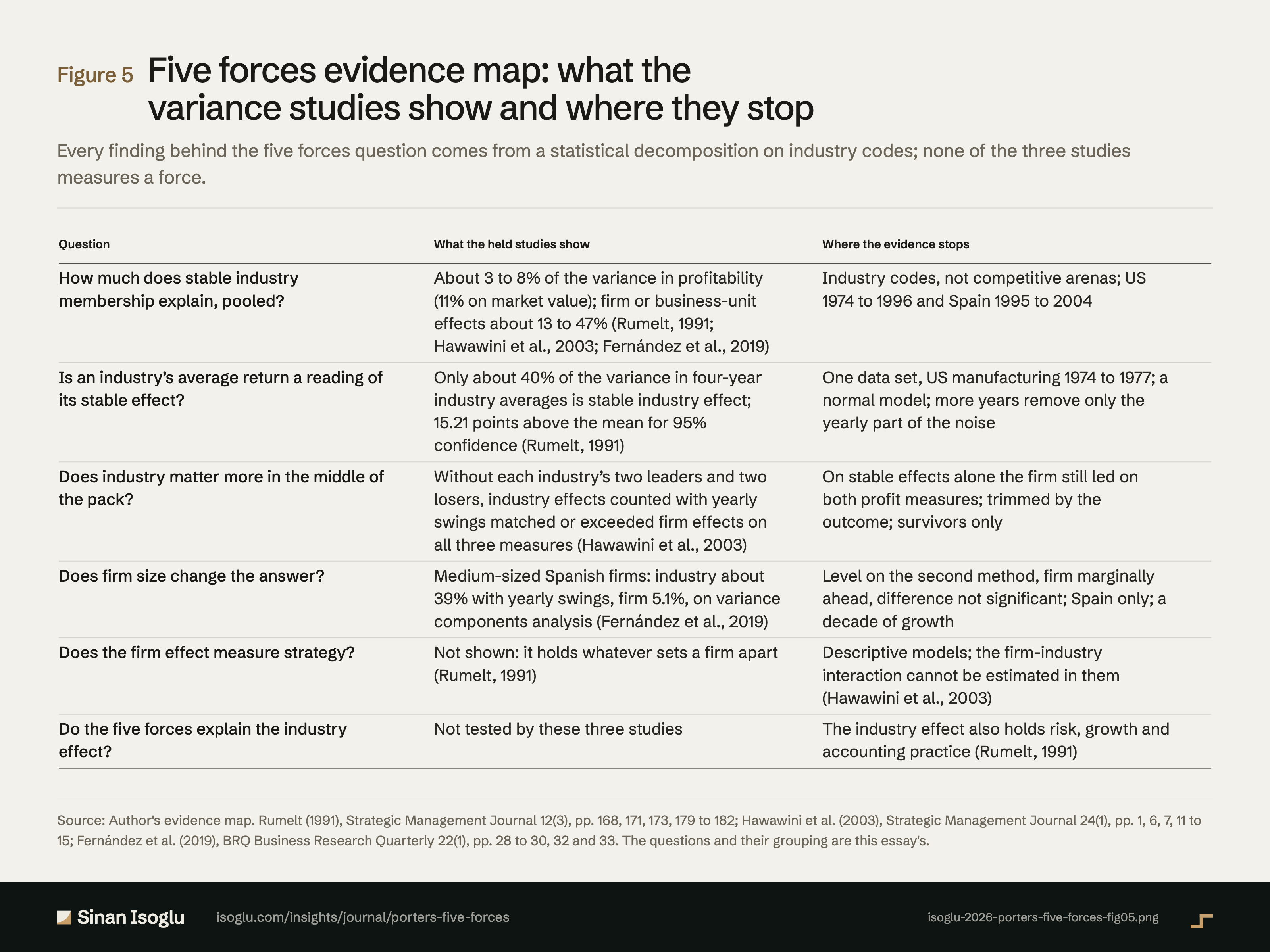
Abbildung 5Grafik
Five-Forces-Evidenzkarte: was die Varianzstudien zeigen und wo sie enden
Porters Five Forces: warum die Firma mehr zählt als die Branche
Kontakt
Schicken Sie die Frage, an der Sie arbeiten.
Forschung, ein Gastvortrag oder eine Frage aus der Praxis.