Abbildung 1Aus „Die 20-55-Regel verfehlt das Portfolio“
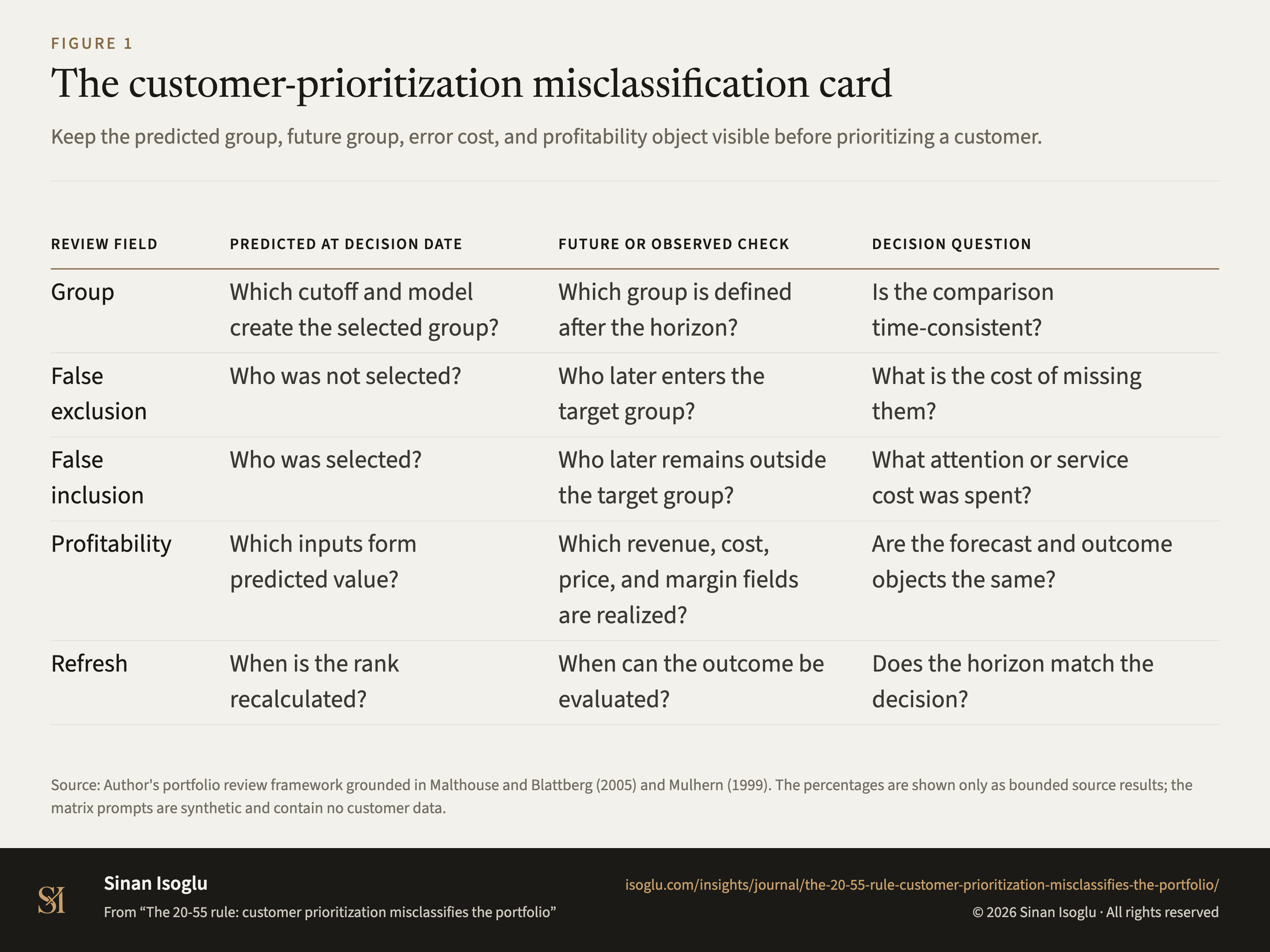
Die Fehlklassifikationskarte für Kundenpriorisierung
Halten Sie vorhergesagte und künftige Gruppe, Fehlkosten und Profitabilitätsobjekt sichtbar, bevor ein Kunde priorisiert wird.
Abbildung 1Die Fehlklassifikationskarte für Kundenpriorisierung
| Prüffeld | Zum Entscheidungsdatum vorhergesagt | Künftige oder beobachtete Prüfung | Entscheidungsfrage |
|---|---|---|---|
| Gruppe | Welche Schwelle und welches Modell erzeugen die Auswahl? | Welche Gruppe wird nach dem Horizont definiert? | Ist der Vergleich zeitlich konsistent? |
| Falscher Ausschluss | Wer wurde nicht ausgewählt? | Wer kommt später in die Zielgruppe? | Was kostet das Übersehen? |
| Falscher Einschluss | Wer wurde ausgewählt? | Wer bleibt später außerhalb der Zielgruppe? | Welche Aufmerksamkeit oder Leistungskapazität wurde eingesetzt? |
| Profitabilität | Welche Inputs bilden den prognostizierten Wert? | Welche Umsatz-, Kosten-, Preis- und Margenfelder werden realisiert? | Sind Prognose- und Ergebnisobjekt identisch? |
| Aktualisierung | Wann wird das Ranking neu berechnet? | Wann kann das Ergebnis geprüft werden? | Passt der Horizont zur Entscheidung? |
Bei breiten Tabellen horizontal wischen oder scrollen.
Quelle: Portfolio-Freigaberahmen des Autors, begründet mit Malthouse und Blattberg (2005) sowie Mulhern (1999). Die Prozentsätze werden nur als begrenzte Quellenresultate gezeigt; die Matrixfragen sind synthetisch und enthalten keine Kundendaten.
Quelle und Evidenz
Jede Zeile nennt eine Aussage zu dieser Abbildung, ihre Quelle und die Art ihrer Prüfung.
- A MB05-C1 The question is feasibility, not desirability: relationship-marketing strategies "presume that a firm can accurately predict the future profitability of customers", and the paper is "a detailed empirical evaluation of how accurately the future profitability of customers" can be predicted across four industry data setsMalthouse & Blattberg. (2005)
- A MB05-C2 The 20-55 rule, as posited: of the actual best customers, "approximately 55% will be misclassified and not receive special treatment". The authors call these "two new empirical rules of thumb based on these results", so they are rules of thumb from four data sets, not constants. About 15% of the future bottom 80% may be misclassified and receive special treatment.Malthouse & Blattberg. (2005)
- A MB05-C3 "the feasibility of such strategies depends on the probabilities and costs of misclassifying customers", so it turns on prediction accuracy, forecast horizon, and the costs of misclassification.Malthouse & Blattberg. (2005)
- A MUL99-C1 The paper is METHOD, not an empirical finding, in its own words: "This paper provides a conceptual and methodological foundation for measuring customer profitability" by extending customer-lifetime-value approaches to broader target-marketing applications.Mulhern. (1999)
- A MUL99-C2 Concentration is analysed as a distribution, not asserted as a ratio: "a sharply descending curve for the ordering of customer profit" corresponds to a skewed frequency distribution, and the Lorenz curve's shortcoming is that "it cannot portray percentiles of customers who represent a financial loss to a firm"Mulhern. (1999)
Prüfgrade: A, gegen die gedruckte Seite der Primärquelle geprüft · B, Primärquelle, nur Textebene · C, belastbare Sekundärquelle · D, berichtet.
Aus dem Beitrag
Wachstum, das sich potenziert
Die 20-55-Regel verfehlt das Portfolio
Ein Kundenranking kann künftige Topkunden verfehlen: Halten Sie Prognosehorizont, Schwelle, Fehlkosten und Profitabilitätsinputs sichtbar.
Den Beitrag lesenDiese Abbildung gehört zu einem Essay: Die Zahlen stehen hier, das Argument dort.
Zitieren oder einbetten
Verwandte Abbildungen
Tabelle 1Tabelle
Die Portfoliomatrix für Kundenallokation
Kundenauswahl ist eine Ressourcenallokationsentscheidung
Abbildung 1Grafik
Die CAC-Abgrenzungskarte
Was sind Kundenakquisitionskosten?
Tabelle 1Tabelle
Die Multi-Outcome-Kundenmodellkarte
Ein Kundenmodell kann nicht jedes Ergebnis prognostizieren
Kontakt
Schicken Sie die Frage, an der Sie arbeiten.
Forschung, ein Gastvortrag oder eine Frage aus der Praxis.