Abbildung 1Aus „Was ist Key Account Management?“
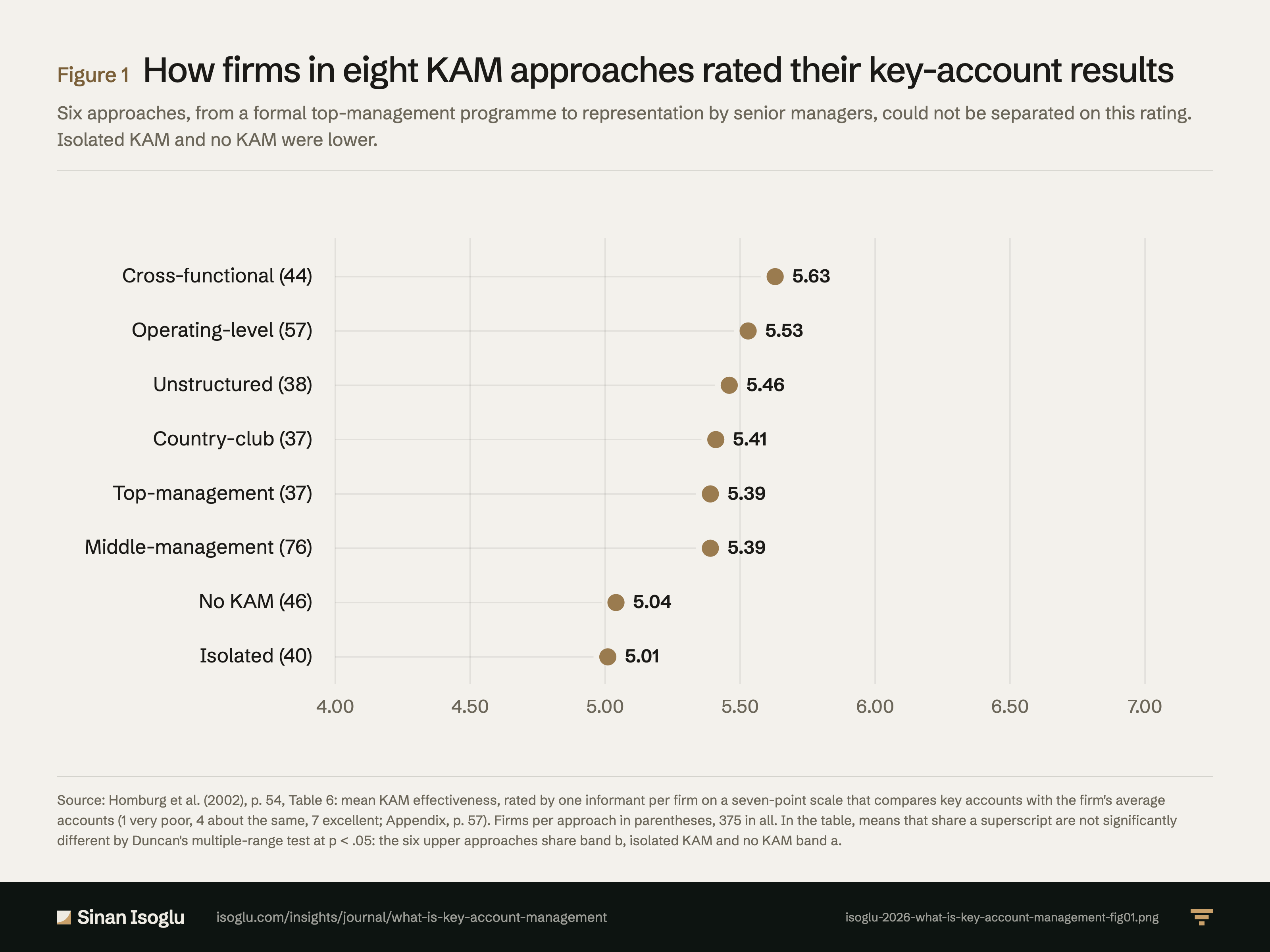
Ergebnisse mit Key Accounts, bewertet nach acht KAM-Ansätzen
Sechs Ansätze, vom formalen Top-Management-Programm bis zur Repräsentation durch die Führungsebene, ließen sich in dieser Bewertung nicht trennen. Isoliertes KAM und kein KAM lagen darunter.
Abbildung 1Ergebnisse mit Key Accounts, bewertet nach acht KAM-Ansätzen
Quelle: Homburg et al. (2002), S. 54, Tabelle 6: mittlere KAM-Effektivität, bewertet von einer Auskunftsperson je Unternehmen auf einer siebenstufigen Skala, die Key Accounts mit den durchschnittlichen Kunden des Unternehmens vergleicht (1 sehr schlecht, 4 etwa gleich, 7 ausgezeichnet; Anhang, S. 57). Unternehmen je Ansatz in Klammern, insgesamt 375. In der Tabelle unterscheiden sich Mittelwerte mit gleichem hochgestelltem Buchstaben nach dem multiplen Spannweitentest von Duncan nicht signifikant (p < 0,05): Die sechs oberen Ansätze teilen Band b, isoliertes KAM und kein KAM Band a.
Quelle und Evidenz
Jede Zeile nennt eine Aussage zu dieser Abbildung, ihre Quelle und die Art ihrer Prüfung.
- A HWJ02-C5 Table 6 (p. 54, read from the page image), mean KAM effectiveness: cross-functional 5.63, operating-level 5.53, unstructured 5.46, country-club 5.41, top-management 5.39, middle-management 5.39 (band b), no KAM 5.04, isolated 5.01 (band a); profitability highest for top-management KAM (6.38, band b), the only approach significantly above no KAM (4.80, band a), with middle-management and operating-level (4.98) and country-club KAM (4.82) in band a alone and cross-functional (5.64), unstructured (5.84) and isolated KAM (5.23) in bands a and b; cross-functional KAM has the highest mean on performance in the market (5.51, band d, which middle-management, unstructured and country-club KAM share) and on adaptiveness (5.43, band d alone); the authors write that no-KAM and isolated KAM perform worst on both levels, which Table 6 bears out on KAM effectiveness, performance in the market (4.54 and 4.72) and adaptiveness (4.23 and 4.25), the two lowest means each time, but not on profitability, where isolated KAM sits above four approaches; the authors treat profitability as the objective measure that a key-informant bias should not affect (p. 53); the same performance through different approaches; cluster effects remain significant under ANCOVA with market dynamism and competitive intensity; most effective not the most profitable, possibly from higher costs; the no-KAM result called the most comprehensive demonstration that suppliers benefit; failure to achieve access to and commitment of cross-functional resources seems to play a critical role (pp. 53 to 55; revised at G5 2026-10-17, F3, N3): "the same level of performance can be accomplished"; "Profitability 6.38b 4.98a 4.98a 5.64ab 5.84ab 5.23ab 4.82a 4.80a"; "Performance in 5.03bc 5.23cd 5.04bc 5.51d 5.19cd 4.72ab 5.16cd 4.54a"; "Adaptiveness 4.75bc 4.87b 4.46ab 5.43d 4.85bc 4.25a 4.50abc 4.23a"; "cluster means that have the same superscript are not significantly"; "not the objective performance measure (i.e., profitability)"; "no-KAM and the isolated KAM approaches perform the"; "the effects of cluster membership on all"; "that the most effective approaches are not the most"; "ones may be explained by some approaches involving"; "higher costs in addition to generating higher revenues"; "the most comprehensive empirical demonstration so"; "far that suppliers benefit from managing their key accounts"; "seems to play a critical"Homburg, Workman & Jensen (2002) · Homburg, Workman & Jensen. (2002)
Prüfgrade: A, gegen die gedruckte Seite der Primärquelle geprüft · B, Primärquelle, nur Textebene · C, belastbare Sekundärquelle · D, berichtet.
Aus dem Beitrag
Revenue Operations & KI
Was ist Key Account Management?
Key Account Management ist, was ein Anbieter für seine wichtigsten Kunden anders macht, und wer es tut. Ein formales Programm ist eine Form davon.
Den Beitrag lesenDiese Abbildung gehört zu einem Essay: Die Zahlen stehen hier, das Argument dort.
Zitieren oder einbetten
Verwandte Abbildungen
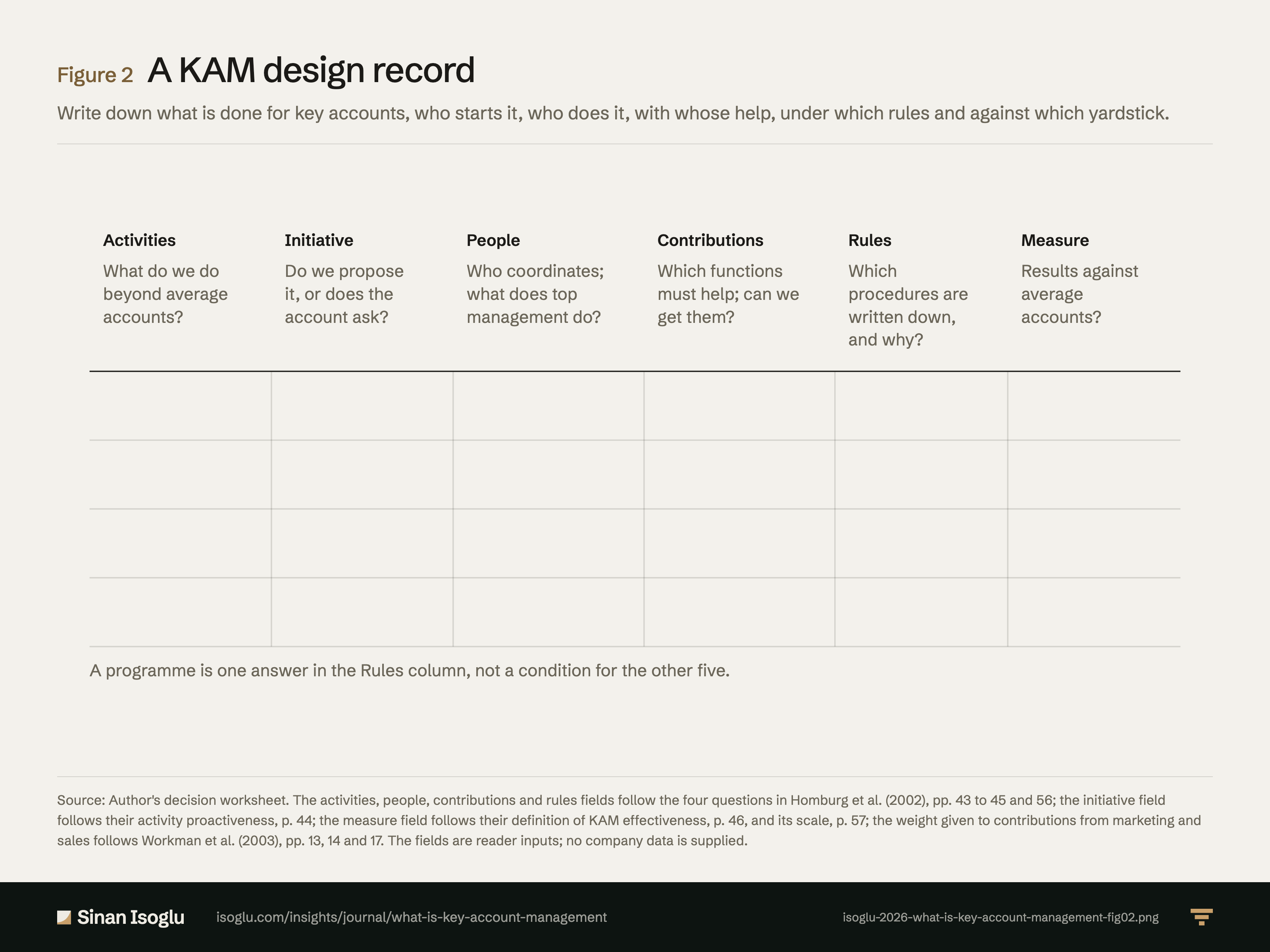
Abbildung 2Grafik
Ein Gestaltungsblatt für KAM
Was ist Key Account Management?
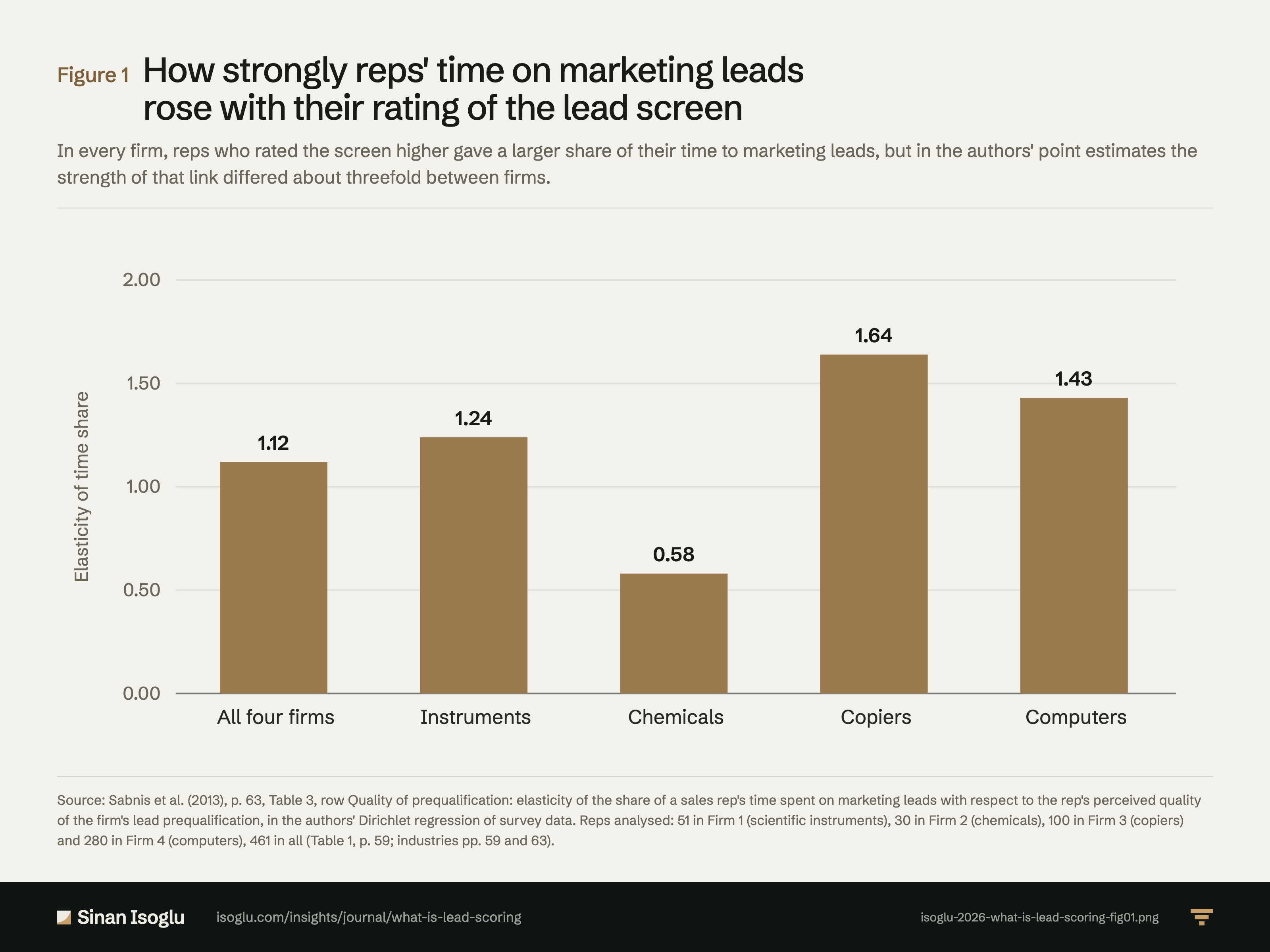
Abbildung 1Grafik
Wie stark der Zeitanteil für Marketing-Leads mit der Bewertung der Vorauswahl stieg
Was ist Lead-Scoring?
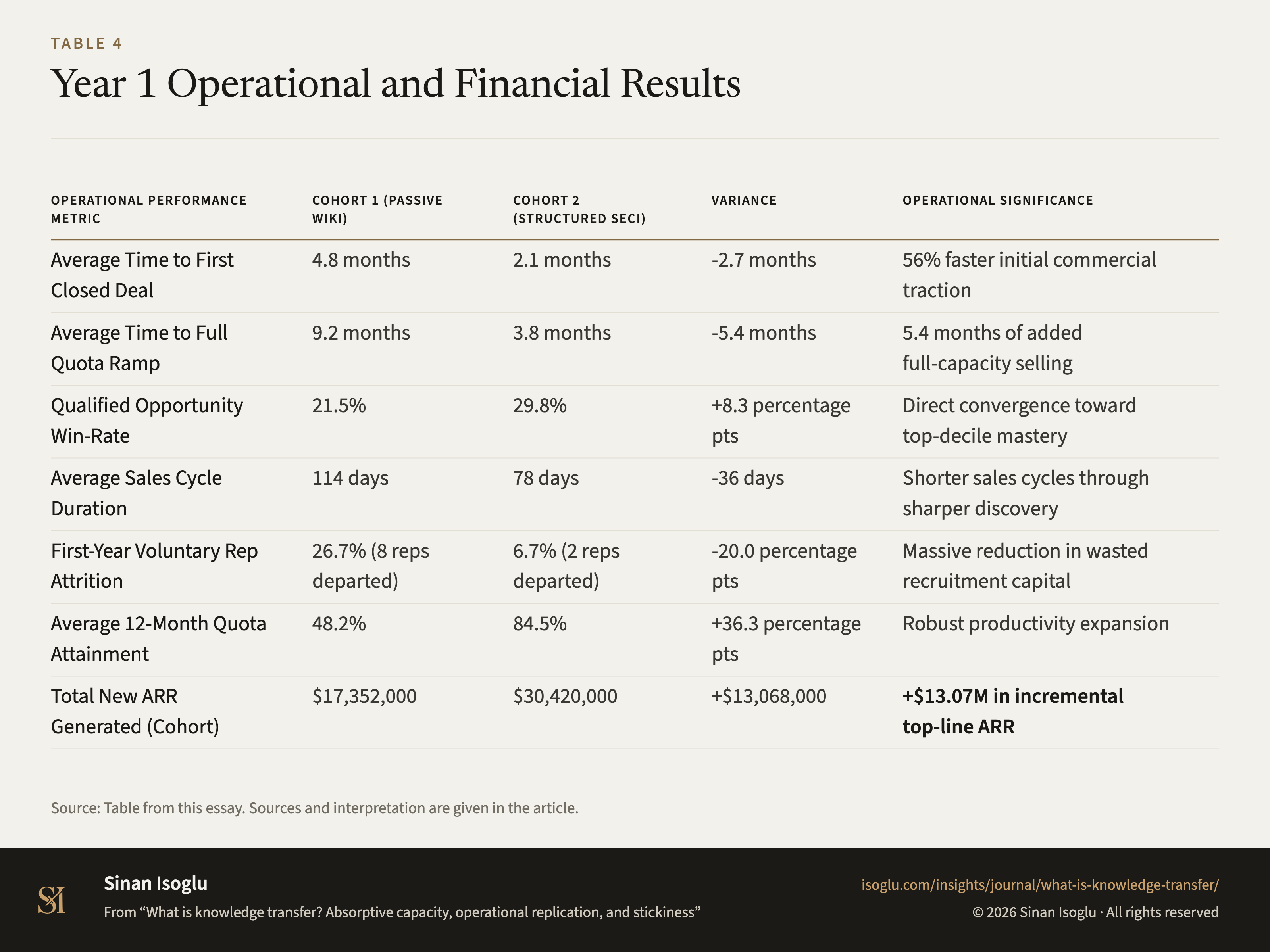
Tabelle 3Tabelle
Operative und wirtschaftliche Ergebnisse nach zwölf Monaten
Was ist Wissenstransfer? Absorptionsfähigkeit, operative Replikation und Stickiness
Kontakt
Schicken Sie die Frage, an der Sie arbeiten.
Forschung, ein Gastvortrag oder eine Frage aus der Praxis.