Tabelle 1Aus „Kundenauswahl ist eine Ressourcenallokationsentscheidung“
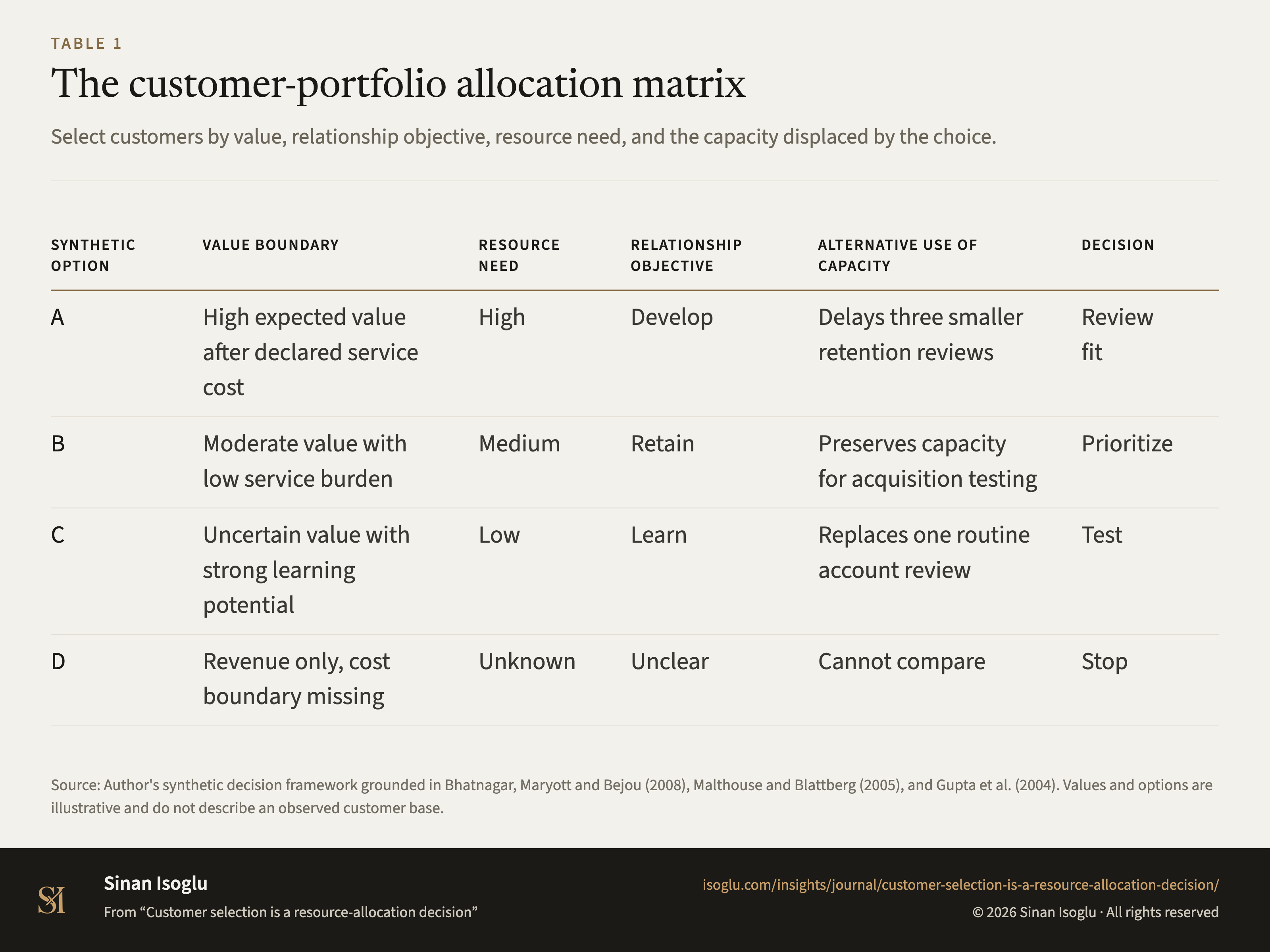
Die Portfoliomatrix für Kundenallokation
Wählen Sie Kunden nach Wert, Beziehungsziel, Ressourcenbedarf und verdrängter Kapazität aus.
Tabelle 1Die Portfoliomatrix für Kundenallokation
| Synthetische Option | Wertgrenze | Ressourcenbedarf | Beziehungsziel | Alternative Kapazitätsnutzung | Entscheidung |
|---|---|---|---|---|---|
| A | Hoher erwarteter Wert nach erklärten Servicekosten | Hoch | Entwickeln | Drei kleinere Bindungsprüfungen verschieben | Passung prüfen |
| B | Mittlerer Wert bei niedriger Servicebelastung | Mittel | Binden | Kapazität für Akquise-Tests erhalten | Priorisieren |
| C | Unklarer Wert mit hohem Lernpotenzial | Niedrig | Lernen | Eine routinemäßige Prüfung ersetzen | Testen |
| D | Nur Umsatz, Kostengrenze fehlt | Unbekannt | Unklar | Nicht vergleichbar | Stoppen |
Bei breiten Tabellen horizontal wischen oder scrollen.
Quelle: Synthetischer Entscheidungsrahmen des Autors auf Grundlage von Bhatnagar, Maryott und Bejou (2008), Malthouse und Blattberg (2005) sowie Gupta et al. (2004). Werte und Optionen sind illustrativ und beschreiben keinen beobachteten Kundenbestand.
Quelle und Evidenz
Jede Zeile nennt eine Aussage zu dieser Abbildung, ihre Quelle und die Art ihrer Prüfung.
- A BMB08-C1 The article treats customer selection and prioritization as a resource-allocation problem aimed at maximizing customer value.Bhatnagar, Maryott & Bejou. (2008)
- A BMB08-C2 Customer acquisition, retention, relationship development, and customer lifetime value are presented as connected inputs to allocation decisions.Bhatnagar, Maryott & Bejou. (2008)
- A BMB08-C3 The framework implies that firms should differentiate customers and investment levels rather than apply uniform relationship-marketing spending across the customer base.Bhatnagar, Maryott & Bejou. (2008)
- A MB05-C1 The question is feasibility, not desirability: relationship-marketing strategies "presume that a firm can accurately predict the future profitability of customers", and the paper is "a detailed empirical evaluation of how accurately the future profitability of customers" can be predicted across four industry data setsMalthouse & Blattberg. (2005)
- A MB05-C2 The 20-55 rule, as posited: of the actual best customers, "approximately 55% will be misclassified and not receive special treatment". The authors call these "two new empirical rules of thumb based on these results", so they are rules of thumb from four data sets, not constants. About 15% of the future bottom 80% may be misclassified and receive special treatment.Malthouse & Blattberg. (2005)
- A MB05-C3 "the feasibility of such strategies depends on the probabilities and costs of misclassifying customers", so it turns on prediction accuracy, forecast horizon, and the costs of misclassification.Malthouse & Blattberg. (2005)
- A GLS04-C2 The sensitivity is theirs and it is asymmetric: "a 1% improvement in retention, margin, or acqui"sition cost "improves firm value by 5%, 1%, and .1%, respectively"Gupta, Lehmann & Stuart. (2004)
- A GLS04-C3 Five firms, public data: the method is demonstrated "by using publicly available data for five firms", and retention outweighs the discount rate, since "a 1% improvement in retention has almost five times greater impact on firm value than a 1% change in discount rate or cost of capital"Gupta, Lehmann & Stuart. (2004)
Prüfgrade: A, gegen die gedruckte Seite der Primärquelle geprüft · B, Primärquelle, nur Textebene · C, belastbare Sekundärquelle · D, berichtet.
Aus dem Beitrag
Wachstum, das sich potenziert
Kundenauswahl ist eine Ressourcenallokationsentscheidung
Kundenauswahl ist kein Score: Vergleichen Sie Akquise, Bindung, Entwicklung, Kundenwert und knappe Kapazität in einem Zeithorizont.
Den Beitrag lesenDiese Abbildung gehört zu einem Essay: Die Zahlen stehen hier, das Argument dort.
Zitieren oder einbetten
Verwandte Abbildungen
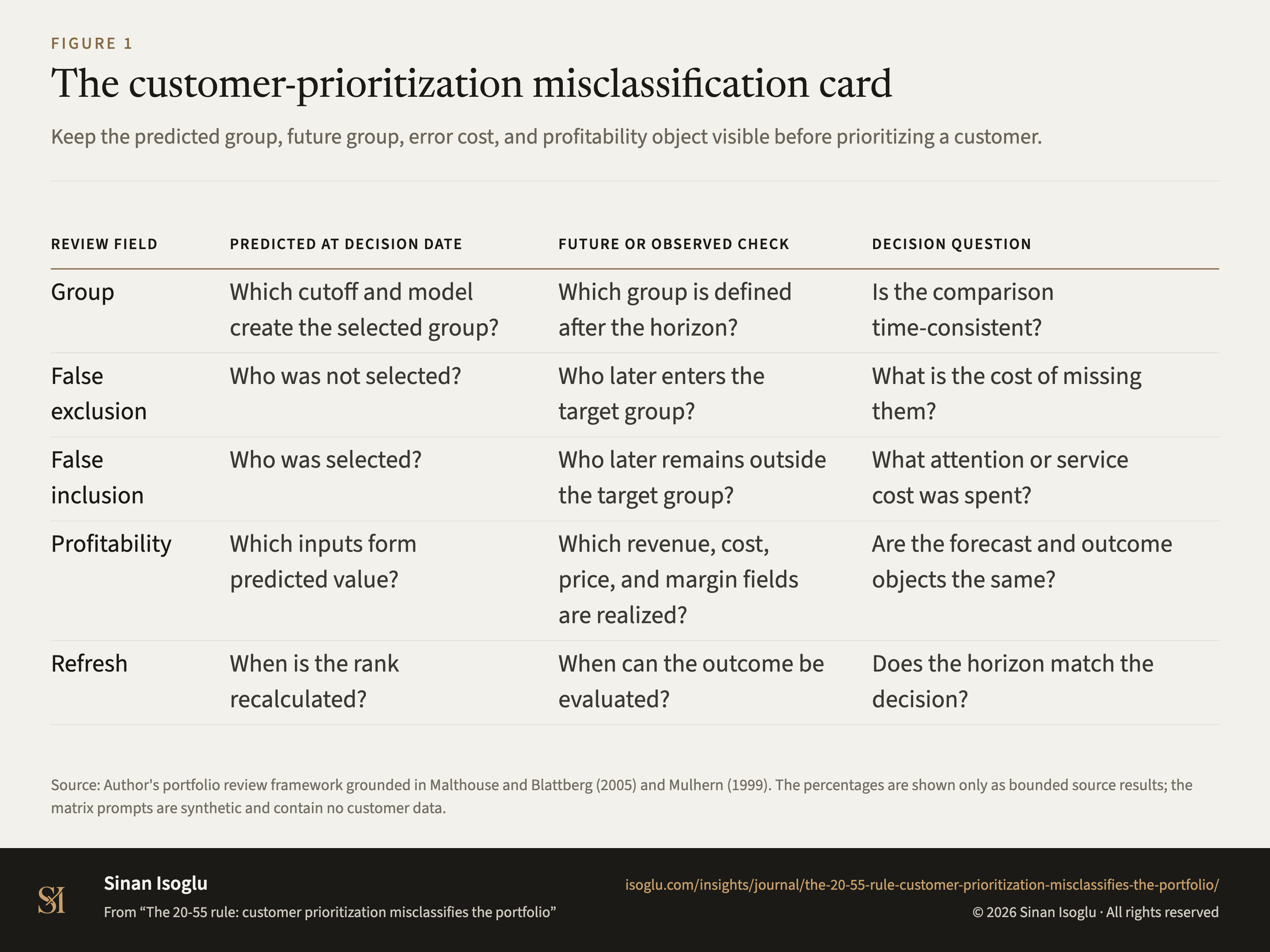
Abbildung 1Grafik
Die Fehlklassifikationskarte für Kundenpriorisierung
Die 20-55-Regel verfehlt das Portfolio
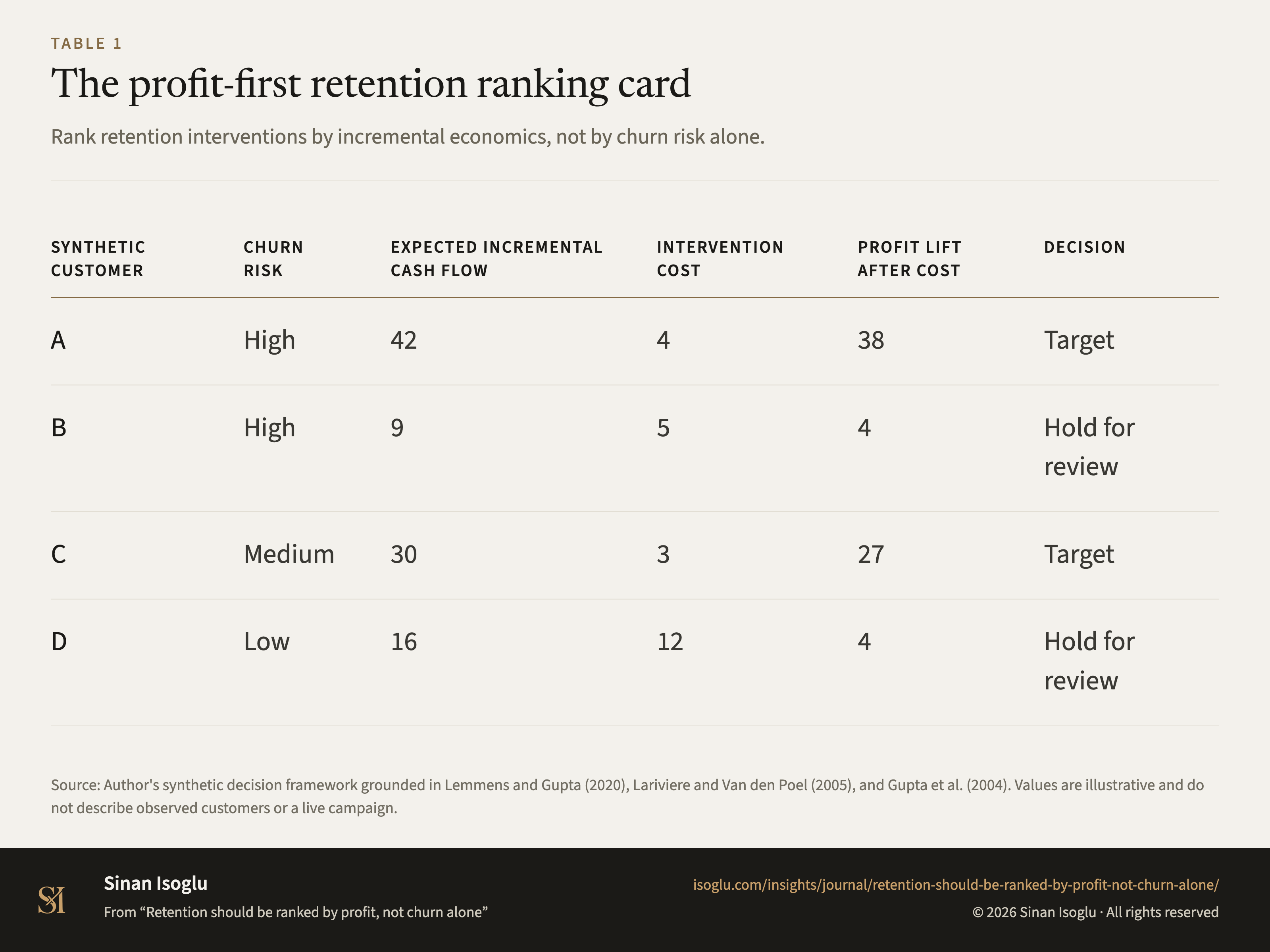
Tabelle 1Tabelle
Die profitbasierte Kundenbindungskarte
Kundenbindung sollte nach Profit gerankt werden, nicht nur nach Churn
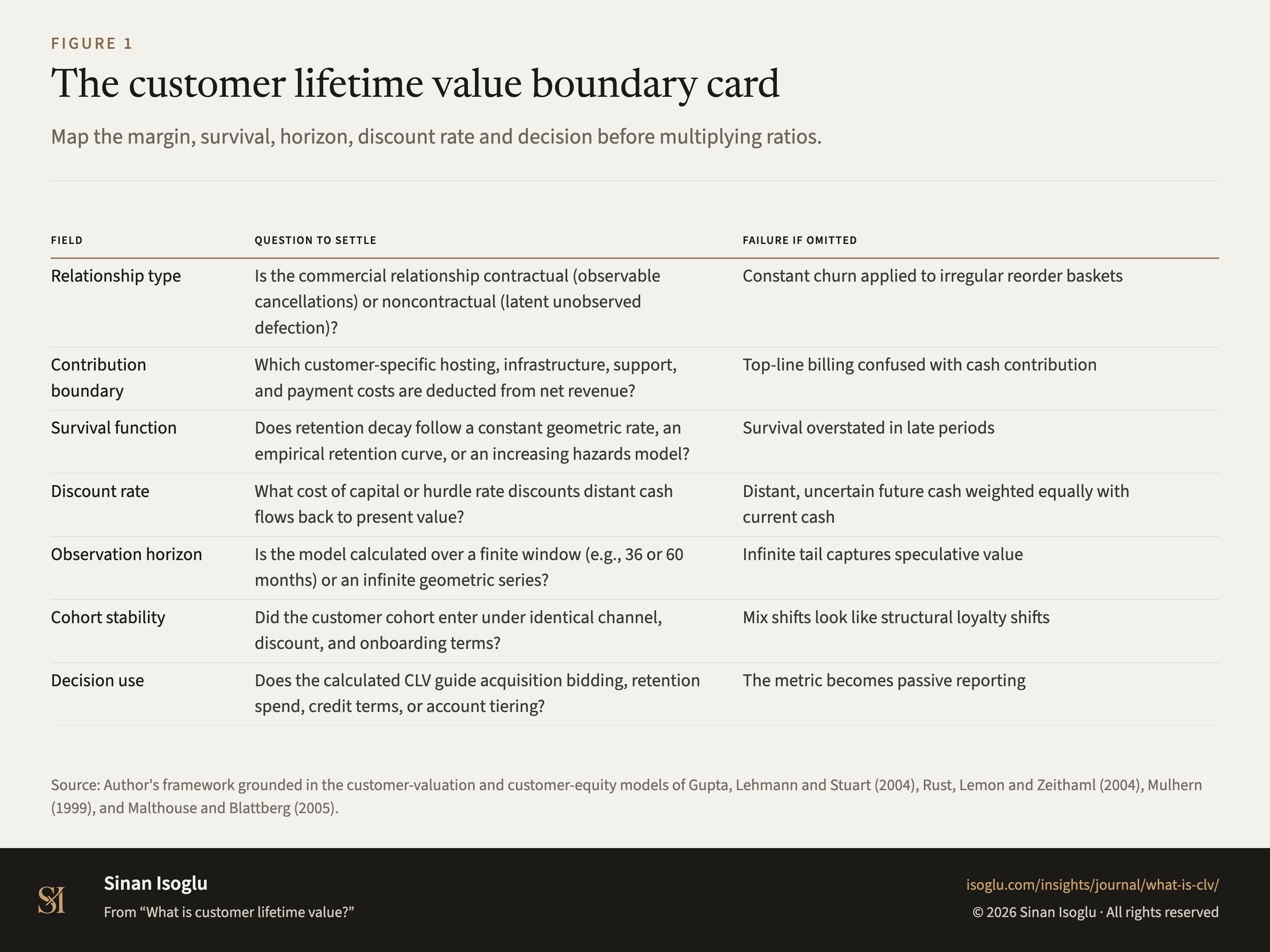
Abbildung 1Grafik
Die CLV-Abgrenzungskarte
Was ist Customer Lifetime Value?
Kontakt
Schicken Sie die Frage, an der Sie arbeiten.
Forschung, ein Gastvortrag oder eine Frage aus der Praxis.