Abbildung 2Aus „Was ist kausale Inferenz?“
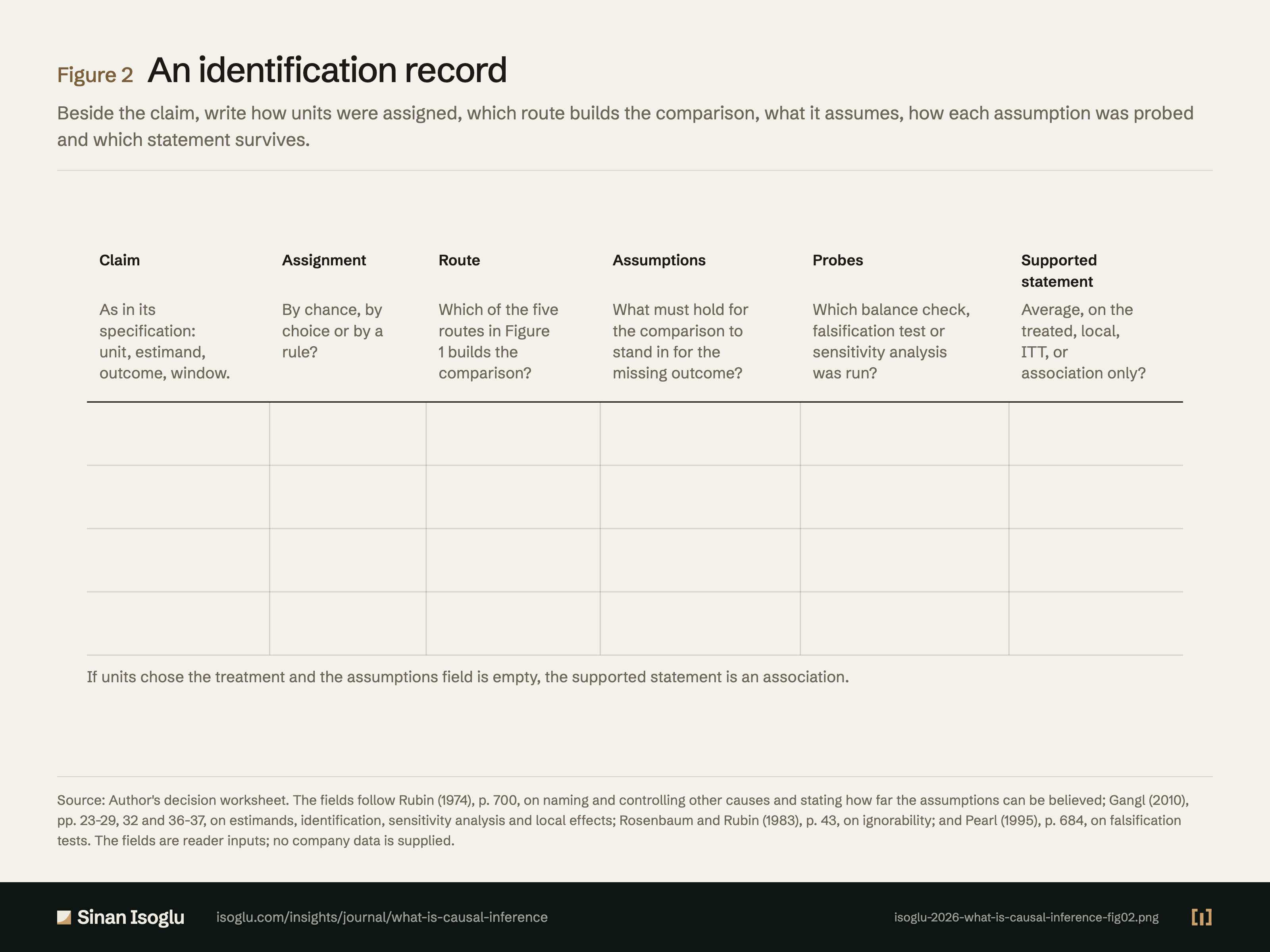
Ein Identifikationsblatt
Neben der Aussage festhalten, wie die Einheiten zugeteilt wurden, welcher Weg den Vergleich baut, was er annimmt, wie jede Annahme geprüft wurde und welche Aussage bleibt.
Abbildung 2Ein Identifikationsblatt
Quelle: Entscheidungsblatt des Autors. Die Felder folgen Rubin (1974), S. 700, zur Benennung und Kontrolle anderer Ursachen und zur Glaubhaftigkeit der Annahmen; Gangl (2010), S. 23-29, 32 und 36-37, zu Estimands, Identifikation, Sensitivitätsanalyse und lokalen Effekten; Rosenbaum und Rubin (1983), S. 43, zur Ignorierbarkeit; und Pearl (1995), S. 684, zu Falsifikationstests. Die Felder sind Eingaben der Lesenden; Unternehmensdaten werden nicht geliefert.
Quelle und Evidenz
Jede Zeile nennt eine Aussage zu dieser Abbildung, ihre Quelle und die Art ihrer Prüfung.
- B CINF-OWN-C4 A causal claim is written down in two halves: a specification of what it is about (the uplift essay's nine-field sheet) and an identification record of the claim, the assignment mechanism, the route, its assumptions, the probes of each assumption and the statement the evidence supports.Author worksheet grounded in RUB74-C7, GNG10-C3, GNG10-C7, GNG10-C11, RR83-C4 and PRL95-C5
- A RUB74-C7 Think hard about other causes of the outcome, plan their control in advance, and state how far the assumptions can be believed (p. 700): "the investigator should think hard about variables besides the treatment that may causally affect Y and plan in advance how to control for the important ones"; "it is important to indicate the extent to which the assumptions of subjective randomization and subjective random sampling can be believed"Rubin. (1974)
- A GNG10-C3 With heterogeneous effects no single number gives the causal effect; choosing the parameter is a first theoretical issue; the effect on the treated may be easier to identify and more informative (pp. 23, 24): "there is no single number that would provide the causal effect of D on Y"; "Determining which causal parameter(s) to focus on in any given study thus becomes a first theoretical issue to be settled by the analyst"; "may be both easier to identify and theoretically more informative"Gangl. (2010)
- A GNG10-C7 The conditional independence assumption: given covariates, treatment is as good as random; it is a theoretical statement about joint causes, and a minimally sufficient set of covariates is enough (p. 27): "so that, conditional on covariates, variation in D is as good as randomly assigned"; "is not a primarily statistical, but rather a fundamentally theoretical statement about the joint causes X of D and Y"; "a minimally sufficient set of covariates"Gangl. (2010)
- A GNG10-C11 Sensitivity analysis gauges remaining bias under plausible degrees of unmeasured confounding, and is most meaningful when the simulated range has empirical content (p. 32): "to understand the extent of remaining bias in the empirical estimates under plausible assumptions about the degree of unmeasured confounding in the data"; "are most meaningful if the range of simulated values has empirical content"Gangl. (2010)
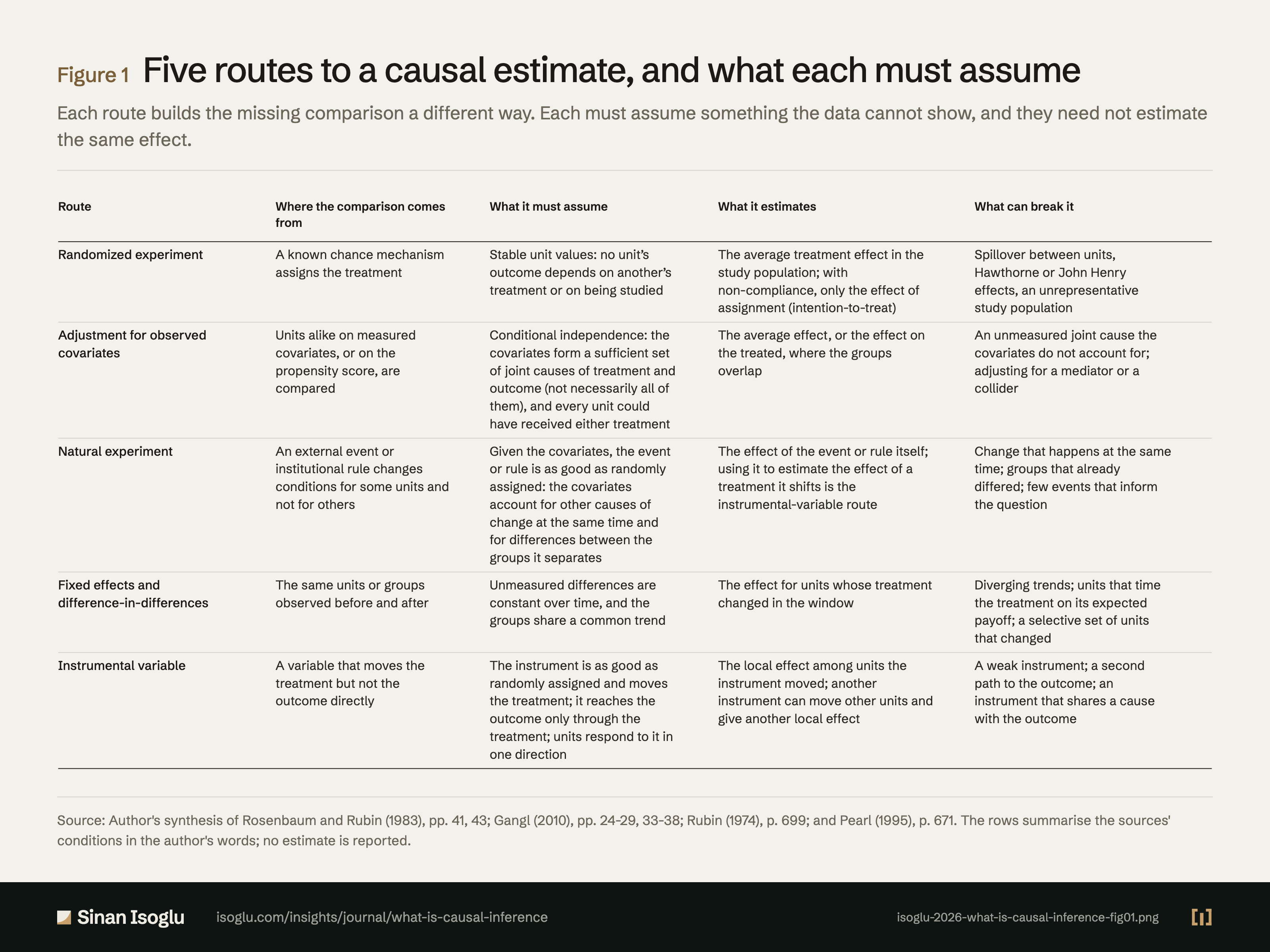
- A GNG10-C12 An instrument predicts treatment but not outcomes; IV does not reliably identify the average effect unless it is constant; under monotonicity it gives the local effect for compliers, which depends on the instrument; weak instruments undermine the estimator; in experiments the local effect is the complier average causal effect and the effect of the manipulation is the intention-to-treat effect (pp. 33, 36, 37): "that predicts treatment status D, but not outcomes"; "IV does not reliably identify the average treatment effect of D unless the"; "those units i that complied with treatment D because of the instrument Z"; "LATE is defined by the specific instrument Z available to the researcher"; "reliance on weak instruments undermines the statistical consistency and efficiency of the estimator"; "identifies the complier average causal effect (CACE), whereas the net effect of the manipulation Z corresponds to the intention-to-treat (ITT) effect"; "Z needs to be relevant for treatment assignment"; "potential outcomes need to be independent of Z given D"; "is untestable in principle and needs to be justified theoretically"; "the population of compliers cannot actually be identified in the sample data"; "variation in LATE estimates based on alternative instruments Z is indeed a desirable property of the analysis"Gangl. (2010)
- A RR83-C4 Strong ignorability: conditional independence of outcomes and assignment given covariates, known in a randomized trial and usually not in a nonrandomized one, plus a chance of each treatment for every unit (p. 43): "This condition is usually not known to hold in a nonrandomized experiment."; "every unit in the population has a chance of receiving each treatment"; "Generally, we shall say treatment assignment is strongly ignorable given a"; "with properly collected data in a randomized trial"Rosenbaum & Rubin. (1983)
- A PRL95-C5 The results rest on assumptions shown in the graph that usually cannot be tested in observational studies; some instrumental-variable assumptions can be falsified; any causal inference from observational data rests on causal assumptions, and diagrams make them explicit; identification assumes samples large enough to ignore sampling variability (p. 684): "the results must rest on the causal assumptions shown in the graph, and that these cannot usually be tested in observational studies"; "most notably those associated with instrumental variables"; "any causal inferences from observational studies must ultimately rely on some kind of causal assumptions"; "an effective language for making those assumptions precise and explicit"; "that the sample size is so large that sampling variability may be ignored"; "In related papers (Pearl, 1994a, 1995) we show that some of the assumptions"Pearl. (1995)
Prüfgrade: A, gegen die gedruckte Seite der Primärquelle geprüft · B, Primärquelle, nur Textebene · C, belastbare Sekundärquelle · D, berichtet.
Aus dem Beitrag
Aus der Forschung
Was ist kausale Inferenz?
Kausale Inferenz schätzt, was eine Änderung bewirkt hat, aus Ergebnissen, die nie alle beobachtet werden. Die Antwort tragen Design und Annahmen.
Den Beitrag lesenDiese Abbildung gehört zu einem Essay: Die Zahlen stehen hier, das Argument dort.
Zitieren oder einbetten
Verwandte Abbildungen
Kontakt
Schicken Sie die Frage, an der Sie arbeiten.
Forschung, ein Gastvortrag oder eine Frage aus der Praxis.