Tabelle 1Aus „Conjoint-Analyse schätzt Präferenzen, nicht Nachfrage“
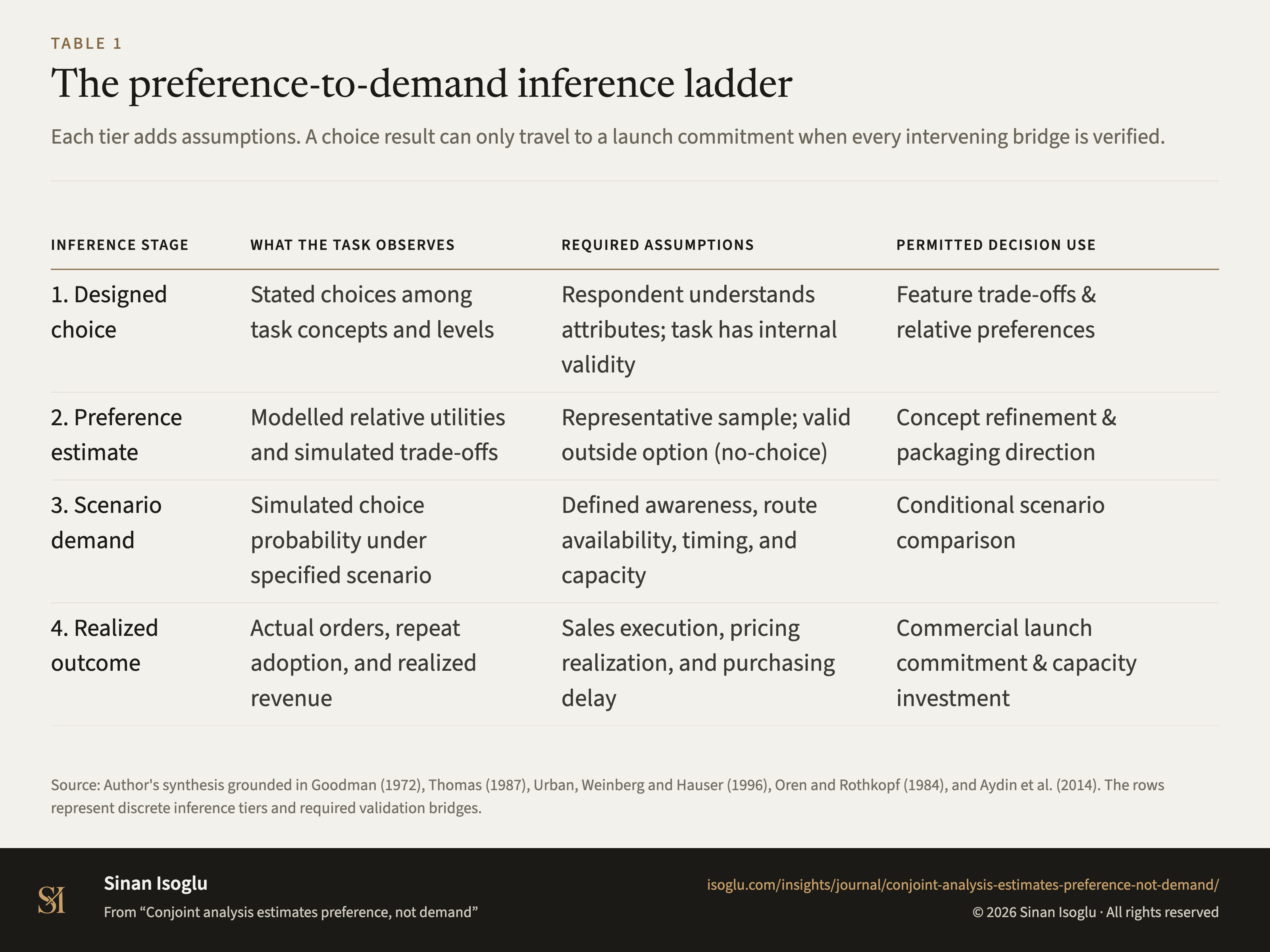
Die Schlussfolgerungsleiter von Präferenz zu Nachfrage
Jede Stufe erfordert zusätzliche Annahmen. Ein Auswahlergebnis rechtfertigt eine Markteinführung erst, wenn alle Zwischenstufen belegt sind.
Tabelle 1Die Schlussfolgerungsleiter von Präferenz zu Nachfrage
| Inferenzstufe | Was die Erhebung beobachtet | Erforderliche Annahmen | Zulässige Entscheidungsnutzung |
|---|---|---|---|
| 1. Gestaltete Auswahl | Angegebene Auswahl zwischen vorgegebenen Konzepten | Befragte verstehen Attribute; Aufgabe besitzt interne Validität | Merkmal-Trade-offs & relative Präferenzen |
| 2. Präferenzschätzung | Modellierte Teilnutzenwerte und relative Gewichtung | Repräsentative Stichprobe; realistische Nicht-Wahl-Option | Konzeptverfeinerung & Angebotspaketierung |
| 3. Szenario-Nachfrage | Simulierte Auswahlwahrscheinlichkeit unter Szenario | Definierte Bekanntheit, Verfügbarkeit, Timing und Kapazität | Konditionierter Szenarienvergleich |
| 4. Realisiertes Ergebnis | Tatsächliche Bestellungen, Nutzung und erzielter Umsatz | Vertriebsumsetzung, Preisdurchsetzung und Kaufverzögerung | Kommerzielle Einführung & Kapazitätsbindung |
Bei breiten Tabellen horizontal wischen oder scrollen.
Quelle: Autorensynthese auf Grundlage von Goodman (1972), Thomas (1987), Urban, Weinberg und Hauser (1996), Oren und Rothkopf (1984) sowie Aydin et al. (2014). Die Zeilen bilden diskrete Inferenzstufen und Validierungsbrücken ab.
Quelle und Evidenz
Jede Zeile nennt eine Aussage zu dieser Abbildung, ihre Quelle und die Art ihrer Prüfung.
- B MSB27-C1 Goodman's own distinction: market potential is a measure "of an environmental state at a point in time (present or future)", whereas "sales forecasts are measures of expectation which are conditional upon inputs of the various marketing decision variables", and "it is usually necessary to rely on proxy data for most of the things a marketer would like to measure"Goodman. (1972)
- B NPM27-C1 The three steps are Thomas's own: "defining a concept of market potential for the new product", independent operationalisations, and reconciliation. The reason he gives for the plurality: "Multiple methods help to ensure that what is measured is due to the phenomenon under study and not the method"Thomas. (1987)
- B NPM27-C2 The decision the forecast serves is three-way in the paper's own words: whether "the really-new product would be a viable business ven"ture, whether to plan improvements, or whether "the firm should stop development", and it is reached because "the authors describe how one firm combines managerial judgment and state"-of-the-art market measurementUrban, Weinberg & Hauser. (1996)
- B NPM27-C3 One case, and a named one: "the authors describe how one firm combines managerial judgment and state"-of-the-art market measurement to decide whether "the really-new product would be a viable business ven"tureUrban, Weinberg & Hauser. (1996)
- B NPM27-C4 The path is enumerated in the paper: "This model accounts for differ""ences in customer awareness of different products, for differences in product announcement dates, for differences in product availability, for differences in marketing efforts, for customer inertia and for customer purchasing delays", applied in "a system developed for market analysis of high speed nonimpact computer printers"Oren & Rothkopf. (1984)
- B NPM27-C5 The uncertainty the fuzzy model preserves is in the survey data itself: "a high degree of fuzziness always exists in the data obtained from conjoint surveys", and "ignorance of the fuzziness would lead to the over-estimation of market demands"Aydin, Kwong, Ji & Law. (2014)
Prüfgrade: A, gegen die gedruckte Seite der Primärquelle geprüft · B, Primärquelle, nur Textebene · C, belastbare Sekundärquelle · D, berichtet.
Aus dem Beitrag
Aus der Forschung
Conjoint-Analyse schätzt Präferenzen, nicht Nachfrage
Eine Conjoint-Analyse zeigt Abwägungen in einer gestalteten Auswahl, doch Nachfrage hängt auch von Verfügbarkeit, Timing, Kapazität und Wettbewerb ab.
Den Beitrag lesenDiese Abbildung gehört zu einem Essay: Die Zahlen stehen hier, das Argument dort.
Zitieren oder einbetten
Verwandte Abbildungen
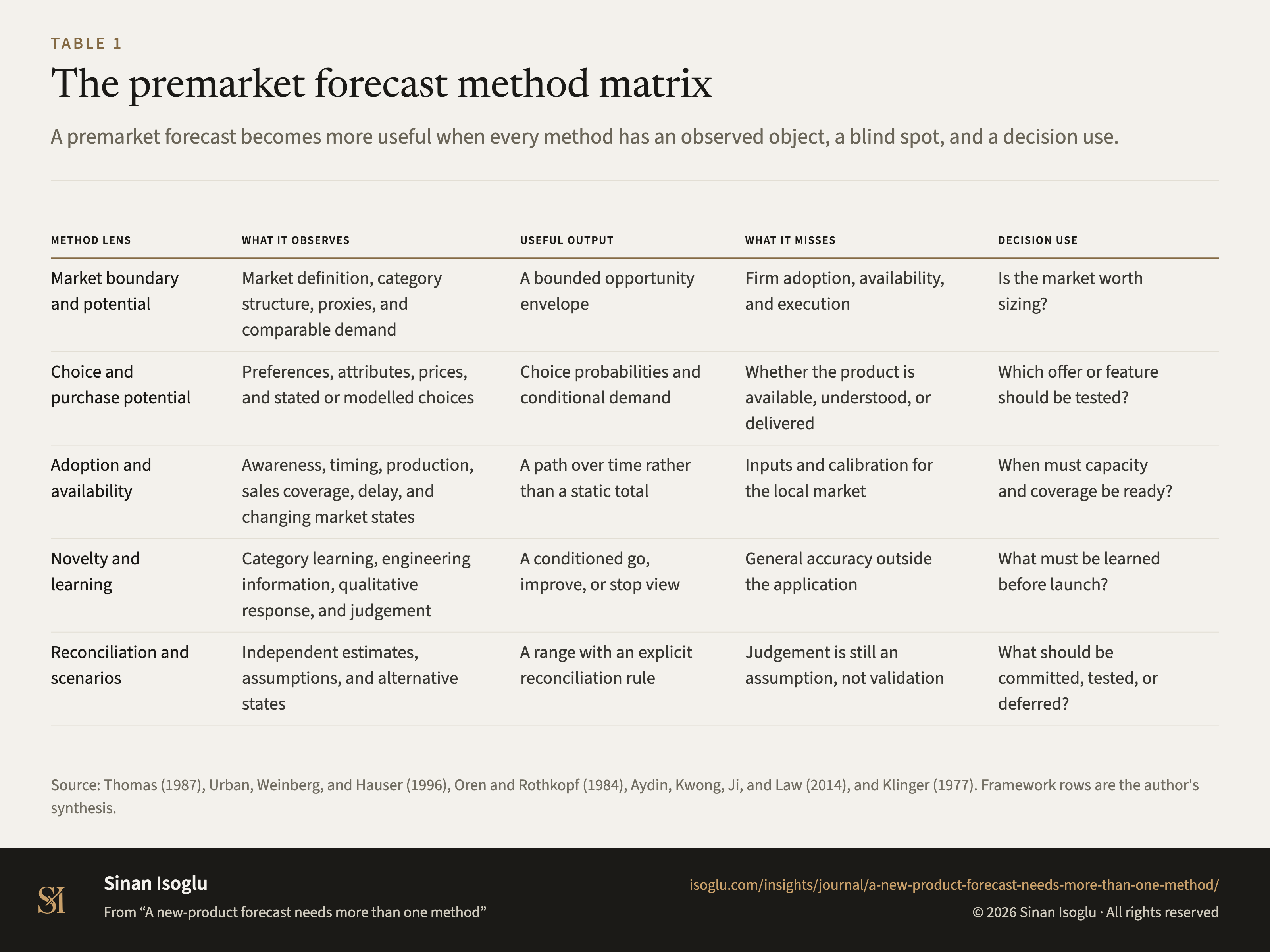
Tabelle 1Tabelle
Die Methodenmatrix für Vorabprognosen
Eine neue Produktprognose braucht mehr als eine Methode

Tabelle 1Tabelle
Der Screen für ausländische Märkte und Moduspassung
Auslandsmarktauswahl sollte modusspezifische Passung vergleichen
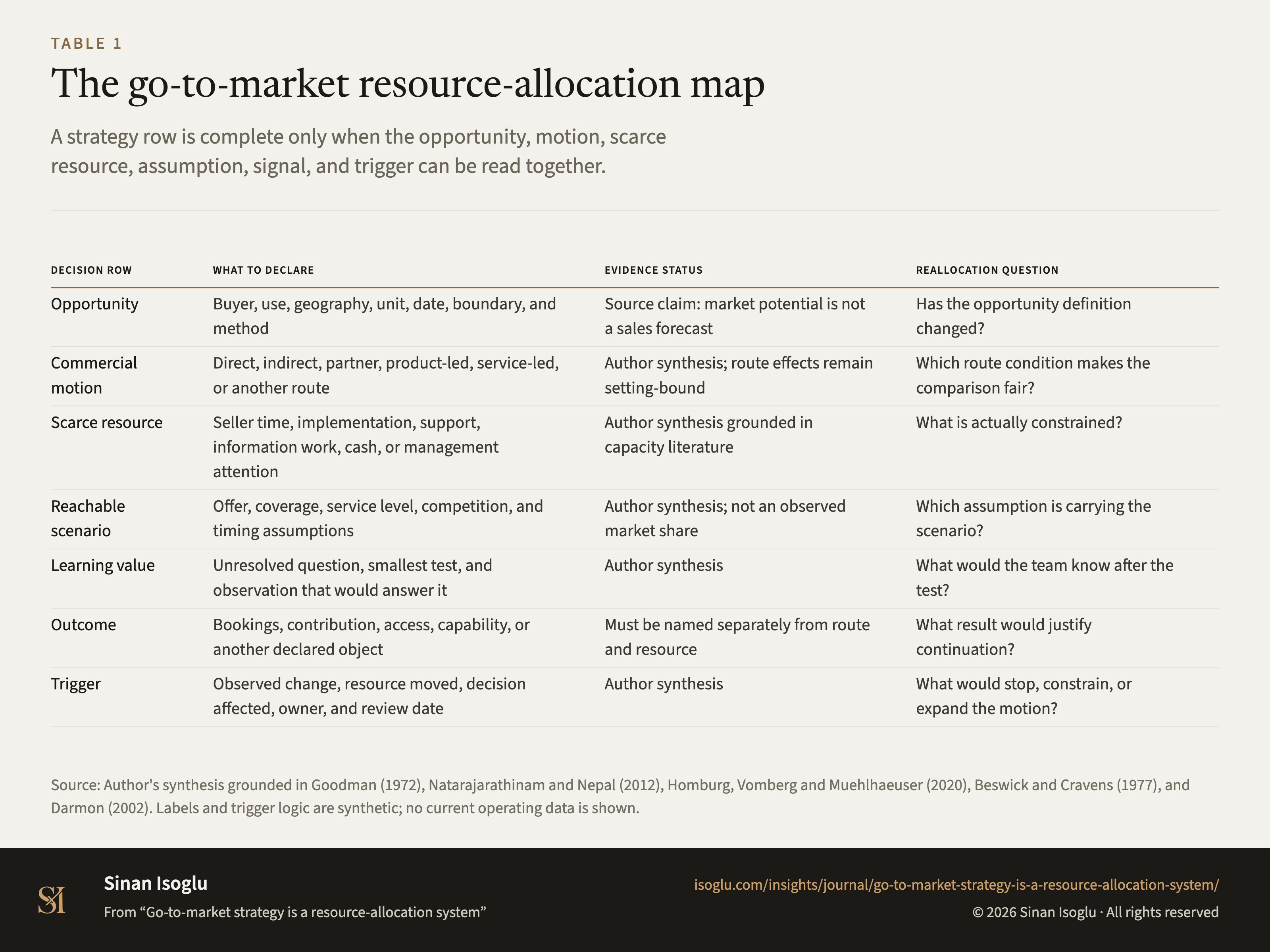
Tabelle 1Tabelle
Die Karte der Go-to-Market-Ressourcenallokation
Eine Go-to-Market-Strategie ist ein Ressourcenallokationssystem
Kontakt
Schicken Sie die Frage, an der Sie arbeiten.
Forschung, ein Gastvortrag oder eine Frage aus der Praxis.