Abbildung 5Aus „Was ist Sales and Operations Planning (S&OP)?“
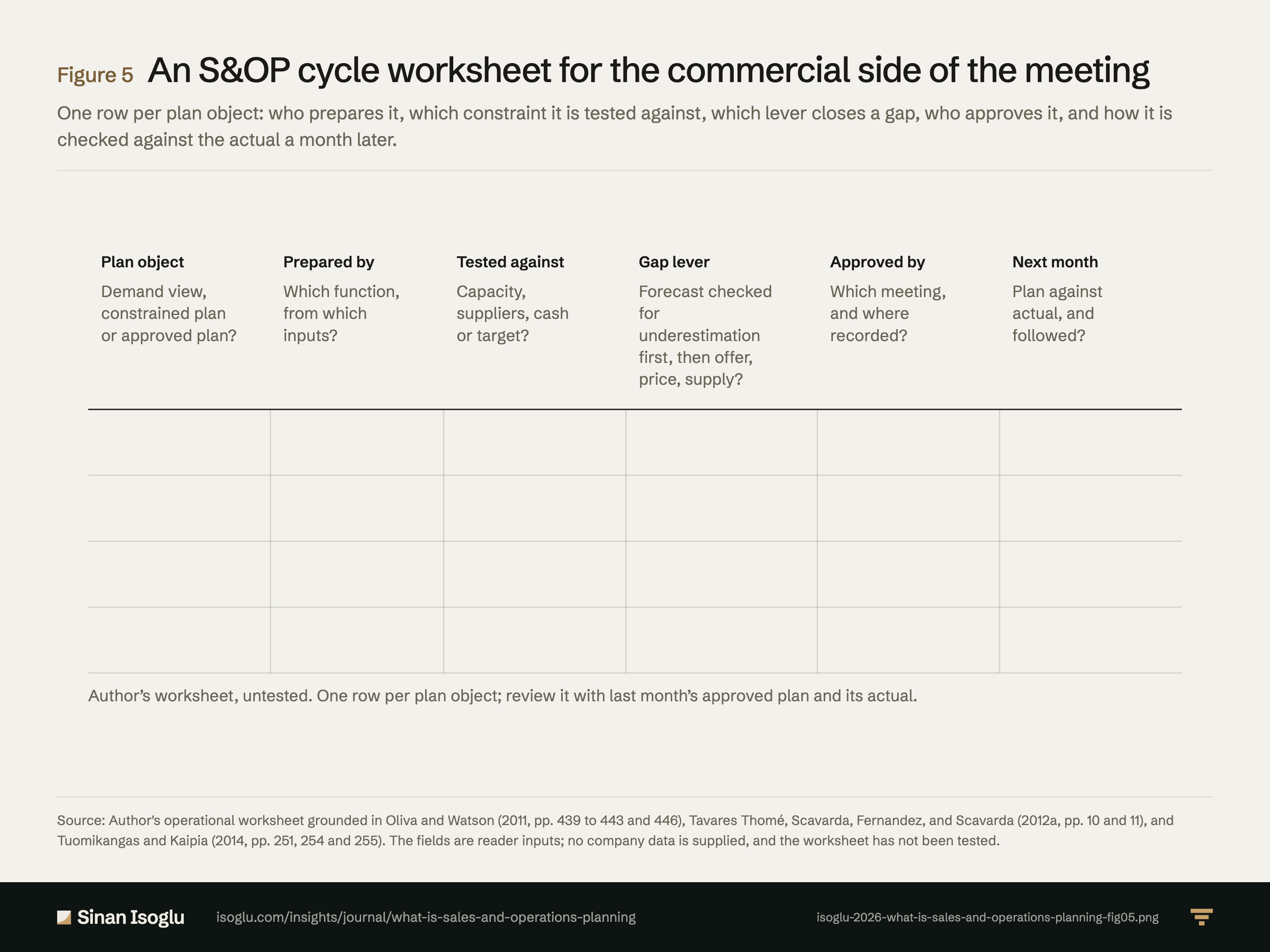
Ein Prüfblatt für den S&OP-Zyklus aus Sicht des Vertriebs
Eine Zeile je Plangegenstand: wer ihn erstellt, woran er geprüft wird, welcher Hebel eine Lücke schließt, wer ihn freigibt und wie er einen Monat später mit dem Istwert verglichen wird.
Abbildung 5Ein Prüfblatt für den S&OP-Zyklus aus Sicht des Vertriebs
Quelle: Operatives Prüfblatt des Autors auf Grundlage von Oliva und Watson (2011, S. 439 bis 443 und 446), Tavares Thomé, Scavarda, Fernandez und Scavarda (2012a, S. 10 und 11) sowie Tuomikangas und Kaipia (2014, S. 251, 254 und 255). Die Felder sind Eingaben der Leserinnen und Leser; es werden keine Unternehmensdaten geliefert, und das Prüfblatt wurde nicht erprobt.
Quelle und Evidenz
Jede Zeile nennt eine Aussage zu dieser Abbildung, ihre Quelle und die Art ihrer Prüfung.
- B A gegen die gedruckte Seite der Primärquelle geprüftB Primärquelle, nur TextebeneC belastbare SekundärquelleD berichtet An S&OP cycle worksheet for the commercial side: one row per plan object (unconstrained demand view, constrained plan, approved plan) with who prepares it, what it is tested against, which lever closes a gap, who approves it and where, and the next month's plan-against-actual and adherence check. UntestedAuthor operating framework
- A A gegen die gedruckte Seite der Primärquelle geprüftB Primärquelle, nur TextebeneC belastbare SekundärquelleD berichtet The monthly process (Fig. 1, p. 440): owned by the DMO; business assumptions package agreed on the first Wednesday; three functional forecasts at product-family level ignoring capacity; formula-weighted consensus discussed on the third Wednesday; financial validation against targets and operations validation of capacity; if the revenue fell short of targets, finance first checked that sales was not underestimating market potential, and only then were offer, prices and promotions revised and validation repeated (p. 441); the approved forecast drives the MPS; gap-filling at quarter end; accuracy feedback on each stream (pp. 440, 441): "Ownership of the forecasting and planning process was assigned to the demand management organization (DMO)"; "with the BAP and the Consensus meetings taking place in the first and third Wednesdays of the month"; "These three functional forecasts ignored capacity constraints since it was common at Leitax at this time for forecasts to be affected by perceptions of present and future supply chain capacity and thus to become self-fulfilling prophecies."; "more weight to the SDs' bottom-up forecast in the short term and increased the weight of the PPS's top-down forecast as the consensus forecast went out to the future"; "If there were capacity or financial concerns, the product offering and promotion decisions in the BAP were changed and the process of validation repeated."; "The approved forecast was released and used to generate the master production schedule (MPS)."; "usually occurred at the end of each quarter"; "the DMO presented evidence that sales forecasts tended to overestimate near-term sales and underestimate long-term sales" Repair 2026-11-13, the gap-filling order (p. 441): "If gaps were identified, the finance group would first ensure that the sales group was not underestimating the product’s market potential."; "return to the BAP and, together with the marketing department, revise the pricing and promotion strategies to meet financial goals and analyst expectations"; and "self-fulfilling prophecies" (p. 440).Oliva & Watson (2011)
- A A gegen die gedruckte Seite der Primärquelle geprüftB Primärquelle, nur TextebeneC belastbare SekundärquelleD berichtet Process attributes (information, procedural and alignment quality) and constructive engagement explain integration without changed incentives; functional bias persisted; in the authors' account, validation feedback changed the offer and promotions plan and the forecasts only through it (p. 443), after finance's first check of the sales forecast (p. 441); Proposition I (pp. 438, 442 to 444): "Active involvement by relevant participants in effectively collecting, validating, and processing information and in voicing and defending their interpretations"; "we try to be very participative and everyone tries to throw in their two cents and try to explain their point of view."; "Sales always does its forecast high because they don't pay a penalty if there is too much inventory and they do get a penalty if there is not enough."; "feedback from operations and finance validations directly prompted changes to the product offering and promotions plan in the BAP and then indirectly prompted changes in the forecasts, rather than inappropriately affecting the forecasts directly."; "can be a mediator in achieving integration" Repair 2026-11-13: "pushback from finance during gap-filling exercises" (p. 442); "rather than inappropriately affecting the forecasts directly" (p. 443); Proposition I: "changes in incentives are not the only solution for what appears to be incentive misalignment" (p. 444).Oliva & Watson (2011)
- A A gegen die gedruckte Seite der Primärquelle geprüftB Primärquelle, nur TextebeneC belastbare SekundärquelleD berichtet The synthesis reports Wallace and Stahl's (2008) five-step monthly process (data gathering; demand review; supply review; pre-executive meeting on decisions, recommendations, scenarios and agenda; executive meeting), meeting regularity from monthly to weekly, participation by marketing, sales, production, logistics, sourcing and less often finance, agreement on formal empowered teams with top management, and dashboards comparing planned with actual (pp. 10, 11): "Wallace and Stahl (2008) described a five-step monthly S&OP process used at most companies."; "The executive S&OP meeting closes the monthly process."; "Meeting regularity varied from monthly to weekly"; "cross-functionality was sought through joint participation in meetings and communication channels by marketing, sales, production, logistics, sourcing, and to a lesser extent, finance"; "There is no single rule, but authors agree on the need to define formal S&OP teams; to empower participants; and to ensure the participation of top management, key customers, and suppliers from the beginning of the process."; "Dashboards review functional plans and ensure adherence to the plans as measured by the comparison between planned and effected demand, production and inventory, a follow-up of forecast accuracy, and comparison of quantities shipped versus quantities ordered." The five-step sequence is a practitioner model passed on by the synthesis, not a tested standard. Repair 2026-11-13: Wallace and Stahl (2008) is a Journal of Business Forecasting article, not a book (reference list, p. 13): "Wallace, T.F., Stahl, R.A., 2008. The demand planning process in executive planning S&OP. Journal of Business Forecasting".Tavares Thomé, Scavarda, Fernandez & Scavarda (2012)
- A A gegen die gedruckte Seite der Primärquelle geprüftB Primärquelle, nur TextebeneC belastbare SekundärquelleD berichtet Six coordination mechanisms (S&OP organization, process, tools and data, performance management, strategic alignment, culture and leadership), described in Table 6 and pp. 254, 255; a hard and a soft side (p. 256); conflict handling and escalation rules singled out as important (p. 251): "we identify six relevant coordination mechanisms for S&OP: the S&OP process, S&OP organization, S&OP tools and data, performance management, strategic alignment, and S&OP culture and leadership"; "The essential elements of the formal structure are the decision making authorities, the configuration for centralization/decentralization, and the descriptions of roles and responsibilities and process activities."; "the dynamic collaborative planning and decision making process between functions"; "the hard side, consisting of formal procedures, schedules, data, and performance, and the soft side, consisting of a common culture, commitment, trust, and collaboration"; "dealing with conflicts and creating the rules for escalated decision making"Tuomikangas & Kaipia (2014)
Aus dem Beitrag
Revenue Operations & KI
Was ist Sales and Operations Planning (S&OP)?
In S&OP beschließen Vertrieb, Operations und Finanzen mindestens monatlich aus einer Nachfragesicht ohne Kapazitätsgrenzen einen lieferbaren Plan.
Den Beitrag lesenDiese Abbildung gehört zu einem Essay: Die Zahlen stehen hier, das Argument dort.
Zitieren oder einbetten
Verwandte Abbildungen
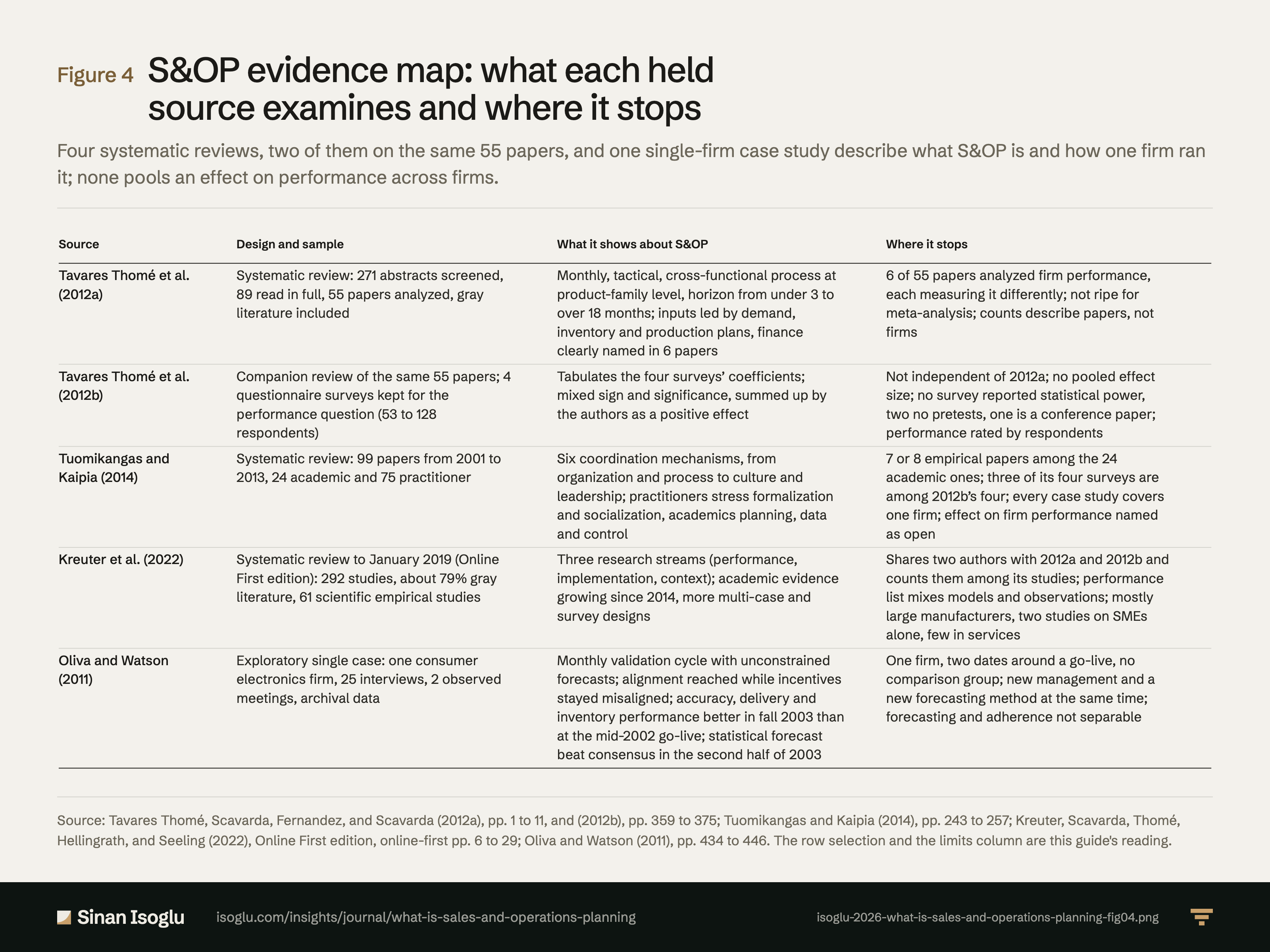
Abbildung 4Grafik
S&OP-Evidenzkarte: was jede vorliegende Quelle untersucht und wo sie endet
Was ist Sales and Operations Planning (S&OP)?
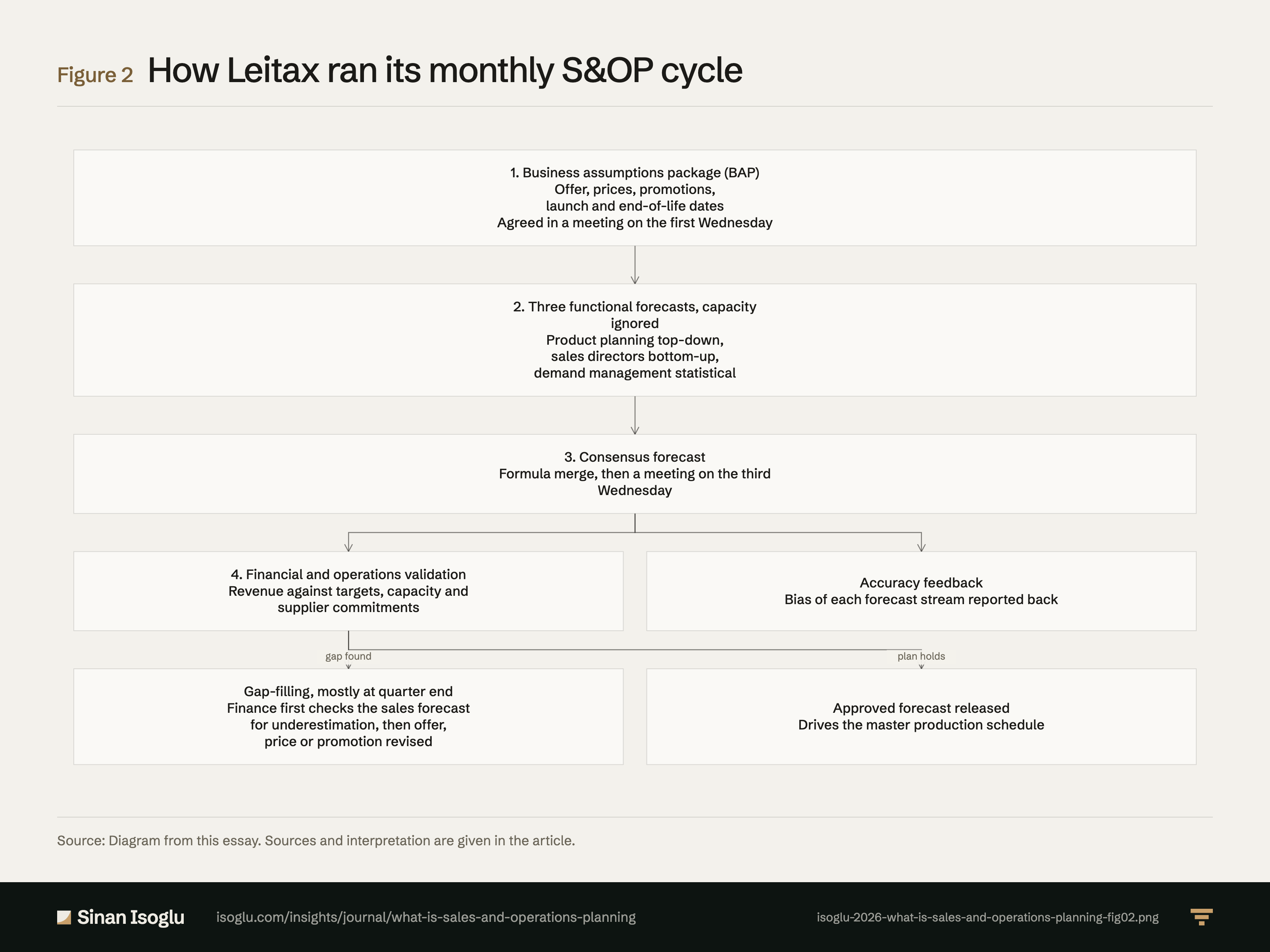
Abbildung 2Grafik
Wie Leitax seinen monatlichen S&OP-Zyklus organisierte
Was ist Sales and Operations Planning (S&OP)?
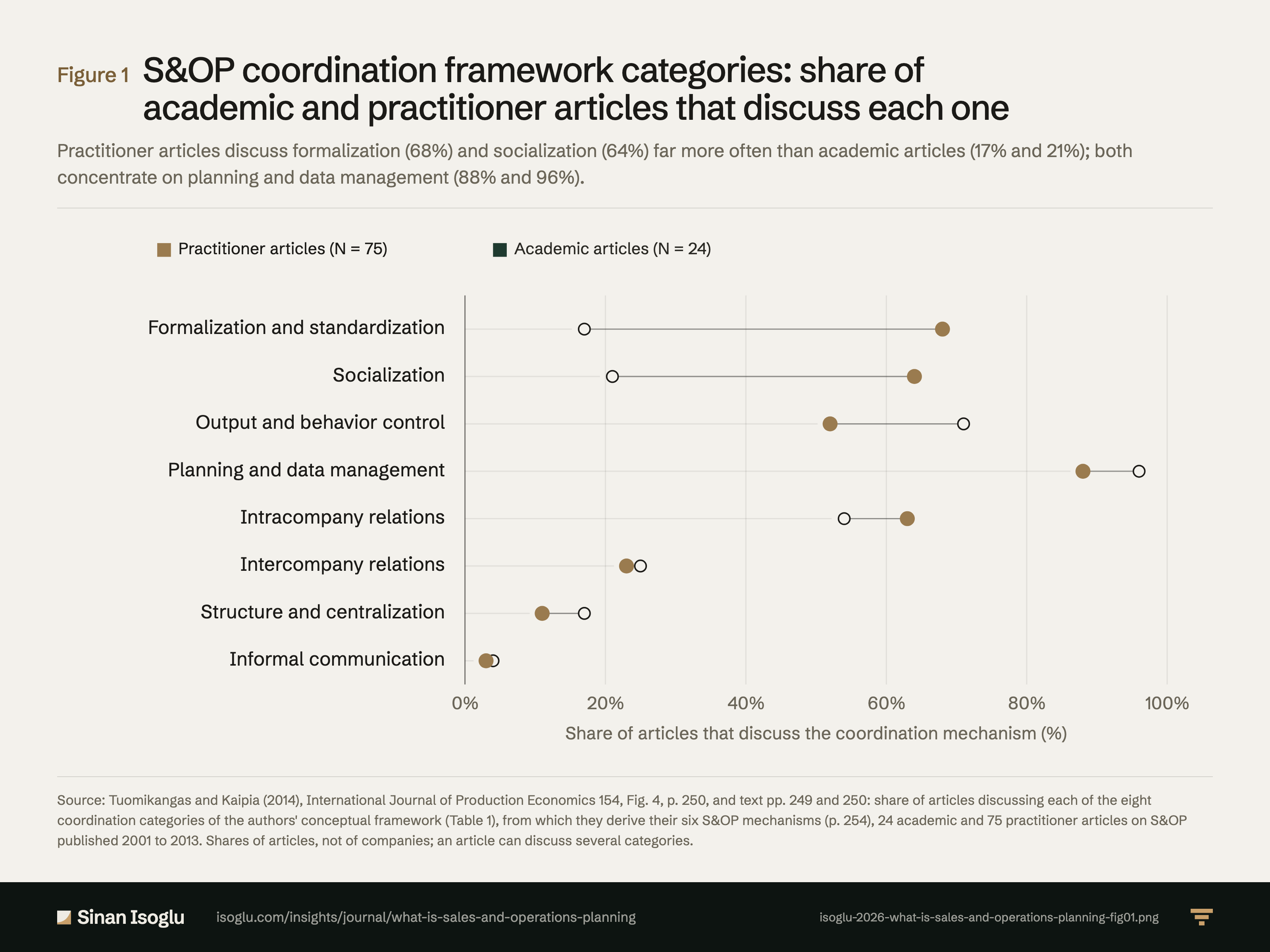
Abbildung 1Grafik
S&OP-Koordinationskategorien: Anteil wissenschaftlicher und praxisorientierter Artikel, die jede behandeln
Was ist Sales and Operations Planning (S&OP)?
Kontakt
Schicken Sie die Frage, an der Sie arbeiten.
Forschung, ein Gastvortrag oder eine Frage aus der Praxis.