Abbildung 2Aus „Was ist Publikationsbias?“
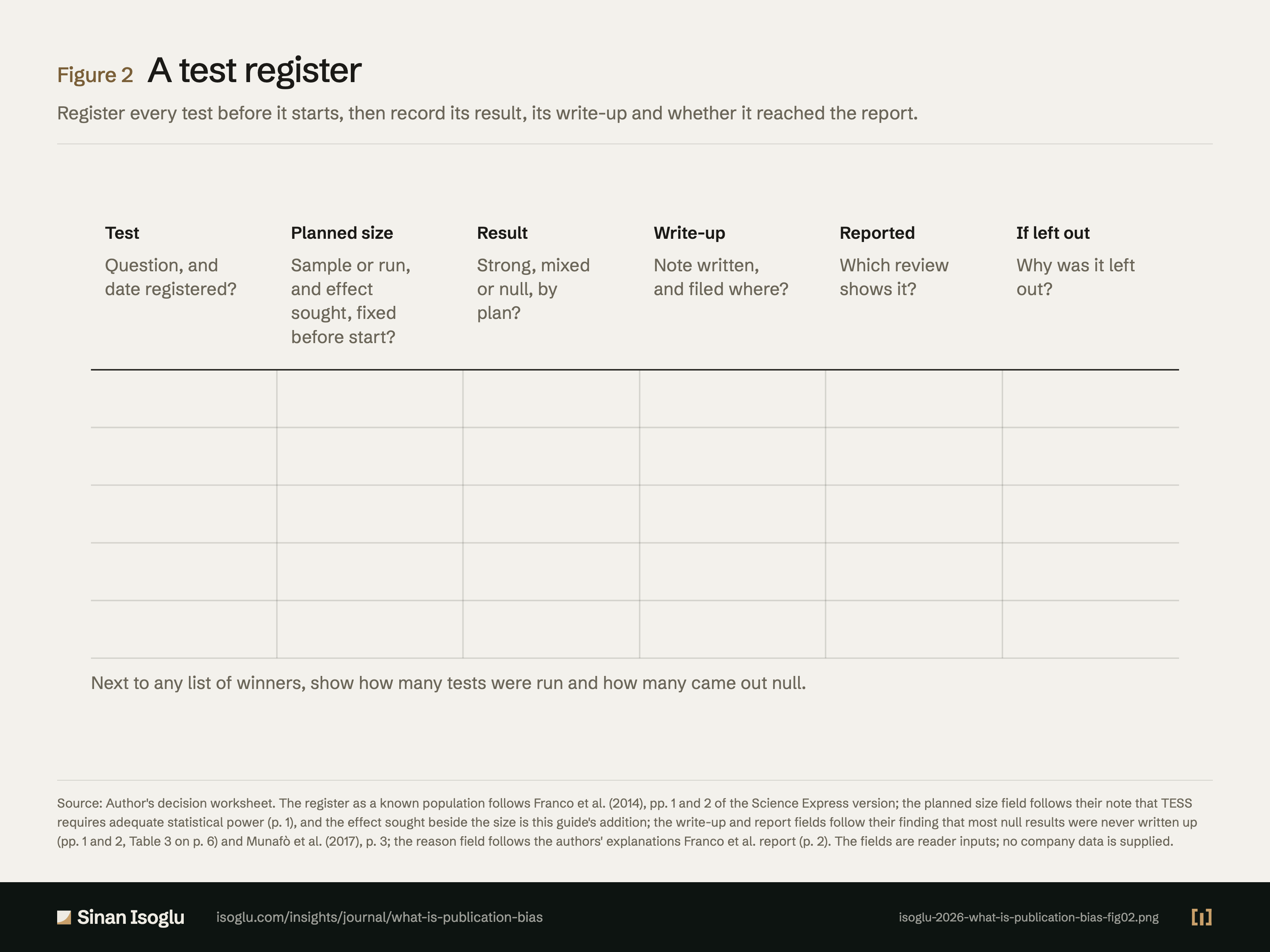
Ein Testregister
Registrieren Sie jeden Test vor dem Start und halten Sie dann Ergebnis, Notiz und Weg in den Bericht fest.
Abbildung 2Ein Testregister
Quelle: Entscheidungsblatt des Autors. Das Register als bekannte Gesamtheit folgt Franco et al. (2014), S. 1 und 2 der Science-Express-Fassung; das Feld für die geplante Größe folgt ihrem Hinweis, dass TESS ausreichende Teststärke verlangt (S. 1), den gesuchten Effekt neben der Größe ergänzt dieser Leitfaden; die Felder für Notiz und Bericht folgen ihrem Befund, dass die meisten Nullergebnisse nie ausgearbeitet wurden (S. 1 und 2, Tabelle 3 auf S. 6), und Munafò et al. (2017), S. 3; das Feld für den Grund folgt den Erklärungen der Autorinnen und Autoren, die Franco et al. berichten (S. 2). Die Felder sind Eingaben der Lesenden; es werden keine Unternehmensdaten geliefert.
Quelle und Evidenz
Jede Zeile nennt eine Aussage zu dieser Abbildung, ihre Quelle und die Art ihrer Prüfung.
- B PUB-OWN-C3 In a pricing or sales analytics team, a review that shows only tests with significant results is a dashboard of winners and carries the selection Franco et al. found at the write-up, a step the analyst controls and which, as in TESS, can anticipate what the review is expected to want; Sterling's chain can run inside a team when a test with a null result leaves no note and is rerun until a chance success is reported; a register of every test made before it starts makes the team's file drawer countable, so Rosenthal's question, how many hidden studies it would take to overturn a result, need not be asked, because the number of tests left out is known (Rosenthal computed a threshold, not an estimate of any drawer); Figure 2 records the question and registration date, the planned size with the effect sought (power is defined for a stated effect, so a size alone cannot show whether a null could have detected the effect; recording the effect is this guide's addition), the result as strong, mixed or null against the plan, the write-up, the review that shows it and the reason it was left out; illustrated with a hypothetical 24 price tests, each with its question, sample, run length and smallest effect worth finding fixed before the start, 7 significant, all shown by result with notes on the nulls; a null from a test too small for the effect sought says little either way; the mapping is untested.Author mapping grounded in STE59-C2, FMS14-C2, FMS14-C4, ROS79-C2 and MUN17PB-C1; untested
Prüfgrade: A, gegen die gedruckte Seite der Primärquelle geprüft · B, Primärquelle, nur Textebene · C, belastbare Sekundärquelle · D, berichtet.
Aus dem Beitrag
Aus der Forschung
Was ist Publikationsbias?
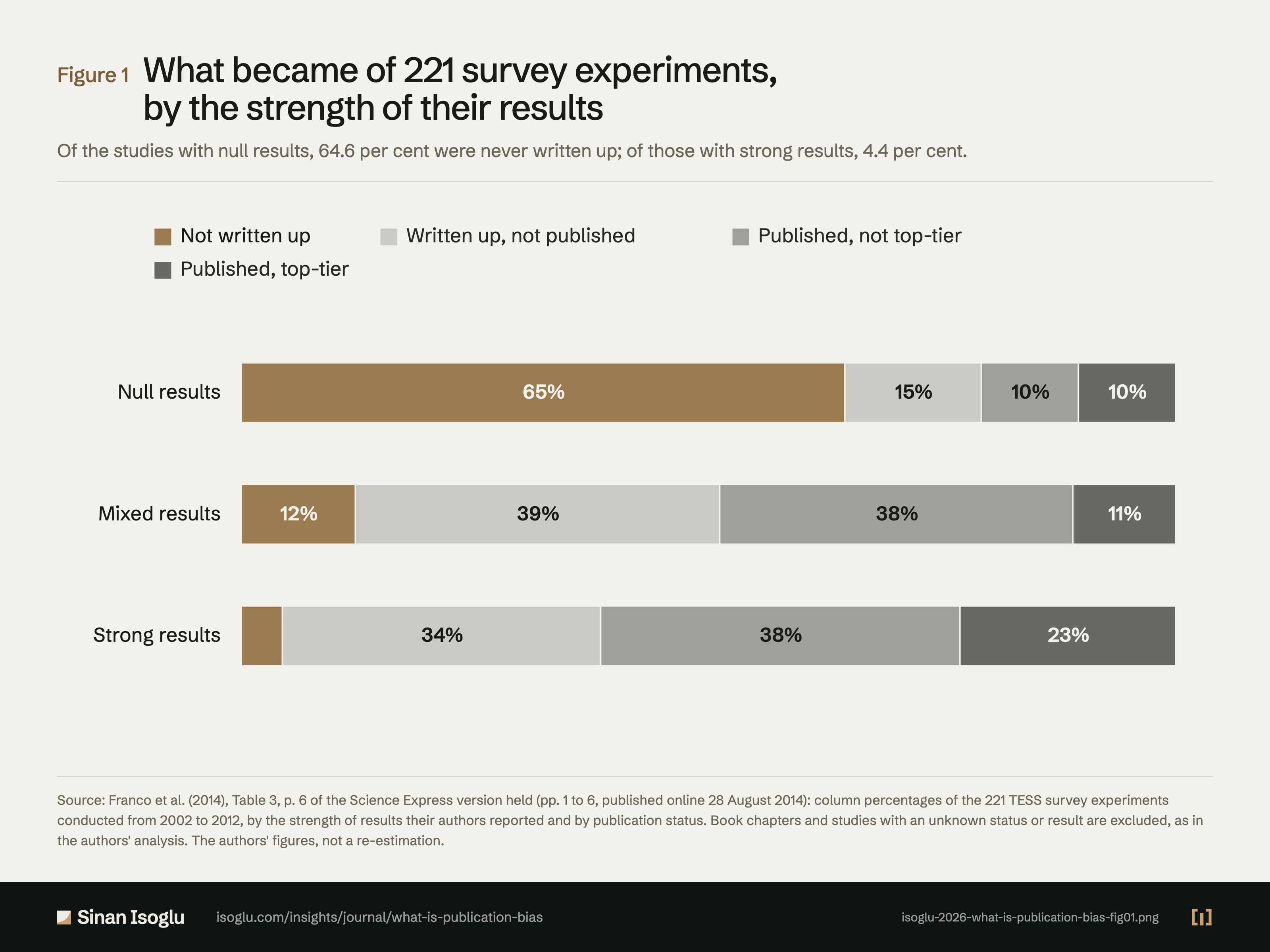
Bei Publikationsbias bestimmt das Ergebnis, ob eine Studie erscheint. In einer bekannten Studienmenge wurden die meisten Nullergebnisse nie ausgearbeitet.
Den Beitrag lesenDiese Abbildung gehört zu einem Essay: Die Zahlen stehen hier, das Argument dort.
Zitieren oder einbetten
Verwandte Abbildungen
Kontakt
Schicken Sie die Frage, an der Sie arbeiten.
Forschung, ein Gastvortrag oder eine Frage aus der Praxis.