Abbildung 1Aus „Was ist P-Hacking?“
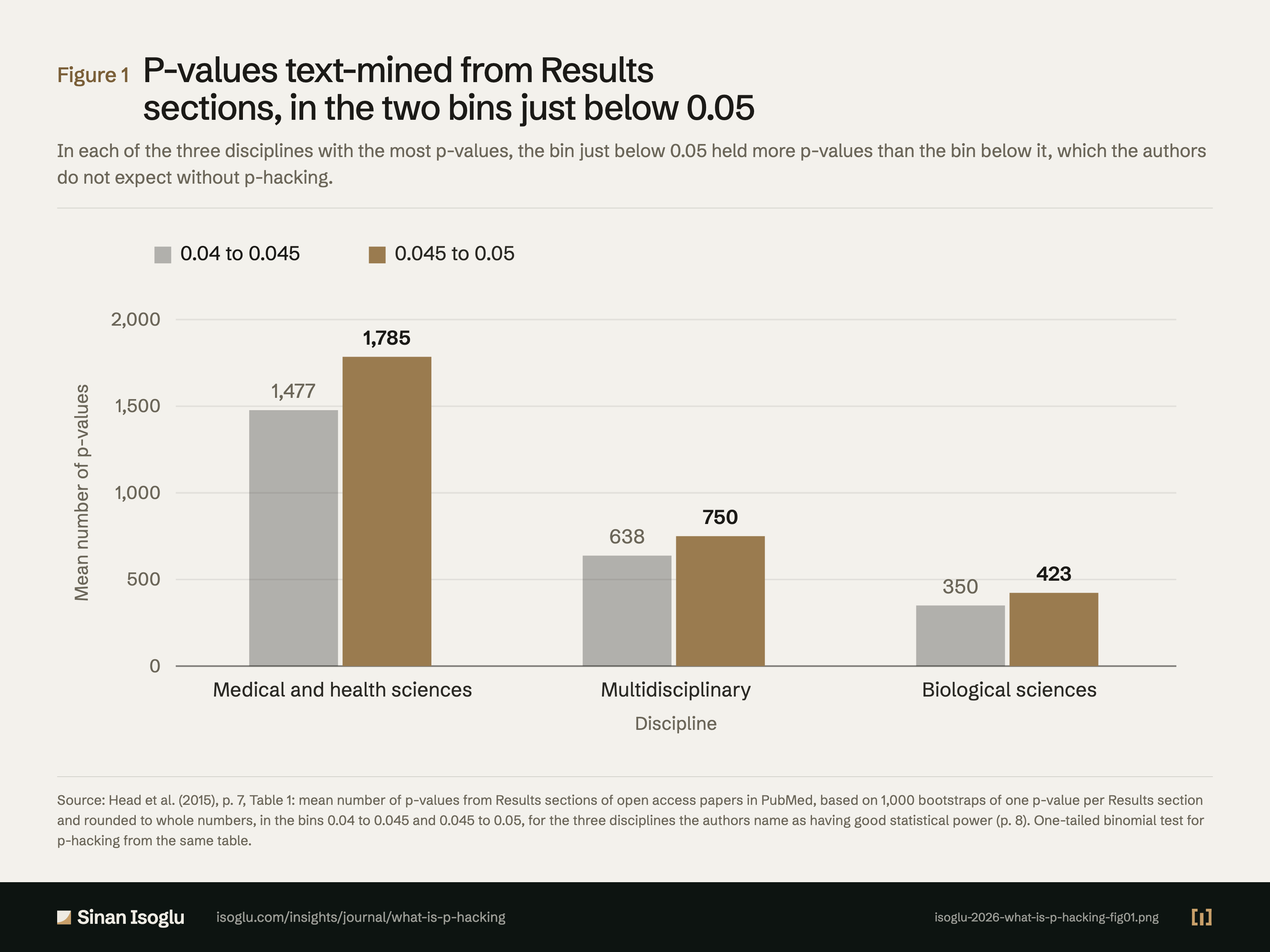
Per Text-Mining gewonnene p-Werte aus Ergebnisteilen in den beiden Intervallen knapp unter 0,05
In jeder der drei Disziplinen mit den meisten p-Werten lagen im Intervall knapp unter 0,05 mehr p-Werte als im Intervall darunter, was die Autoren ohne P-Hacking nicht erwarten.
Abbildung 1Per Text-Mining gewonnene p-Werte aus Ergebnisteilen in den beiden Intervallen knapp unter 0,05
Quelle: Head et al. (2015), S. 7, Tabelle 1: mittlere Zahl der p-Werte aus Ergebnisteilen frei zugänglicher Artikel in PubMed, auf Grundlage von 1.000 Bootstrap-Ziehungen von je einem p-Wert pro Ergebnisteil und auf ganze Zahlen gerundet, in den Intervallen 0,04 bis 0,045 und 0,045 bis 0,05, für die drei Disziplinen, für die die Autoren eine gute Teststärke angeben (S. 8). Einseitiger Binomialtest auf P-Hacking aus derselben Tabelle.
Quelle und Evidenz
Jede Zeile nennt eine Aussage zu dieser Abbildung, ihre Quelle und die Art ihrer Prüfung.
- A HEAD15-C6 Text-mining of p-values in all open access papers in PubMed, Results sections and Abstracts separately; pooled, a strong right skew (researchers appear to study mainly nonzero effects) and strong evidence for p-hacking: upper-bin share 0.546 (lower CI 0.536) across 14 disciplines in Results, 0.537 (0.518) across 10 in Abstracts; more p-values in the upper bin in most disciplines; in Results significant in every discipline with good statistical power (medical and health sciences, biological sciences, multidisciplinary), in Abstracts only for the multidisciplinary and information and computing sciences categories. Table 1 (p. 7), Results-section mean counts from 1,000 bootstraps, lower and upper bin with the one-tailed binomial p: medical and health sciences 1,477 and 1,785 (below 0.001), multidisciplinary 638 and 750 (0.001), biological sciences 350 and 423 (0.005), psychology and cognitive sciences 29 and 50 (0.012); nine of the 14 disciplines have more p-values in the upper bin (counted from Table 1). The authors read the result as p-hacking being widespread, note a strong right skew in all curves and that text-mining pools many types of questions; the proportion 0.5 means an equal number of cases in the two bins; they also report that an earlier text-mining study of five medical journals found no evidence of p-hacking and was criticised for using p-values from Abstracts, which are more likely to contain only the strongest results (pp. 4 to 9): "used text-mining to search for p-values in all Open Access papers available in the PubMed database"; "researchers appear to be predominantly studying phenomena with nonzero effect sizes"; "there was also strong evidence for p-hacking in both the Results"; "estimated proportion of p-values in the upper bin (0.045 < p < 0.05) (lower CI) = 0.546 (0.536)"; "values in the upper bin (0.045 < p < 0.05) (lower CI) = 0.537 (0.518)"; "In most disciplines, there were more p-values in the upper than the lower bin"; "in every discipline where we had good statistical power"; "only the multidisciplinary and Information and Computer Science categories were significant"; "Number of p-values in each bin is the mean number based on 1,000 bootstraps of one p-value per Results section, rounded to the nearest whole number."; "Our text-mining suggests that p-hacking is widespread."; "there was still a strong right skew in all the p-curves we examined"; "we are combining many different types of questions to generate our p-curves"; "differed from 0.5 (i.e., equal number of cases in the two bins)"; "found no evidence of p-hacking in a text-mining study of five medical journals"; "they were criticized for using p-values from Abstracts"; "so they are more likely to contain only the strongest"Head et al. (2015) · Head et al. (2015)
Prüfgrade: A, gegen die gedruckte Seite der Primärquelle geprüft · B, Primärquelle, nur Textebene · C, belastbare Sekundärquelle · D, berichtet.
Aus dem Beitrag
Aus der Forschung
Was ist P-Hacking?
P-Hacking heißt, Daten und Analysen anzupassen, bis ein Ergebnis signifikant ist, und diese Fassung zu berichten. Es kann p-Werte knapp unter 0,05 häufen.
Den Beitrag lesenDiese Abbildung gehört zu einem Essay: Die Zahlen stehen hier, das Argument dort.
Zitieren oder einbetten
Verwandte Abbildungen
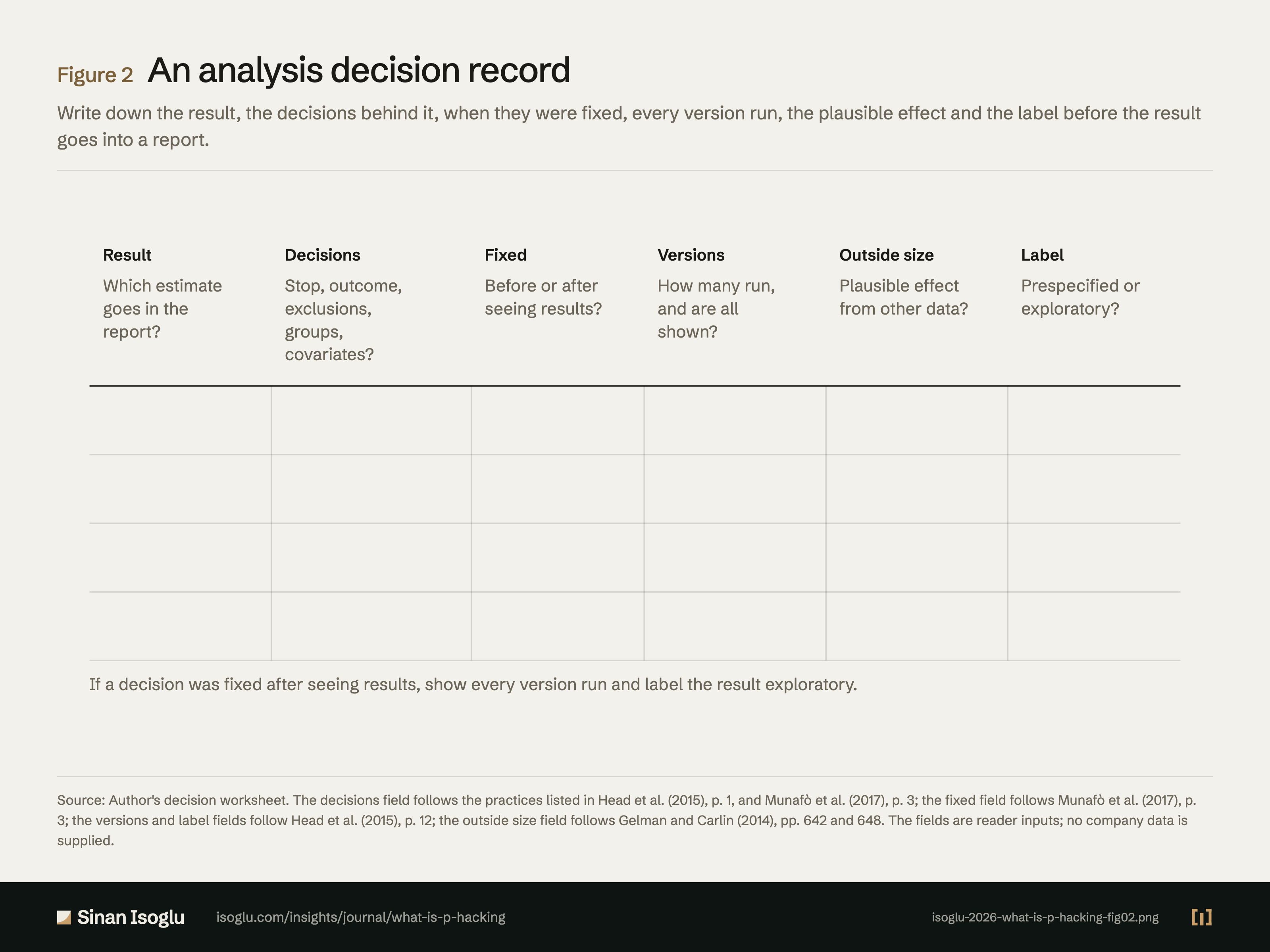
Abbildung 2Grafik
Ein Blatt für Analyseentscheidungen
Was ist P-Hacking?
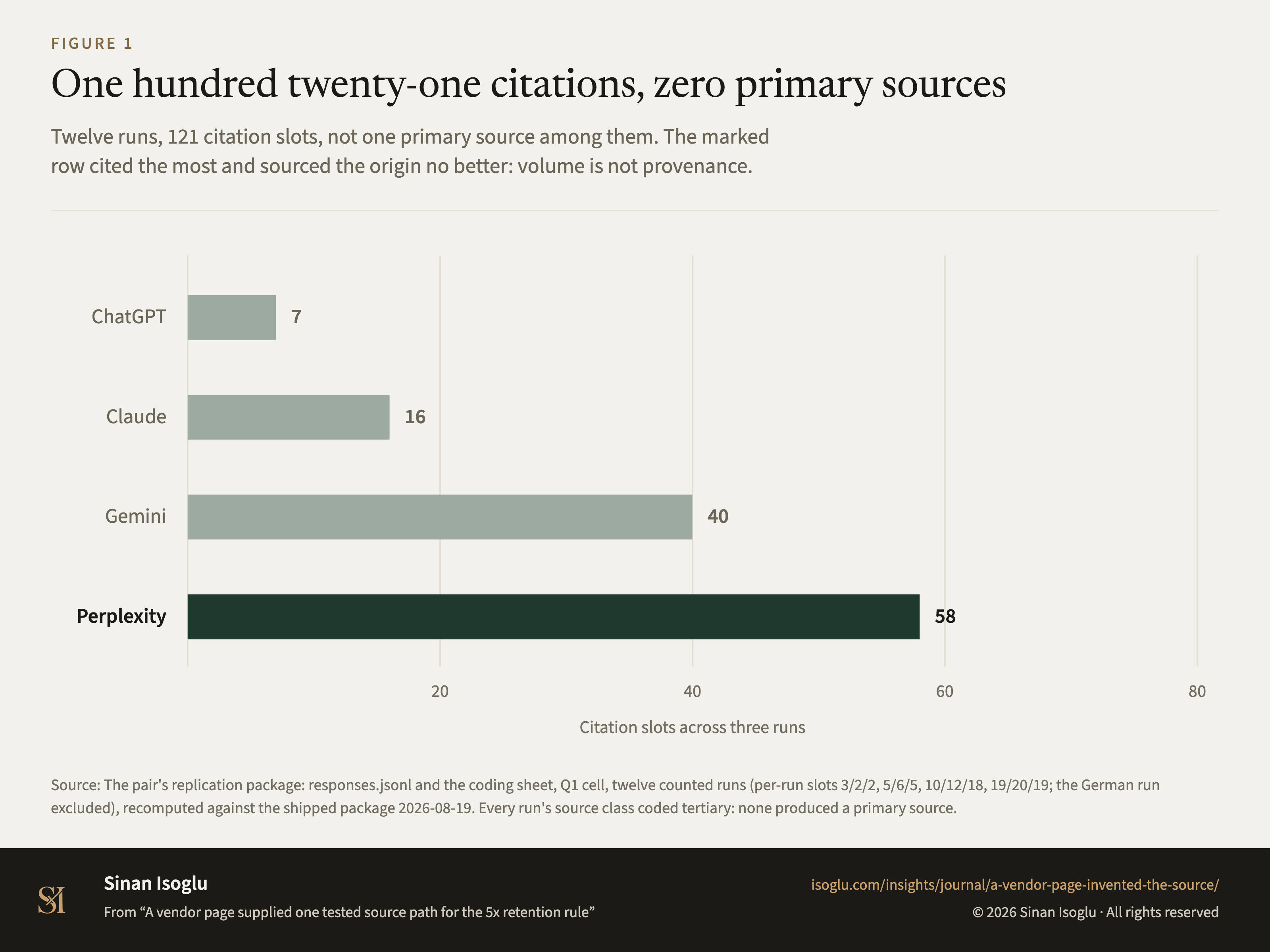
Abbildung 1Grafik
Hunderteinundzwanzig Zitate, null Primärquellen
Eine Anbieterseite lieferte einen getesteten Quellenpfad für die 5x-Regel
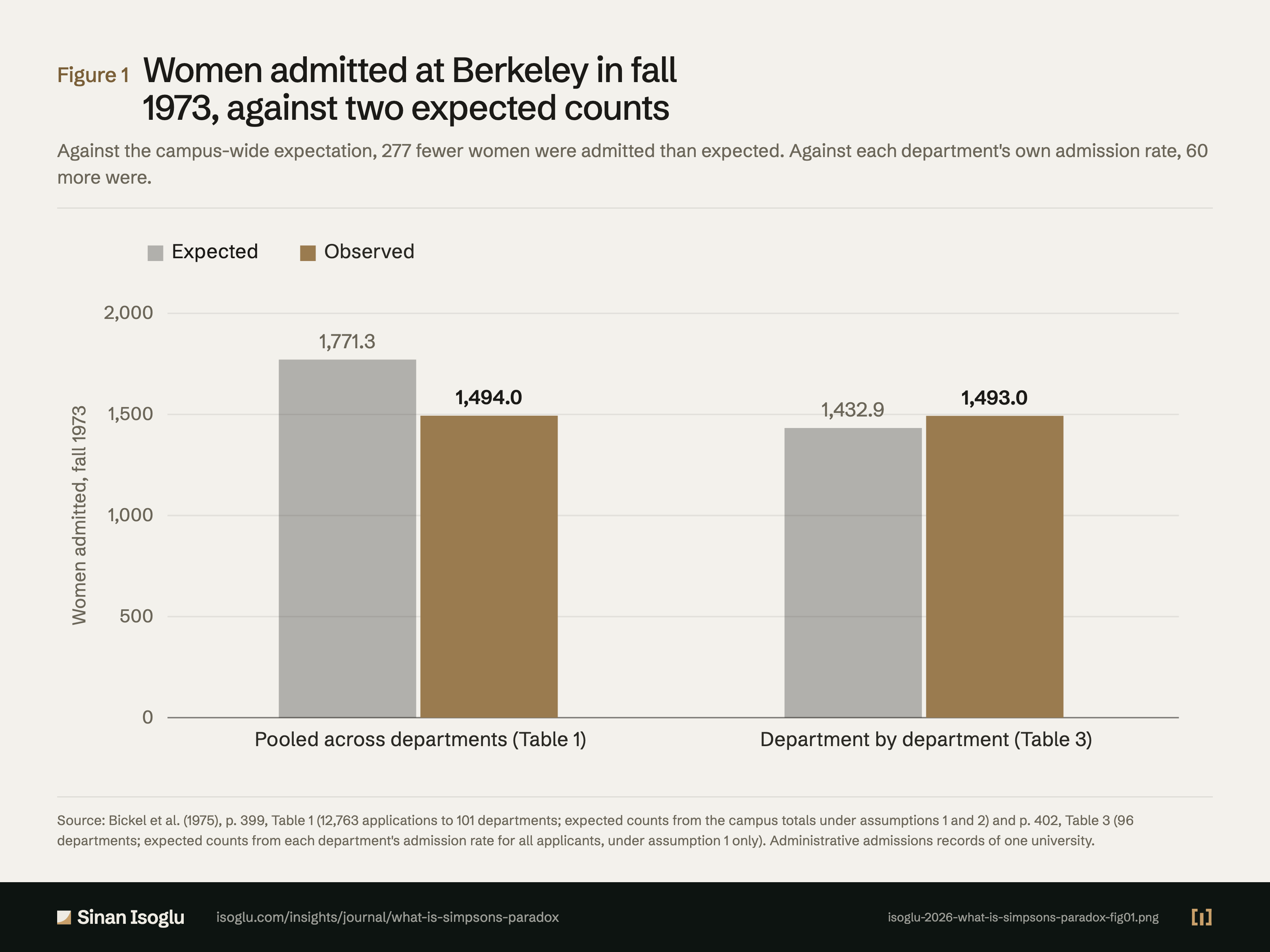
Abbildung 1Grafik
Zugelassene Frauen in Berkeley im Herbst 1973, verglichen mit zwei erwarteten Zahlen
Was ist das Simpson-Paradoxon?
Kontakt
Schicken Sie die Frage, an der Sie arbeiten.
Forschung, ein Gastvortrag oder eine Frage aus der Praxis.