Abbildung 1Aus „Hybride Intelligenz braucht eine Grenze zwischen Fähigkeit und Ergebnis“
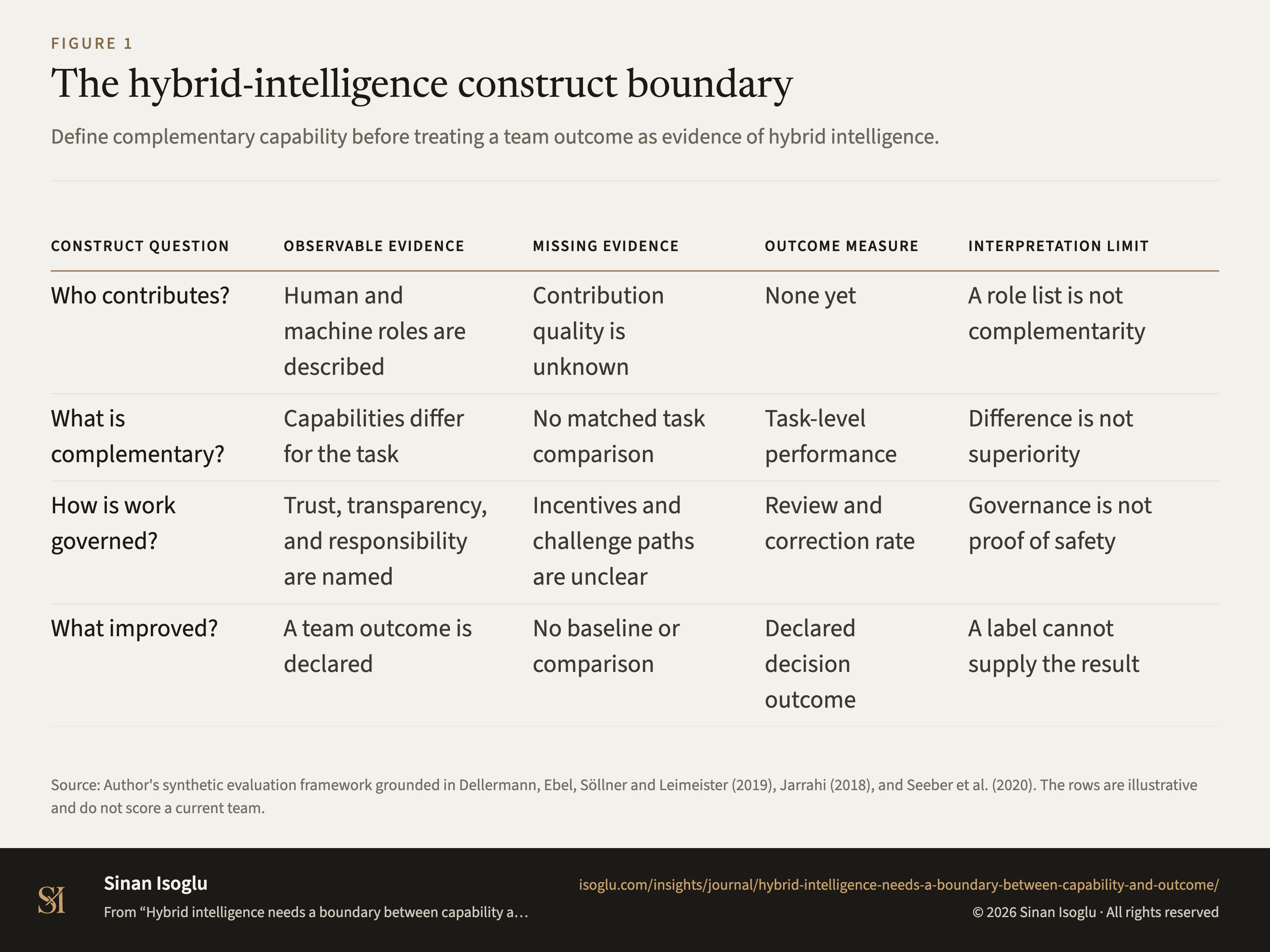
Die Konstruktgrenze hybrider Intelligenz
Definieren Sie komplementäre Fähigkeiten, bevor Sie ein Teamergebnis als Evidenz hybrider Intelligenz behandeln.
Abbildung 1Die Konstruktgrenze hybrider Intelligenz
| Konstruktfrage | Beobachtbare Evidenz | Fehlende Evidenz | Ergebnismessung | Interpretationsgrenze |
|---|---|---|---|---|
| Wer trägt bei? | Rollen von Mensch und Maschine sind beschrieben | Beitragsqualität unbekannt | Noch keine | Rollenliste ist keine Komplementarität |
| Was ist komplementär? | Fähigkeiten unterscheiden sich in der Aufgabe | Kein passender Aufgabenvergleich | Aufgabenleistung | Unterschied ist keine Überlegenheit |
| Wie wird gesteuert? | Vertrauen, Transparenz und Verantwortung sind benannt | Anreize und Widerspruchswege unklar | Prüfung und Korrekturrate | Governance ist kein Sicherheitsbeweis |
| Was wurde besser? | Ein Teamergebnis ist definiert | Basis oder Vergleich fehlt | Definiertes Entscheidungsergebnis | Ein Etikett liefert kein Ergebnis |
Bei breiten Tabellen horizontal wischen oder scrollen.
Quelle: Synthetischer Prüfrahmen des Autors auf Grundlage von Dellermann, Ebel, Söllner und Leimeister (2019), Jarrahi (2018) sowie Seeber et al. (2020). Die Zeilen sind illustrativ und bewerten kein aktuelles Team.
Quelle und Evidenz
Jede Zeile nennt eine Aussage zu dieser Abbildung, ihre Quelle und die Art ihrer Prüfung.
- A DEL19-C1 The definition, in the authors' words: "the most likely paradigm for the division of labor between humans and machines in the next decades is Hybrid" Intelligence, a concept that aims "at using the complementary strengths of human intelligence and AI, so that they can perform better than each of the two could separately"Dellermann, Ebel, Sollner & Leimeister. (2019)
- A DEL19-C2 The boundary against collective intelligence, verbatim: "collective intelligence typically refers to large groups of homogenous individuals", whereas "Hybrid Intelligence combines the complementary intelligence of heterogeneous agents"Dellermann, Ebel, Sollner & Leimeister. (2019)
- A DEL19-C3 Why the division of labour is the unit: "humans and computers have complementary capabilities that can be combined to augment each other", and "These complementary strengths of humans and machi"nes lead to two different forms of interplay, with trust, transparency, governance and incentives left as open design issuesDellermann, Ebel, Sollner & Leimeister. (2019)
- A JAR18-C1 Augmentation, not replacement, and the article says so: it "highlights the complementarity of humans and AI", mirroring "the idea of intelligence augmentation which states that AI systems should be designed with the intention of augmenting not replacing human contributions"Jarrahi. (2018)
- A JAR18-C2 The division is drawn on the kind of problem: "with a greater computational information processing capacity and an analytical approach AI can extend humans cognition when addressing complexity whereas humans can still offer a more holistic intuitive approach in dealing with uncertainty and equivocality"Jarrahi. (2018)
- A JAR18-C3 The context is named in the same sentence: decision processes "typically characterized by uncertainty complexity and equivocality", which is what makes the division of labour a task property rather than a ruleJarrahi. (2018)
- A SEE20-C1 A research agenda, and it counts itself: "this paper reports on an international initiative by 65 collaboration scientists to develop a research agenda for exploring the potential risks and benefits of machines as teammates", from "819 research questions"Seeber et al. (2020)
- A SEE20-C2 The structure is three areas and seventeen dualities: "three design areas machine artifact collaboration and institution and 17 dualities significant effects with the potential for benefit or harm"Seeber et al. (2020)
- A SEE20-C3 It is a question set, not a finding: the agenda "offers a structure and archetypal research questions to organize early thought and research in this new" areaSeeber et al. (2020)
Prüfgrade: A, gegen die gedruckte Seite der Primärquelle geprüft · B, Primärquelle, nur Textebene · C, belastbare Sekundärquelle · D, berichtet.
Aus dem Beitrag
Aus der Forschung
Hybride Intelligenz braucht eine Grenze zwischen Fähigkeit und Ergebnis
Hybride Intelligenz bezeichnet komplementäre menschliche und maschinelle Fähigkeiten, nicht automatisch bessere Leistung: Definieren Sie das Konstrukt.
Den Beitrag lesenDiese Abbildung gehört zu einem Essay: Die Zahlen stehen hier, das Argument dort.
Zitieren oder einbetten
Verwandte Abbildungen
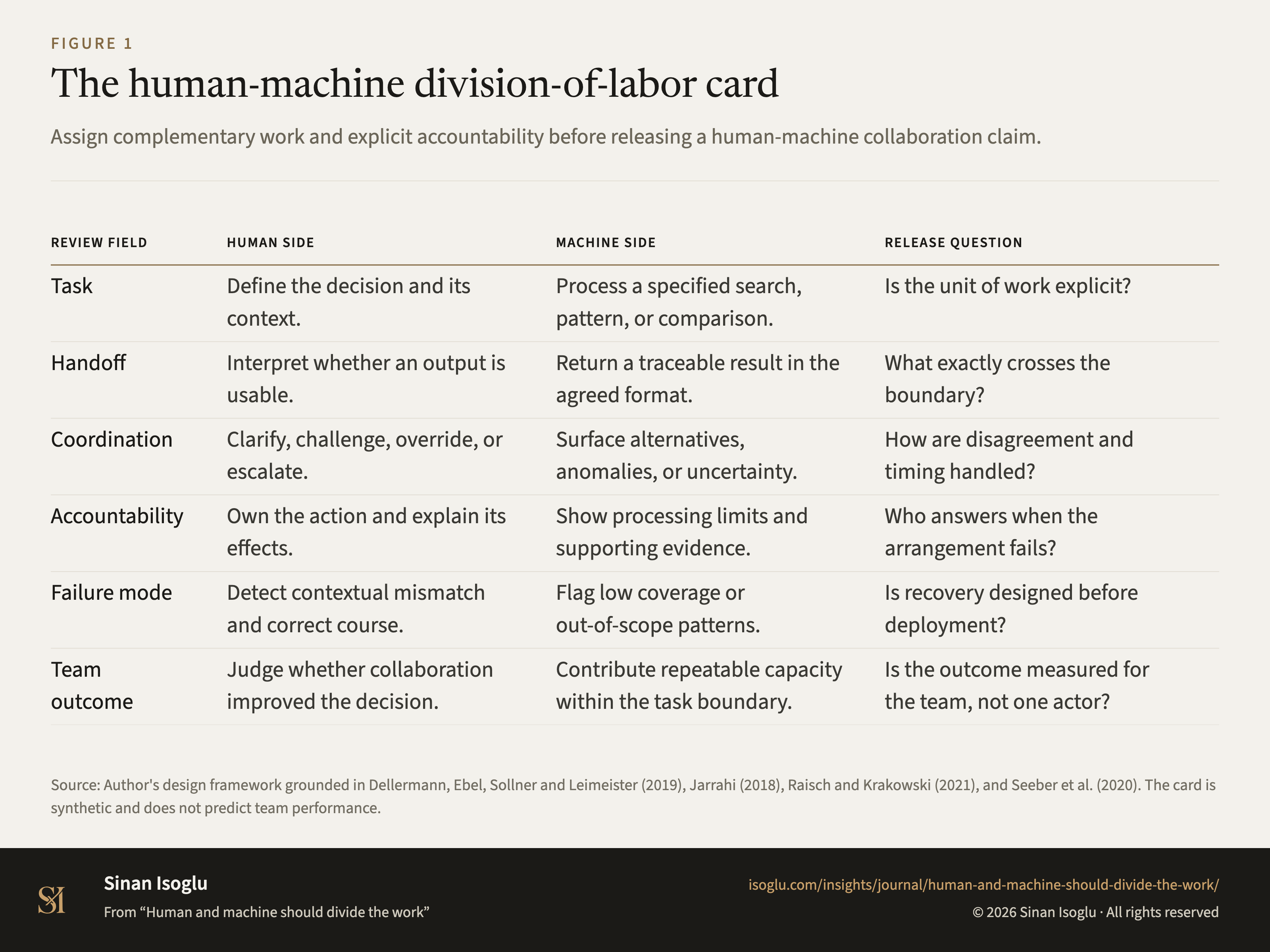
Abbildung 1Grafik
Die Mensch-Maschine-Arbeitsteilungskarte
Menschen und Maschinen sollten die Arbeit teilen
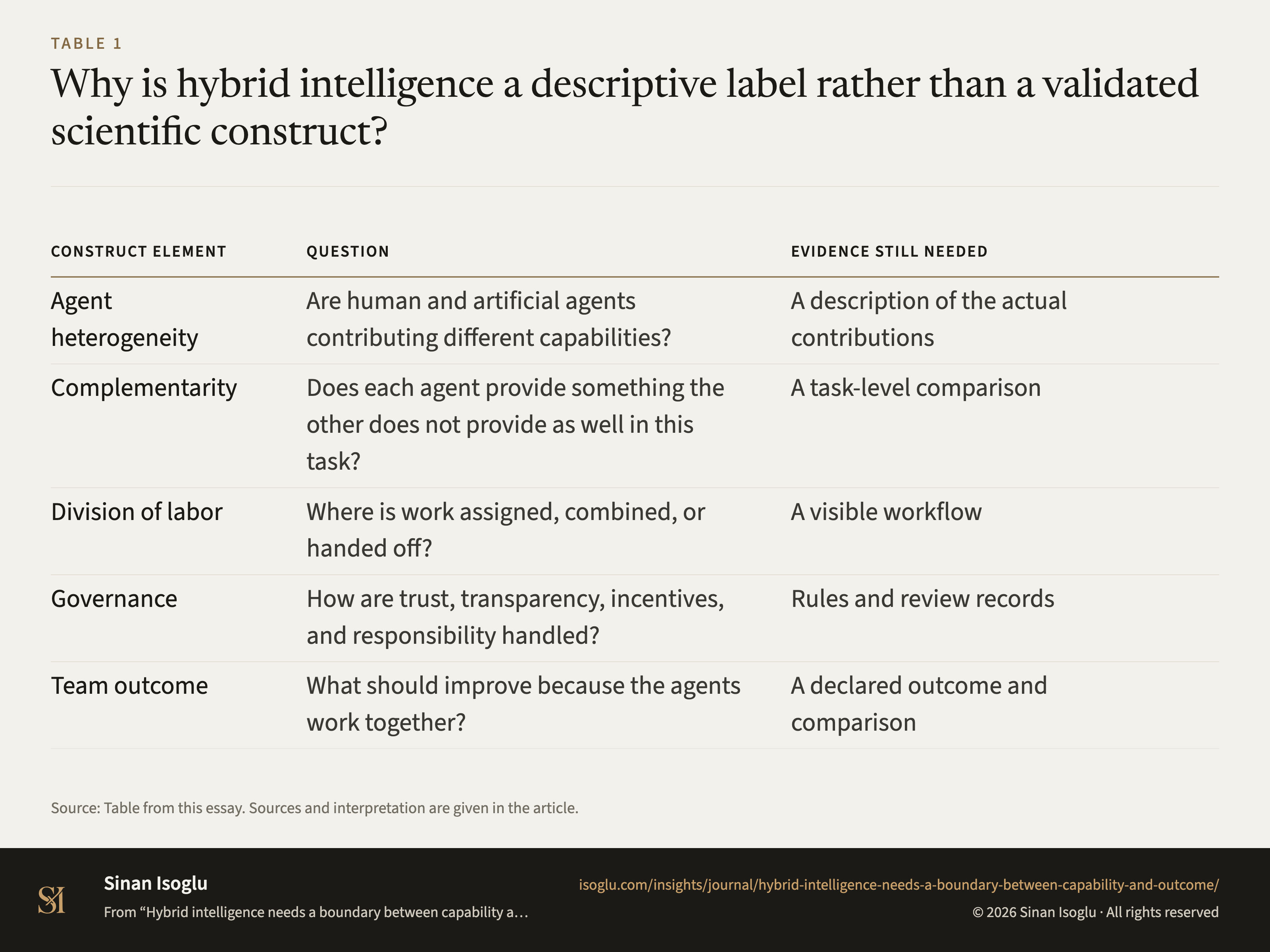
Tabelle 1Tabelle
Warum ist hybride Intelligenz ein beschreibendes Etikett und kein valides Konstrukt?
Hybride Intelligenz braucht eine Grenze zwischen Fähigkeit und Ergebnis
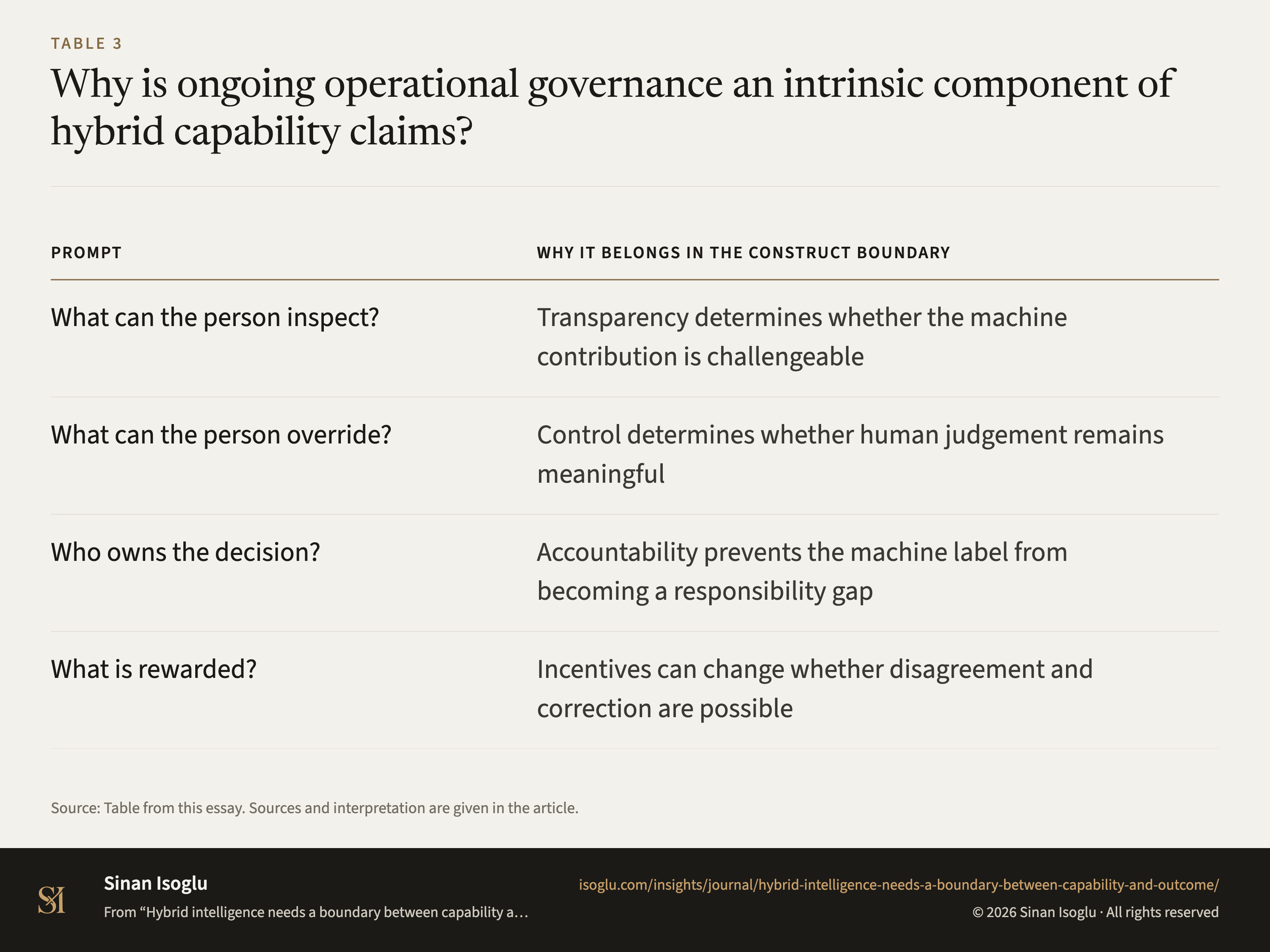
Tabelle 2Tabelle
Warum ist laufende operative Governance integraler Bestandteil von KI-Fähigkeitsaussagen?
Hybride Intelligenz braucht eine Grenze zwischen Fähigkeit und Ergebnis
Kontakt
Schicken Sie die Frage, an der Sie arbeiten.
Forschung, ein Gastvortrag oder eine Frage aus der Praxis.